
So many people avoid reading news they expect to be depressing. But checking in with established journalists might just help you make sense of it all.
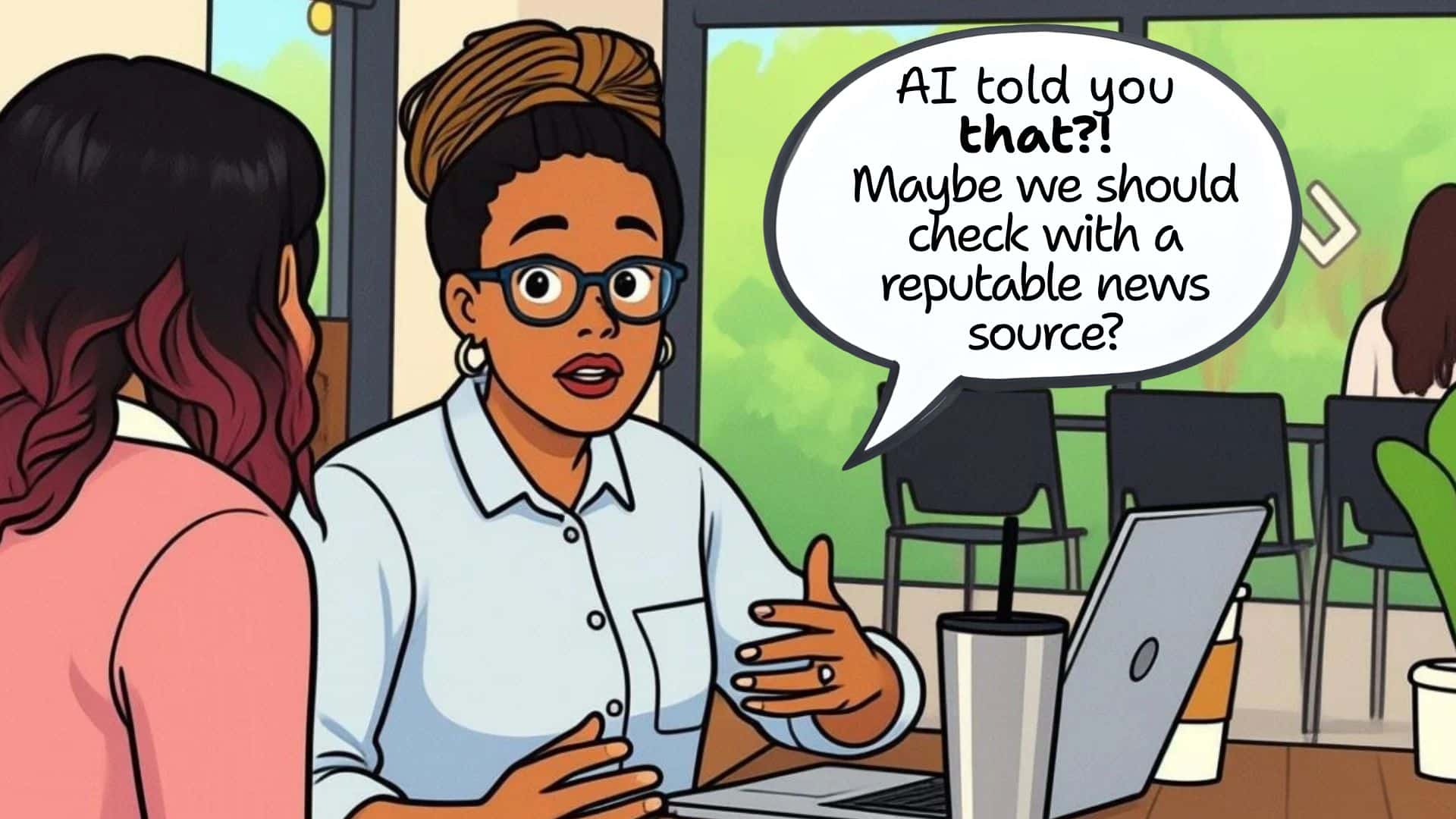
A teen voices skepticism over info from AI. (Illustration by News Decoder)

This article is the second in a series we are publishing to recognize World News Day. On Friday, we published an article by News Decoder Educational News Director Marcy Burstiner on how people think they can rely on news only in crisis situations. Today, for World News Day, we publish an article by News Decoder Intern Isabel Wen on why people avoid reading the news and why that is harmful.
We are in the digital age where so much information is out there, yet information literacy is becoming rare.
Mobile devices and social media and the Internet push limits, constantly loading in new forms of stimulating content. AI entities, meanwhile, learn by sifting all that content, and then blend truth with fiction. How can we possibly keep up with it all and tell what’s valid?
Meanwhile, many people avoid reading the news because they find it bleak or disillusioning. Many of my friends and classmates tell me that when they read articles, they get more disappointed with the state of the world and politics.
To decipher complicated international relationships we defer to AI chatbots and their condensed summary of general media sources. We end up consuming information that has been stripped, abbreviated, dehumanised and very often riddled with mistakes and falsities.
When you have immediate stresses in your life — grades, finance, housing crises, job shortages, cost of living — you want to avoid other forms of stress. But never has it been more important to ask questions and then question the information we receive.
Communication is key.
My university psychology and literature classes currently echo each other as they endlessly drive home this statement: “Communication is the basis for societies.”
What if we were never curious about what happens in other parts of the world, and remained solely concerned with ourselves? It is so easy to forget what a privilege it is to have access to diverse news sources and contrasting perspectives.
Though the news can come off as intimidating and depressing, abstaining from reading it doesn’t make the world less terrifying and daunting.
Instead, if you don’t read and think about tough topics you might find the world more difficult; you become less aware of danger and unable to detect deceit, manipulation and misinformation.
We don’t participate in general, civil, open-minded conversation. All this makes us more polarised.
Is your news source reliable?
To know if you can trust the material you read, here’s a few questions to guide you.
→ Is it published in a news outlet?
Have they written about this topic before? Do they cite their sources for the information they are reporting? Is the author of the article or photographer who took the photo or video identified and can that person be found with a Google search?
→ Are other news outlets reporting the story?
If what you are reading seems important and or surprising, multiple outlets should be reporting it.
→ Is there hyperbole?
Reliable news stories try to report actualities. If the author or speaker seems to exaggerate or use inflated adjectives, be skeptical.
The news isn’t always serious and depressing. News outlets also share exciting, novel developments that show that the world is less dire than we might think: The discovery of plastic-eating bacteria that consumes garbage; the birth of new vaccines to eliminate fatal ailments and cancers; the arrival of justice for a long-fought court case.
When we read the news and learn from the information it shares, we can engage in conversation and discourse which can propel global development.
Other people’s stories
By hearing and acknowledging the personal struggles or tragedies of others, you might find a situation you sympathise with (whether personally or generally). Just by reading, you may contribute to the creation of spaces which acknowledge human issues and work towards facilitating change, be it social, political, economic or cultural.
In avoiding news spaces and conversations, you may be unconsciously doing the opposite — supporting the problematic status quo. If no one is aware of what issues there are, how will problems be solved? When a solution arrives, how can we ensure we collectively make best use of it if we don’t know about its existence?
Cutting yourself off from human stories and developments may blunt your sense of reality, and more dangerously, limit your ability to sympathise with the circumstances of others.
Hard to stomach? Read it anyway. Don’t understand it? Read deeper. Learning seems a mammoth task to undertake, and disillusionment and truth are hard to face. But if we constantly defer to sterilised versions of information, what effect will that have upon our emotional capacities?
Reading the news — especially when it’s hard to engage with — is to practise your ability to think and empathise with others. When current events become summarised for easily digestible information, it becomes harder for us to see the personal impacts. When we distance ourselves from the personal perspectives and experiences of others, we lose the ability to empathise and sympathise.
Everyone I hear and read lectures about how AI affects our ability to think critically for ourselves. But the easiest way to safeguard against this is to personally read articles and stories written by humans!
Today, 28 September, is World News Day, an annual reminder on the importance of education, curiosity and communication. Countless types of articles are published daily, allowing us to access the lived experiences of others, decode politics and share in scientific breakthroughs.
On this day especially, resist the urge to get your news from a bot or short-form TikTok or reel. Even if it’s just a single article, read the actual news!
If you need a place to start, here are some news stories for your brain, your compassion, and your curiosity. Happy World News Day!
Questions to consider:
1. What’s one reason you should read news that might be depressing?
2. How can a news story help you better understand what is happening around you?
3. If something important were happening where you live how would you find out what is going on?

Isabel Wen is a News Decoder intern. Having grown up in both England and Taiwan, her interest in global affairs and cultures means she is never in one place for long. Currently studying English Literature in Trinity College Dublin, she will also be studying at Columbia University. She has been exploring different literary programs and organisations from across the world, spanning from Oxford to Amherst to Taipei to the basements of the New York Times. When she’s not hopping around the literary world, her time is otherwise occupied with long hikes or training sessions as a target-shooting athlete.