Thousands of students in India were able to sustain a protest with the help of food ordered by strangers from across the ocean.
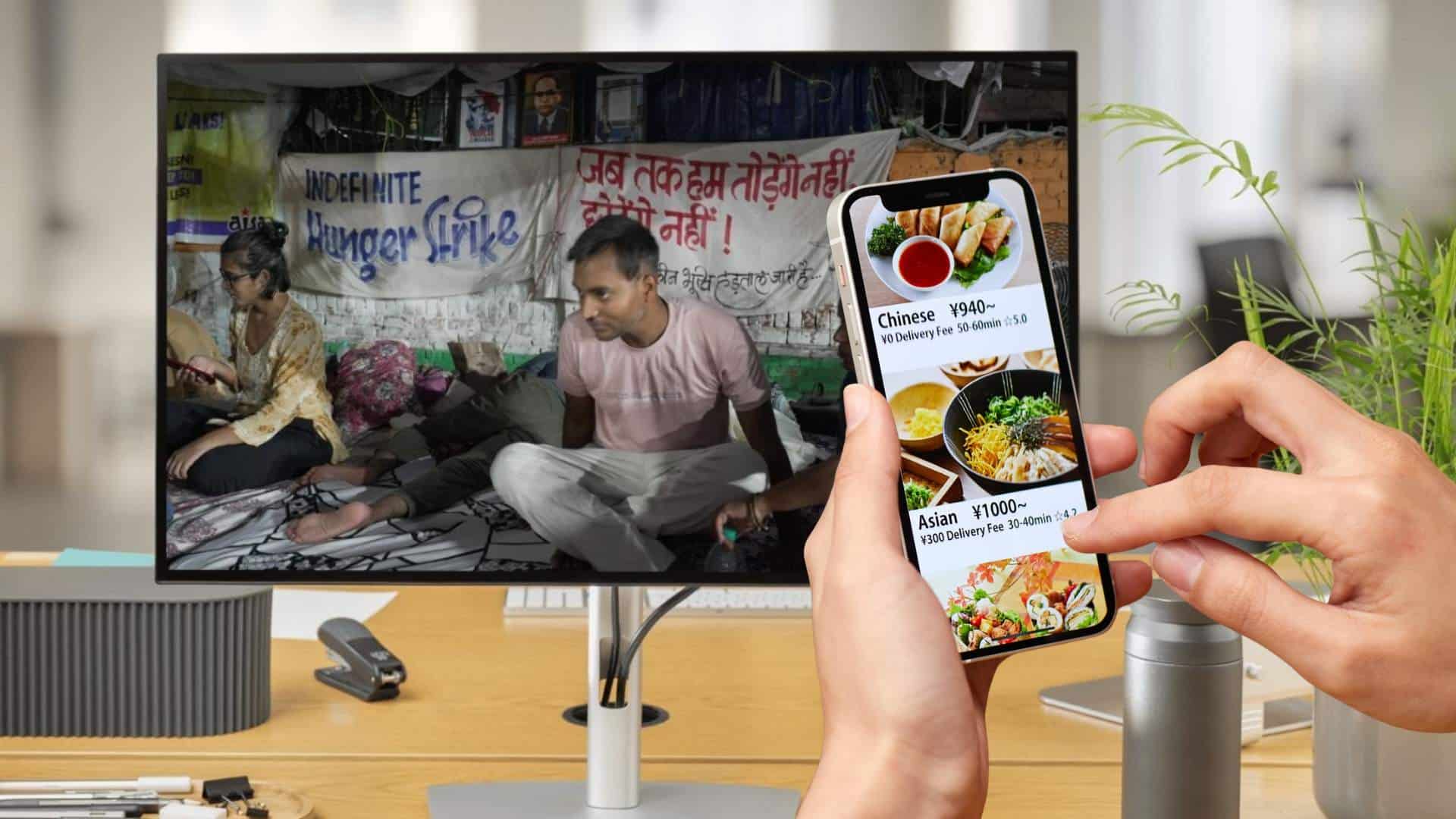
Illustration of someone ordering food when seeing the Delhi protests on their computer. (Illustration by News Decoder with a photo by Mohsin Aarif.)
This article was produced exclusively for News Decoder’s global news service. It is through articles like this that News Decoder strives to provide context to complex global events and issues and teach global awareness through the lens of journalism. Learn how you can incorporate our resources and services into your classroom or educational program.
On the evening of July 20, a rider from a delivery service that partners with the money transfer company Bankit rode up to the site of a massive protest in Delhi carrying dozens of food packets.
“Someone from the United States ordered dinner worth about $157 for 20 people,” he said. “They specifically asked me to deliver it to the protesters here.”
For a brief moment, the crowd fell silent before erupting into chants of “Salute! Salute! Salute!” as volunteers collected the meals.
It wasn’t the first time that kind of thing had happened.
Each morning before the Delhi heat reached its peak, delivery riders would weave through traffic toward the Jantar Mantar observatory, where thousands of young people had been protesting since 6 June. The riders carried tea, water, rice, bread, snacks and sometimes full meals.
A little help from afar
This became the invisible lifeline of what is now known as the Cockroach Movement, a student-led protest that began over a scandal around leaked academic exams before growing into one of India’s largest youth movements in recent years.
What made each delivery of food remarkable was that whoever paid for it, did so anonymously from hundreds — or even thousands — of miles away.
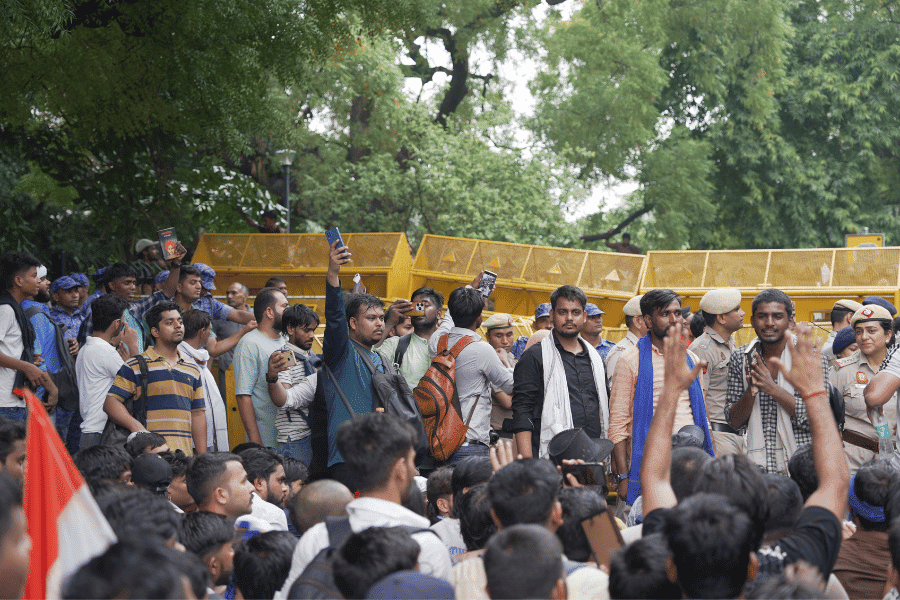
Students protesting at Jantar Mantar, New Delhi. (Photo by Mohsin Aarif.)
Some were software engineers in California. Others were doctors in the Gulf, students in Canada, business owners in Australia or professionals in the United Kingdom. Many had never visited Jantar Mantar. Some did not personally know a single protester. The name of the movement emerged after students reclaimed the word “cockroach” — used in derision by a Supreme Court justice — and turned it into a symbol of resilience.
For more than two weeks, thousands gathered at Jantar Mantar demanding transparency in examinations, timely recruitment and institutional accountability.
While the protest ended on July 25, after Education Minister Dharmendra Pradhan resigned, one of its most remarkable stories unfolded far from the protest site.
There’s an app for that
Almost every day, people from across the world opened food delivery apps, entered the destination — Jantar Mantar — and sent food and beverages to students they had never met.
In doing so, thousands of anonymous donors quietly created one of the most unusual support networks seen in any recent protest movement. It was another reminder that even from thousands of miles away, strangers were helping sustain a movement they had never physically joined.
Organisers said many donors intentionally concealed their identities. Some included only brief messages with their orders:
“Stay strong.”
“Don’t lose hope.”
“The country is watching.”
Taking no credit
Nishant Kapoor, a 25-year-old protester said that the donors remained invisible. “Their presence could only be traced through the names flashing on delivery apps and the paper bags piling up beside the protest tents,” Kapoor said. “For the riders, it was another delivery. For us, it was proof that someone, somewhere, believed our struggle mattered.”
Many supporters sent food without leaving any message at all.
Unlike traditional protest movements backed by political parties, labour unions or organised fundraising campaigns, much of the movement’s logistical support relied on decentralised online contributions. Individual donations — often only a few hundred rupees — collectively funded hundreds of meals every day.
The result was a new form of digital solidarity where participation no longer required physical presence.
For delivery workers, Jantar Mantar became unlike any other stop on their route. Many arrived expecting to hand over food to a single customer only to find dozens of students waiting together.
“Initially I thought someone had ordered a large meal for friends. Later I realised people from different cities — and even different countries — were sending food every day. I had never seen anything like it,” said Mukesh, a 26-year-old delivery rider.
Supporting a movement
Sunil Kumar, another rider, said the deliveries rarely stopped.
“Sometimes we delivered breakfast, then lunch, then tea to the same location,” Kumar said. “Every order carried a different name, but they all had the same destination.”
For the delivery platforms, each order was simply another transaction. For those carrying the packages, however, the protest revealed an unexpected role for technology — turning apps built for convenience into instruments of civic participation.
Not everyone who supported the movement could travel to Delhi.
Tabasum, a PhD scholar, said she followed the protests from afar but still wanted to contribute.
“I couldn’t travel to Delhi, but I felt a responsibility to support the students,” Tabasum said. “I ordered meals, fruit juice and basic medical supplies using only the Jantar Mantar location. It was my way of standing with them even though I couldn’t be there.”
Demands that resonate across borders
Sumit Sharma, who was in Australia as the demonstrations intensified, said distance did not prevent him from participating.
“When I saw India’s largest student movement gaining momentum, I knew I couldn’t join in person,” Sharma said. “Instead, I kept ordering tea, juice and snacks for the protesters through delivery apps. Sometimes support means showing up; sometimes it means making sure those who show up don’t go hungry.”
Students insisted the movement was never about political affiliations.
Inside the protest site, donated food was distributed without asking who belonged to which religion, caste or state. Students from across India shared meals, studied together and slept under temporary shelters despite Delhi’s scorching summer and monsoon showers.
Indian flags remained visible across the site. Demonstrations often began or concluded with the national anthem, while volunteers cleaned the protest grounds after public meetings.
Participants said those routines reflected their belief that demanding institutional accountability was an act of patriotism rather than opposition to the nation.
Standing one’s ground
The demonstrations were also marked by confrontation.
Students alleged repeated detentions, injuries during clashes with police and the use of tear gas and baton charges while attempting to march toward Parliament. Authorities maintained that security measures were necessary to preserve public order in one of the capital’s most sensitive administrative zones.
For many protesters, however, every meal delivered by an unknown supporter represented another day they could continue their sit-in.
Student movements have historically reshaped political debates — the Umbrella Movement in Hong Kong in 2014 and the quota reform movement in Bangladesh in 2024 and education protests in Morocco in 2025 and Chile in 2026.
India’s movement echoed familiar demands for fairness, transparency and accountability. What distinguished it was the way ordinary people supported it.
An informal support network
Instead of relying primarily on organised fundraising, supporters transformed everyday food delivery applications into an informal welfare network. Technology designed for convenience became a tool of civic participation.
Each individual order was modest. Together, they sustained a movement.
As the tents at Jantar Mantar were dismantled after the protest concluded on July 25, the anonymous donors remained exactly as they had throughout the demonstrations — largely unseen.
Most never delivered speeches. Many never revealed their names.
Yet, through thousands of meals, bottles of water, cups of tea and packets of medical supplies, they quietly expanded the meaning of participation in a democratic movement.
Whether the protests ultimately reshape India’s education system will be judged in the years ahead.
What is already clear is that the movement offered a new lesson in civic engagement: sometimes solidarity is not expressed through slogans or speeches, but through a simple food order placed from thousands of miles away — ensuring that those demanding change did not have to protest on an empty stomach.
Questions to consider:
1. Why do you think people in other countries wanted to support the student protesters in India?
2. How did individual food orders help lengthen the Cockroach protests?
3. Can you think of other ways to support a political movement that isn’t money or food?

Tauseef Ahmad is a Delhi-based freelance journalist. He has worked with news organizations including The News International, Al-Jazeera, Article 14, Polis Project, Fair Planet and Mongabay. He tweets @wseef_t.