
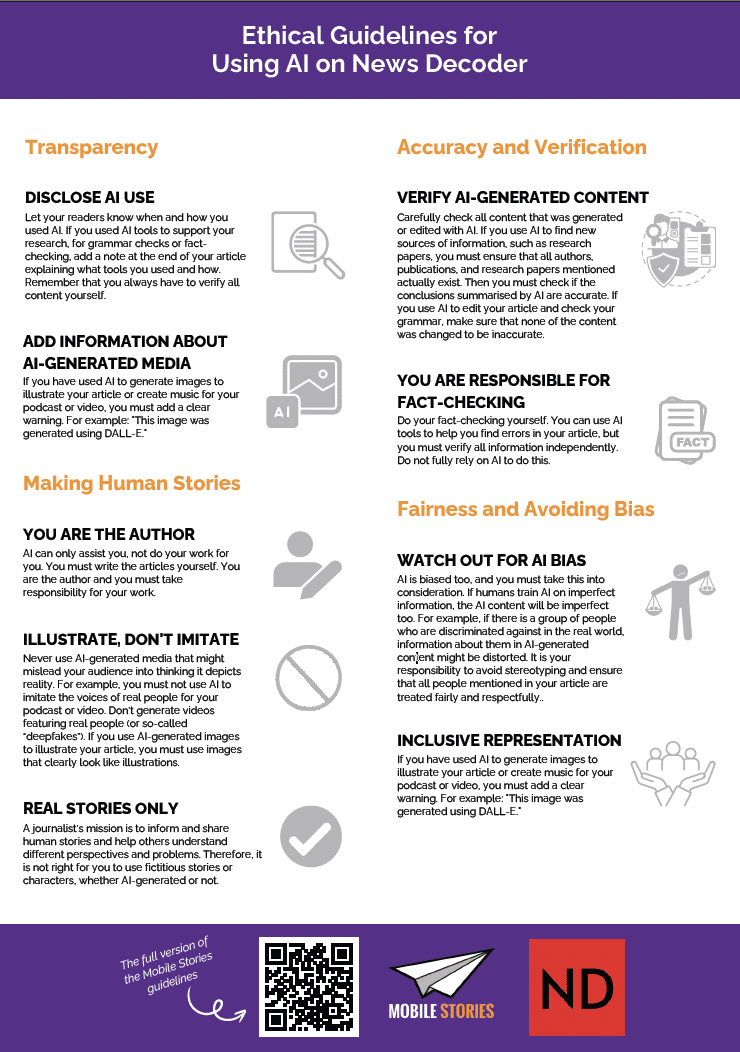
In collaboration with Swedish nonprofit Mobile Stories, we have developed Ethical Guidelines for Using AI to create and publish content with News Decoder. Download a poster to hang in classrooms and corridors.
I. Transparency
Disclose AI use
Let your readers know when and how you used AI. If you used AI tools to support your research, for grammar checks or factchecking, add a note at the end of your article explaining what tools you used and how. Remember that you always have to verify all content yourself.
Add information about AI-generated media
If you have used AI to generate images to illustrate your article or create music for your podcast or video, you must add a clear warning. For example: “This image was generated using DALL-E.”
II. Accuracy and Verification
Verify AI-generated content
Carefully check all content that was generated or edited with AI. If you use AI to find new sources of information, such as research papers, you must ensure that all authors, publications, and research papers mentioned actually exist. Then you must check if the conclusions summarised by AI are accurate. If you use AI to edit your article and check your grammar, make sure that none of the content was changed to be inaccurate.
You are responsible for fact-checking
Do your fact-checking yourself. You can use AI tools to help you find errors in your article, but you must verify all information independently. Do not fully rely on AI to do this.
III. Making Human Stories
You are the author
AI can only assist you, not do your work for you. You must write the articles yourself. You are the author and you must take responsibility for your work.
Illustrate, don’t imitate
Never use AI-generated media that might mislead your audience into thinking it depicts reality. For example, you must not use AI to imitate the voices of real people for your podcast or video. Don’t generate videos featuring real people (or so-called “deepfakes”). If you use AI-generated images to illustrate your article, you must use images that clearly look like illustrations.
Real stories only
A journalist’s mission is to inform and share human stories and help others understand different perspectives and problems. Therefore, it is not right for you to use fictitious stories or characters, whether AI-generated or not.
IV. Fairness and Avoiding Bias
Watch out for AI bias
AI is biased too, and you must take this into consideration. If humans train AI on imperfect information, the AI content will be imperfect too. For example, if there is a group of people who are discriminated against in the real world, information about them in AI-generated content might be distorted. It is your responsibility to avoid stereotyping and ensure that all people mentioned in your article are treated fairly and respectfully.
Inclusive representation
Ensure that different opinions and people are represented in your articles. This includes considering various viewpoints and giving a voice to underrepresented groups to maintain balance and fairness.