
Calling unemployed youth pests doesn’t make them go away. Instead, they are mobilizing for change in systems where they are treated with contempt.
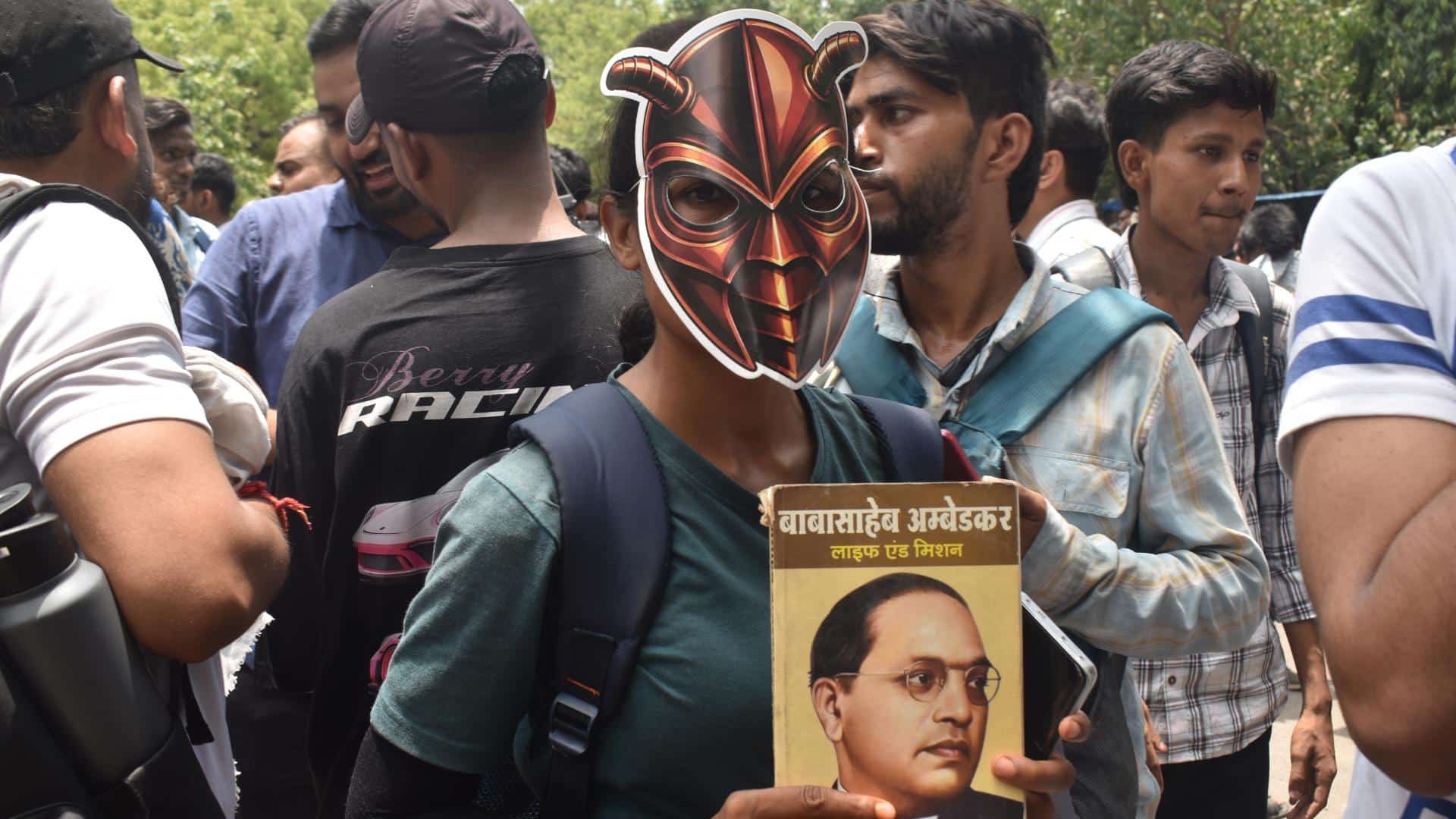
A demonstrator wearing a cockroach mask participates in the protest, symbolising solidarity with the Cockroach Janta Party. (Photo: Hana Vahab)
This article was produced exclusively for News Decoder’s global news service. It is through articles like this that News Decoder strives to provide context to complex global events and issues and teach global awareness through the lens of journalism. Learn how you can incorporate our resources and services into your classroom or educational program.
As Delhi reeled under a 45°C (113°F) heatwave in June, 25-year-old Bewesh Adhikari travelled nearly 1,500 kilometres from the cool Himalayan state of Sikkim to join a protest organised by a group of people who called themselves “cockroaches”.
Adhikari is a digital marketer who is building an AI platform to help young Indians cope with depression.
He wanted to support students from across the country whose lives have been upended by a controversy involving the cancellation of a test required to get into medical programs.
“The moment I heard about the protest, I decided to come,” he said. “Paper leaks are destroying the spirit of merit and fairness in our country.”
Conducted for admission to medical colleges, the National Eligibility cum Entrance Test or NEET is taken by nearly 2.2 million students every year, but only around 60,000 secure seats in government medical colleges.
The cancellation of the exam following allegations of a paper leak and triggered widespread anger and uncertainty among aspirants. At least six aspirants who had performed well died of suicide after hearing that the had been cancelled.
At the demonstration, protesters demanded the resignation of education minister Dharmender Pradhan.
“I am not a NEET aspirant, but their fight is my fight,” Adhikari said. “When merit is compromised, every young person in this country loses.”
The protest was the Cockroach Party’s first major public mobilisation, but organisers said it would not be the last.
The rise of the cockroaches
In May, Supreme Court Chief Justice Surya Kant likened young people who had no jobs or profession to “cockroaches”.
“There are youngsters like cockroaches, who don’t get any employment or have any place in the profession,” Kant said. “Some of them become media, some of them become social media, RTI activists and other activists, and they start attacking everyone.”
Many saw this as insensitivity to the plight of young Indians who want to work but face limited opportunities.
The Chief Justice later clarified that his remarks were aimed at individuals obtaining fraudulent degrees and not at young people, whom he described as vital to the country’s future.

Bewesh Adhikari, right, and Sourabh Sheelwant hold placards during a protest at Jantar Mantar (Photo courtesy of Bewesh Adhikari)
Anger spreads.
Thousands of miles away in the United States, the controversy inspired an unexpected response.
Abhijeet Dipke, an Indian student pursuing a master’s degree in public relations at Boston University, said he was disturbed by the remarks.
“I was shocked,” Dipke said. “How can someone entrusted with protecting constitutional rights use such language for people exercising their freedom of expression?”
In response, he posted a question on X: “What if all the cockroaches came together?”

A photo posted on Instagram by the CJP shows Abhijeet Dipke displaying a book by B.R. Ambedkar, the chief architect of the Indian Constitution, at the Jantar Mantar protest.
What began as an expression of frustration quickly gained traction, with hundreds of young people responding and calling for a common platform to raise issues affecting them. Within a short period, the post received nearly 800 replies.
The response prompted Dipke to take the idea further. “I thought, why not create a parody political party?” he said. “That’s how the Cockroach Janta Party was born.”
Dipke said he never expected the idea to grow. After creating a simple Google Form using the same eligibility criteria that had sparked debate online, he anticipated only a handful of responses.
“Instead, more than 5,000 people registered within a couple of hours,” he said.
Encouraged by the response, Dipke used AI tools to create a logo and launched social media pages.
The rise of a political party
Dipke said the membership criteria targeting the “unemployed”, “chronically online” and those prone to “ranting” were deliberately ironic, reflecting stereotypes used to dismiss young people and their concerns.
Within a week of its launch, the Cockroach Janta Party (CJP) had surpassed India’s two largest political parties, at least on Instagram. While the BJP and Congress have around 8.9 million and 13.6 million followers respectively, CJP has amassed more than 22 million followers.
“Today, we have more than 22 million followers on Instagram and over 1.2 million registered members,” Dipke said, adding that young people themselves had transformed what began as a joke into a movement.
Buoyed by the overwhelming response, Dipke called for a demonstration to take place 6 June against the education minister and returned to India for it.
Thousands of people, particularly Gen Z youth from different parts of the country, joined the demonstration in support of the cause.
Young people are frustrated.
Professor Apoorvanand Jha, a political commentator and faculty member at the University of Delhi, said the movement reflects growing frustration among India’s youth.
“Young people are angry about unemployment, paper leaks, shrinking opportunities and a political system they feel is not listening to them,” Jha said. “Many hesitate to express that anger on the streets because of fears of legal consequences or police action. Digital platforms have therefore become a safer space for dissent.”
A recent survey by the group Young Leaders for Active Citizenship found limited political participation among young Indians, with nearly three in 10 respondents staying away from political activities altogether.
Jha said CJP’s rapid rise points to a broader mood among young Indians. “This movement exposes something big,” he said. “It is about frustration, alienation and a generation looking for a platform through which it can make itself heard.”
The movement has also attracted support from prominent public figures, including opposition politicians Mahua Moitra and Kirti Azad, senior advocate Prashant Bhushan, climate activist Sonam Wangchuk and actor Prakash Raj.
Their backing has helped transform what began as online satire into a platform drawing attention from politicians, activists and public intellectuals. Dipke said support from figures such as Wangchuk had strengthened the movement’s credibility and encouraged more people to take it seriously.
A model for other movements
The Cockroach Janta Party has since grown beyond a single online movement. Its symbolism has inspired students, civil society groups, residential communities and other collectives to launch their own initiatives.
Students are using digital platforms to demand accountability on issues ranging from exam stress and delayed results to fee hikes and hostel conditions.
At the same time, rights activists, lawyers, creators and politically-engaged youth are adopting the movement’s language to challenge inequality and institutional failures.
Supporters have also begun organising volunteer activities, including cleaning streets and filling potholes, turning online activism into community action.
Ashutosh Ranka, a graduate of the London School of Economics from Jaipur, said he was inspired by the Cockroach Janta Party movement and transformed his small volunteer collective into CJP Jaipur, even renaming its social media pages.
“We want to show that these ‘cockroaches’ can serve the nation,” Ranka said. “The system may have failed us, but we will still find ways to contribute.”
Ranka said he had never met Abhijeet Dipke before the movement but was inspired by the idea behind it. Since then, volunteers associated with CJP Jaipur have been undertaking civic activities such as cleaning streets and public spaces.
The manifesto
A satirical online joke evolved into a movement that now has its own manifesto. On its website, CJP calls for an end to post-retirement political appointments for judges, strict action against electoral malpractice, 50% reservation for women in Parliament and the Cabinet, curbs on corporate influence in the media and lengthy bans on politicians who switch parties after being elected.
Beyond these demands, Dipke said the movement is rooted in accountability and youth concerns. He believes traditional politics has stopped addressing the aspirations and frustrations of young Indians and those in power must be held responsible for their actions.
“No student should have to pay the price for the failures of the system,” Dipke said. “Young people feel ignored, unheard and taken for granted. We want to bring their issues back to the centre of public debate.”
He argued that movements like CJP can help reshape the country’s political conversation by putting youth concerns at the forefront.
While many have praised the Dipke and the Cockroach Party for channeling youth frustration into a national conversation, others argue that the activism is selective.
Pushback against Dipke
Hammad Bukhari, a Kashmiri student pursuing his bachelor’s degree in Delhi, said Dipke’s past political positions have made it difficult for some people, particularly Kashmiris, to trust the movement. Bukhari pointed to Dipke’s support for the 2019 rescinding of the special constitutional status, known as Article 370, that had been granted for the region of Jammu and Kashmir, an area long claimed by both India and Pakistan.
“Millions of Kashmiris were placed under an unprecedented lockdown, with internet and communication services suspended for months, yet Dipke supported the decision,” Bukhari said. “When someone has previously dismissed the aspirations of an entire region, it becomes difficult to accept their claims of speaking for all young people.”
Article 370 granted special autonomous status to the former state of Jammu and Kashmir before it was revoked by the BJP-led government. Following the move, the region witnessed months of communication restrictions and security lockdowns.
Clarifying his stance, Dipke told Decoder that his views had evolved over time. “Back then, I was 25 and I am not a seasoned politician,” he said. “With time, one learns what is right and what is wrong.”
When asked whether he now considers those remarks a mistake, Dipke declined to give a direct answer.
“Anything I say now will be used against this movement,” he said.
Questions to consider:
1. What prompted young people in India to call themselves “cockroaches”?
2. How can social media enable people to organise even in repressive environments?
3. Can you think of a time you were angry when someone denigrated your age group?

Aatif Ammad is a freelance journalist based in India. His work has been published by Al Jazeera, SAAG Anthology, Deccan Herald, Article-14, BOOM, Down To Earth and other publications. He writes on finance, technology, data, education policy and related issues.
Hi, I just went through this article and it left me very confused, and I tried to get clarity on it by doing some research online, but didn’t come up with much. So it would be very helpful if you could share what Dipke’s stance on Kashmir and article 370 has been in the past. Because I have been able to find his tweets in which he highlights the plight of the Kashmir’s immediately after the abrogation of article 370 but I have not been able to find any of remarks supporting the removal of the article as the student named Hammad Bukhari mentioned in your article has said.
Hi Uzma,
After contacting the author of this piece, we received this reply:
**
Thank you for sharing this comment.
I am attaching screenshots of Dipke’s tweets for your reference. [Screenshot are of this tweet: https://x.com/abhijeet_dipke/status/1374376922197626880 ]
Also during our conversation, he did not deny his earlier position.Instead, when I asked him about his stance on the abrogation of Article 370, he said, “Back then, I was 25 and didn’t have much political maturity.”
**
Thank you for your comment and interest in this article.
News Decoder