
From David Cameron to whoever replaces Keir Starmer, why does British politics make voters, and the world, dizzy?
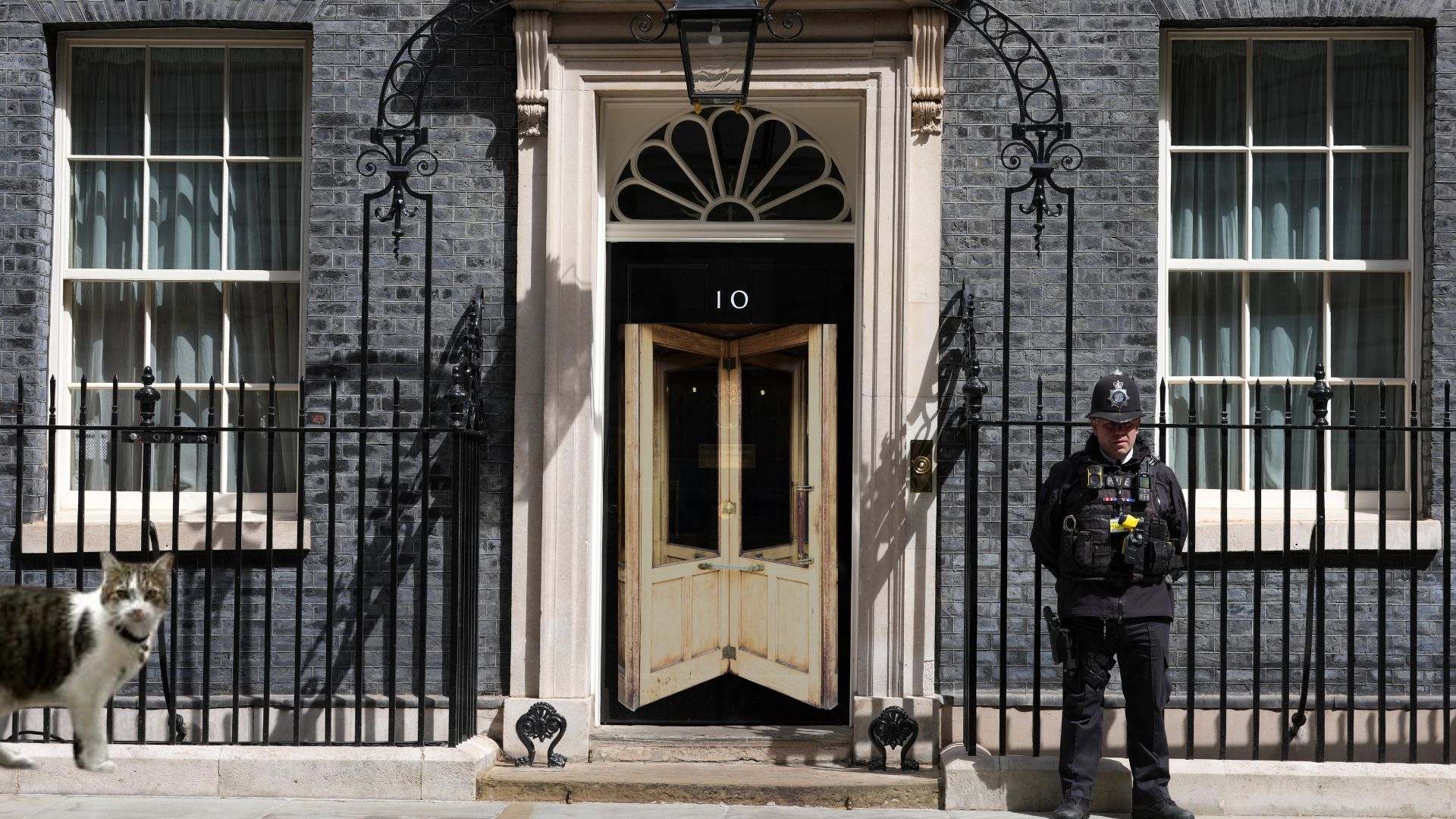
10 Downing Street, the official residence of the British prime minister shown with a revolving door. (Illustration by News Decoder.)
This article was produced exclusively for News Decoder’s global news service. It is through articles like this that News Decoder strives to provide context to complex global events and issues and teach global awareness through the lens of journalism. Learn how you can incorporate our resources and services into your classroom or educational program.
Later this month, Andy Burnham is almost certain to take office as the seventh British prime minister within the last 10 years. In contrast, the previous four leaders had lasted for an average of nearly eight years each.
What accounts for this accelerated churn in British politics? Has the country’s democracy become inherently less stable? Has the United Kingdom for some reason become ungovernable?
These questions can be approached on several levels, from the performance of individuals in office to the fundamental challenges that every leader in a western democracy currently faces.
Let’s start with the circumstances of the six departures since 2016. Most notably, only Rishi Sunak was tossed out by voters in a general election: And only David Cameron resigned of his own accord, after voters opted to leave the European Union in the 2016 Brexit referendum.
Pressure from within their own parties forced the other four leaders to step down: Theresa May, who unexpectedly inherited the task of negotiating the terms of leaving the EU, succumbed to constant rebellion from Boris Johnson and ardent Brexiteers who wanted a ‘harder’ break from Europe than she did.
The Brexit bodge job
Johnson pushed through a complete separation, known as a “hard Brexit” but ran a ramshackle government beset by scandals. Most notably he held parties held at 10 Downing Street, his official residence, during the Covid lockdown.
His ministers eventually resigned en masse, and he was replaced by Liz Truss. Her downfall came after she had to reverse a large programme of tax cuts that ended up destabilizing the economy. She lasted just 49 days.
Only by appointing an economically sound leader in Sunak did the Conservatives limp to the 2024 election, which they lost badly.
Keir Starmer was elected with an enormous majority in Parliament for the Labour party. But Labour had not really captured voters’ hearts: it won only 33% of the vote, hardly increasing its share from the previous election.
Rather, opposing parties split the remaining votes. Voters deserted the Conservatives, whose share fell 20 points to 23%, for the populist right-wing Reform UK party led by Nigel Farage, which secured 14% of the vote.
A fight among the right
This division between right-leaning parties allowed Labour to capture many seats, because the winner in each constituency is simply the candidate taking the most votes.
Labour was, therefore, highly vulnerable if either Reform or the Conservatives were to gain momentum. And in fact, Reform has surged ahead in opinion polls, won sweeping gains in local elections and is currently projected to become the largest party at the next general election.
That election, though, does not have to be held until 2029 and Farage has been immersed in a financial scandal that resulted in him quitting his parliamentary seat only to run again for the same seat in a special election.
How someone can become British prime minister
In the United Kingdom, the leader of the party winning the most parliamentary seats in a general election forms a government as prime minister. The governing party can change its leader between elections. If it does, the new prime minister is not obliged to call an election. But an election must be held within five years of the last one.
Each of 650 constituencies chooses its member of parliament (MP) under the ‘first past the post’ system: the person with the most votes wins the seat. There is no proportional representation.
In the past hundred years, the government has been led by either the right-leaning Conservative Party or the left-leaning Labour Party, but there are also regional parties such as the Scottish National Party, as well as Plaid Cymru in Wales and several in Northern Ireland. Newer challengers include right-wing Reform UK and the left-wing Green Party.
British prime ministers since 1979
Margaret Thatcher: Won elections 1979, 1983, 1987. Removed by Conservative MPs 1990. (In office for 11 years)
John Major: Appointed by Conservative MPs 1990, won election 1992, lost election 1997. (Seven years)
Tony Blair: Won elections 1997, 2001, 2005. Resigned 2007. (Ten years)
Gordon Brown: Appointed by Labour MPs 2007. Lost election 2010. (Three years)
David Cameron: Won elections 2010, 2015. Resigned 2016. (Six years)
Theresa May: Appointed by Conservative MPs 2016. Won election 2017. Removed by Conservative MPs 2019. (Three years)
Boris Johnson: Chosen by Conservative Party members 2019. Won election 2019. Removed by Conservative MPs 2022. (Three years)
Liz Truss: Chosen by Conservative Party members 2022. Removed by Conservative MPs 2022. (49 days)
Rishi Sunak: Appointed by Conservative MPs 2022. Lost election 2024. (Two years)
Keir Starmer: Won election 2024. Removed by Labour MPs 2026. (Two years)
Andy Burnham: To be appointed by Labour MPs 2026.
The urgent task for Starmer, meanwhile, was to shore up Labour’s position by soothing voters. He failed to rise to the challenge. For months, his government did very little, unprepared for leadership after 14 years in opposition.
Pleasing British voters
Starmer squandered the opportunity for big reforms that a large majority offers. Starmer was indecisive, unable to offer a vision or even much of a policy programme. He made clumsy choices and blunders. His manner was lawyerly, bureaucratic, wooden. It became increasingly clear that he could not win the next election. Just two years after his electoral success, his ministers made clear to him that he had to go.
Anthony Seldon, a historian of British politics, writing in The Times, said that “Starmer’s abrupt collapse was unique in the history of British prime ministers.”
Why have the main parties been changing their leaders so many times? According to Seldon, it is partly because of the “cavalier way” that various incumbents acted in office and then used geopolitical and financial upheavals as excuses for their poor performance.
There seems to be truth in this judgment. But it is not the only factor. It is impossible to ignore the populist impatience that engulfed British politics over the issue of Brexit.
Across Europe, easy solutions offered by populists have undermined support for established parties. Governments find it difficult to deliver economic growth, jobs and higher earnings as they try to support ageing populations, channel benefits to the disadvantaged and improve public services – not to mention bolstering defences against the Russian threat.
The popularity of populists
Cameron’s decision to call a popular vote on Britain’s EU membership was the first significant concession to populist pressures.
He feared defections of MPs, or members of Parliament, from the right wing of his own party to Farage’s anti-EU, anti-immigration vehicle, then called the UK Independence Party.
When, in a position of weakness, Cameron called the referendum on leaving the European Union, he surely expected that this would put the issue to bed, because voters would see the virtues of remaining within the EU. But by a margin of 52% to 48%, they did not.nf
The Brexit campaign was a toxic combination of promises that offered quick and deceptive remedies to dissatisfied voters. The money that Britain supposedly paid to the EU would somehow be diverted magically into the state-run National Health Service. Migrants who supposedly took benefits away from Britons would be stopped.
But after the political turmoil triggered by the Brexit decision, what actual effect has populism had on Britain? Has it made the country ungovernable? The answer is that so far, it has not captured the UK political system as it did in the United States.
Post-Brexit politics
Yes, Brexit did happen and has, by wide agreement, severely damaged Britain’s economy. But there is now growing support for renewing ties with Europe. The Brexit issue also turned previously existing tension between the centre and the right of the Conservative party into open conflict, and tore the party apart. After its self-destruction it now has only 117 MPs compared with Labour’s 403. But it may rise again.
Meanwhile, Reform UK, Farage’s current vehicle, still has only eight MPs, and the left-wing Greens just five. Farage himself is under pressure to explain questionable donations to his party.
Britain has not become ungovernable. Still, the public disillusionment that fuelled the growth of populism remains a massive challenge. There is intense resentment of inequalities between regions and between tax-avoiding billionaires and ordinary people struggling to make ends meet.
Voters hold politicians in very low regard. Many people do not feel that the system is working for them. Starmer’s government made this worse – imposing new burdens on taxpayers and failing to curb the rapidly growing bill for state-funded benefits, like health care and pensions.
The rise of Reform
Hence the willingness to vote for alternatives. In the May 2026 local elections in England, Reform won the largest share of votes at 26%, with the Green party second on 18%.
Camilla Cavendish, a journalist who has held senior positions advising governments, wrote in the Financial Times that ‘society is being corroded by a sense that some people are getting away with it.’
Public disillusionment is not just caused by the rising cost of living, she wrote, but by ‘a growing belief that government is not on our side.’ Taxpayers do not feel that their hard work is respected or rewarded.
To change this, Andy Burnham has a mountain to climb. He starts with several advantages. For the past 10 years, he has been outside the Westminster ‘bubble’ and has built a solid reputation as mayor of Manchester, in the north of England.
He champions the interests of northern regions that have felt neglected by governments in London. Untainted by Starmer’s failures, he is in a position to present a new vision, and is already doing so by promising to devolve more powers to regional leaders. ‘People are giving up on politics,’ he told the LBC radio network. ‘We need a new way of doing things.’
Burnham’s ambition resonates with disaffected voters but will be hard to fulfill. He will face the same economic, fiscal and strategic challenges as his predecessors, and will seek to force through an innovative approach to government.
If he is successful, the prize will not just be faster growth, more jobs, greater fairness, reduced spending on benefits and stronger defence, but the vanquishing of the false promises of Farage and his imitators – and thereby the restoration of order in British politics. For that, even the opposition Conservatives might secretly be grateful.
Questions to consider:
1. Why do voters in Western democracies feel disaffected from established political parties?
2. What are some basic things people expect from their government where you live?
3. What do you think are the chances of success for the next prime minister of Great Britain?

Alexander Nicoll is a writer and former journalist. He reported for Reuters and the Financial Times from around the world and later was a writer and editor for a defence think-tank.