
Some promising new drugs have been shown to prevent new HIV infections. But for now, it seems, they go only to countries that can pay.
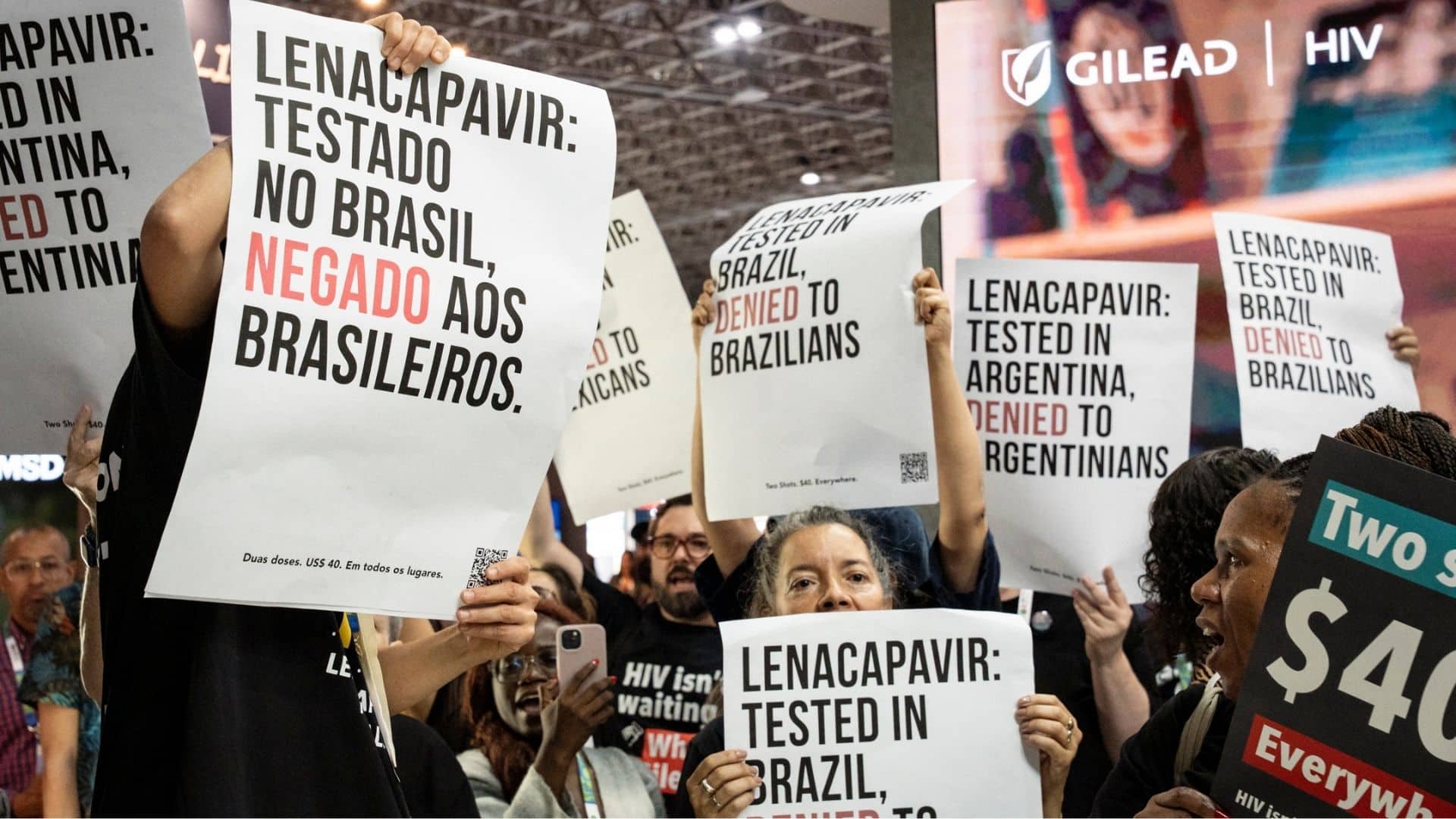
Activists protest the limited access to lenacapavir in front of pharmaceutical company Gilead’s booth at AIDS 2026 in Rio in July 2026. (Photo by Alfonso Silva-Santisteban.)
This article was produced exclusively for News Decoder’s global news service. It is through articles like this that News Decoder strives to provide context to complex global events and issues and teach global awareness through the lens of journalism. Learn how you can incorporate our resources and services into your classroom or educational program.
In 2024, a company developing treatments to prevent HIV, the virus that causes AIDS, found that an experimental drug called lenacapavir injected every six months reduced new HIV infections to zero.
But lenacapavir costs $28,000 per person per year in the United States, more than one thousand times the cost of production.
In October 2024, Gilead, the pharmaceutical company that developed lenacapavir, ceded intellectual property rights so that 120 middle- and low-income countries could obtain a generic form of the drug at a much lower cost — around $40 per person per year. But access to those drugs has been limited.
Two years later, a global funding crisis and protests against Gilead over its prohibitive prices shows that curbing HIV today might depend more on political and economic factors than on scientific achievements.
Experts agree that the biomedical tools needed to end the epidemic already exist. Rapid self-tests let people learn their infection status within minutes. For people living with the virus, sustained treatment halts the progress of the disease and also its transmission. Taking antiretrovirals to prevent infection prevents nearly all new cases.
Preventing AIDS
When Gilead first unveiled the drug at the AIDS 2024 conference it was hailed as one of the biggest advances in prevention in decades and reinforced optimism about ending the HIV epidemic.
Lenacapavir is one of the antiretroviral medicines that can be used as pre-exposure prophylaxis or PrEP. Now the challenge is to get the drugs to the hundreds of thousands of people who need it and help them access public health services on a sustained basis.
At AIDS 2026, the Pan American Health Organization (PAHO) presented the Alliance for the Elimination of HIV in the Americas aimed at bringing together political leaders with international organizations, academia and communities.
The announcement underscored the scale of the problem. Despite medical advancements, in Latin America and the Caribbean the epidemic is growing. New cases rose 17% between 2010 and 2025. Around 2.8 million people live with HIV in the region.
That’s why one of the strategies being promoted is the use of antiviral medications. For every new HIV case, at least three people, and ideally five, should be using it.
What it takes to ensure access
Peru’s Ministry of Health reported around 8,000 new HIV cases in 2024. According to PAHO’s targets, as many as 40,000 people should be taking preventative drugs, but by 2025 only 9,000 were doing so. Studies have shown that the use of the prophylaxis depends on access to health services, the availability of medications and the awareness of potential users.
In that context, lenacapavir has great potential because it’s administered every six months and provides nearly total protection. But the drug hasn’t reached the region.
AIDS activists are taking action. During the opening ceremony of the International AIDS Conference in Rio de Janeiro some 20 activists stormed the stage with signs reading, “HIV doesn’t wait, why does Gilead?” or “Brazil, break the patents.”
The next day, they protested in front of the pharmaceutical company’s booth, one of the largest at the conference, with signs reading, “Lenacapavir, tested on Brazilians, denied to Brazil,” which also referenced Argentina, Mexico and Peru, countries where the drug research took place.
The protests took place on almost every day of the conference.
Easing controls
States can override existing drug patents for reasons of public interest. Brazil did so in 2007 with the antiretroviral efavirenz and Colombia with dolutegravir in 2024.
Susana van der Ploeg, a lawyer with the Brazilian Interdisciplinary AIDS Association (ABIA), stressed that breaking patents is a first step toward manufacturing the drugs more cheaply.
Van der Ploeg showed a plan, developed with a researcher from the Federal University of Rio de Janeiro, to manufacture lenacapavir in Brazil at a cost of $72 per person per year. The government, however, would need to take steps to enable local manufacturing.
“The barrier isn’t technical, it’s political,” she said.
According to data presented by Khadija Richards of the nonprofit organization African Alliance, of the 120 countries included in the agreement, only 12 have received the drug. South Africa and Uganda, among them, have received less than 1% of the doses they need for their national programs.
“Not even the study’s own participants [in South Africa] are receiving lenacapavir,” Richards said.
Innovation without access
The final phases of new drug development consist of clinical trials with thousands of participants.
Between 2021 and 2024, 8,600 people took part in the studies, known as Purpose, in which one group was injected with lenacapavir every six months. Purpose 1 focused on women in South Africa and Uganda and Purpose 2 on gay men and trans people in Argentina, Brazil, Mexico, Peru, South Africa, Thailand and the United States.
The effect was so pronounced — 100% in the first set and 99.9% in the second — that the independent committee monitoring the study recommended ending it ahead of schedule.
But since then, availability of the drug has been limited.
“We devoted time, effort, our lives to science and then we have no access,” said South African activist Tian Johnson of the African Alliance. “At a fundamental level, the situation is perverse,” he said.
Negotiating prices
In Latin America, only Bolivia, Honduras, Nicaragua and the Dominican Republic were included in Gilead’s agreements with the 120 countries, for production that still hasn’t materialized.
The rest, including those that contributed participants to the studies in which the drug was tested, must negotiate prices that run into the thousands of dollars per person per year.
In Armenia, the Positive People Armenian Network (PPAN) has opposed the granting of patents and has sought to work around what they call “procedural traps” — delays or backlogs within the judicial system during these processes — to secure the supply of medicines.
“Patents ultimately determine who does and doesn’t receive medicines,” said Anahit Harutyunan of the PPAN. “Law must ultimately serve humanity, not just intellectual property.”
Brazil’s Minister of Health, Alexandre Padilha, said at a press conference on the first day of AIDS 2026 that the government had not reached an agreement with Gilead to buy lenacapavir, despite having offered 10 times more than what Indonesia or Thailand will pay.
Without giving details, he described the price the laboratory was asking for as “stratospheric,” noting it made it impossible to include the drug in the public health system. “Innovation without access is an injustice,” he said.
Pushing for global access
In response, Gilead issued a statement saying it would push for global access to the drug but didn’t mention specific actions.
Padilha made no reference to the activists’ demand for compulsory licensing of the patents. He also reported that the government had begun negotiations with the British laboratory GSK to purchase cabotegravir, an antiretroviral used as injectable PrEP every two months.
For Van der Ploeg, those negotiations are problematic because pharmaceutical companies require countries to keep agreed prices confidential. As a result, each country negotiates as best it can.
The companies secure bigger profits, usually at the expense of smaller countries. When questioned, Padilha said Brazil’s oversight mechanisms wouldn’t allow for secrecy but Van der Ploeg is skeptical.
“I can confirm that the Brazilian government is acting forcefully,” said Javier Padilla, Spain’s Secretary of State for Health, whose country closed a deal in February with GSK to buy cabotegravir at a price that hasn’t been made public.
Markets versus need
Pharmaceutical companies, Padilla said, need to understand that market access must be faster, even for their own benefit, before other innovations come along.
In the early 2000s, he said, the mere possibility that Brazil or South Africa might disregard patents led pharmaceutical companies to lower their prices and opened the way to universal access to treatment.
Approval records show that by then, some of the antiretrovirals had been on the market for more than a decade.
Activists’ protests stood in contrast to the industry’s presence at the conference. ViiV, the HIV-focused company created by Pfizer and GSK, was one of the main sponsors. And a several-meter-long banner that promoted forums for vulnerable populations, placed near the food court, touted the historic slogan “Nothing about us without us,” which originated from the community response to the epidemic. But it was an ad for Gilead. For Van der Ploeg, it’s hard to attend sessions or talk to activists and see that they’re sponsored by pharmaceutical companies.
Tian Johnson of the African Alliance shows his discontent. “It’s very disturbing to see the people who are responsible for withholding HIV prevention in my country [South Africa], having such a prominent visible presence here without being held to account,” Johnson said.
That search for accountability was, in part, the activists’ mission during this conference. “Back in the day, we would have thrown blood on that Gilead stand,” Johnson said. “But right now we’ve almost become complicit in the greed of pharma and that’s unfortunate.”
Questions to consider:
1. What is preventing people in many countries from getting drugs like lenacapavir?
2. Why do you think that some drug companies think they can charge as much as thousands of dollars a month for new medicines?
3. Can you think of something important that you needed that you couldn’t get because you didn’t have the money?

Alfonso Silva-Santisteban is a public health physician, researcher and photojournalist based in Lima, and a former fellow in global journalism at the Dalla Lana School of Public Health at the University of Toronto.