
Depending on what part of China’s economy you look at, it seems either wealthy or weak. Should the rest of the world be worried?
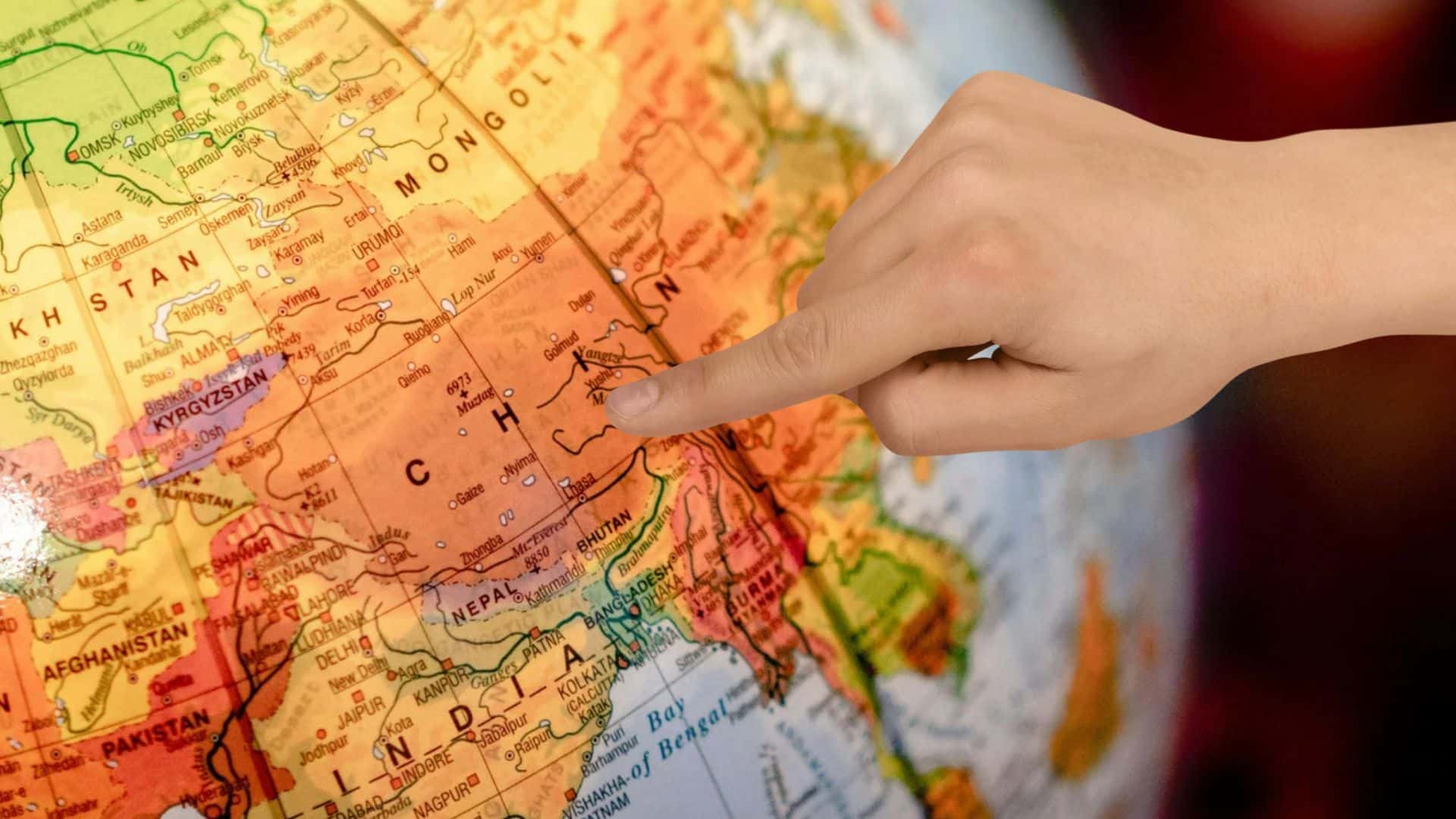
A finger points to China on a globe. (Illustration by News Decoder)
This article was produced exclusively for News Decoder’s global news service. It is through articles like this that News Decoder strives to provide context to complex global events and issues and teach global awareness through the lens of journalism. Learn how you can incorporate our resources and services into your classroom or educational program.
In the ancient Indian parable, several blind men touch an elephant for the first time. Because they all feel a different part of the huge animal — the tail versus an ear versus the trunk — they disagree on what sort of creature it is.
The Chinese economy is like the elephant, the sum of very different parts. If you look at only one, you see a different animal.
The country recorded a trade surplus of $938 billion in the first nine months of this year, up from $875 billion in the same period in 2025, putting it on track to surpass last year’s whole-year record of $1.2 trillion. (The economy must be very powerful!)
The trade surplus with Europe now tops $1 billion a day, fanning fears that China is destroying the continent’s traditional industries, notably automobiles. (For Europe, the economy is very dangerous!)
Yet China’s domestic demand is feeble. Retail sales are barely growing, bank loans to households are actually falling and, according to government data that economists find baffling, investment is shrinking, too. (The economy is so weak!)
After a huge property bubble popped in 2021, consumer confidence has collapsed. With spending subdued, household savings have doubled. And despite higher energy costs there remains a real danger of a relapse into deflation, when prices across the economy fall outright, risking a recession. (The economy needs help quick!)
In short, the world’s second-largest economy is a jumble of contradictions.
A complex economy
China’s economy has long been out of kilter. As far back as 2007, then Premier Wen Jiabao described it as unbalanced and unsustainable. But things have gotten worse since the collapse of the property market turned a credit boom into a bust.
Youth unemployment has risen and tens of millions of Chinese have had to resort to low-paid gig work.
Beijing’s policy response to the domestic slump has been to double down on export-led growth. To that end it has deliberately held down the exchange rate of its currency, the yuan, which the International Monetary Fund estimates is more than 20% below fair value. Brad Setser of the Council on Foreign Relations, a think tank in Washington, puts the undervaluation at 30-35%.
By keeping a lid on its exchange rate, China artificially lowers the price of its goods to foreign buyers.
But China’s export prowess, sustained in the face of tariffs from the United States, is also a by-product of the Chinese Communist Party’s successful long-term bet on sectors such as wind and solar power, batteries and electric vehicles.
Industrial power
China now dominates these industries, on which it has long lavished subsidies, and is exporting its surplus production to the rest of the world, where high oil prices are making renewables increasingly attractive.
Chinese leader Xi Jinping is looking at other ways in which state planners can prop up domestic demand until the property market revives. Real estate used to make up about a quarter of the economy.
The government is spending heavily on what Xi calls “new productive forces.” These are high-tech sectors such as robotics and artificial intelligence. It has also agreed to spend a staggering 25 trillion yuan, or about $3.7 trillion, over the next five years on what it calls six networks: water, electricity, computing, communications, logistics and urban pipelines.
Thanks to these initiatives, China is on course to hit its official growth target for this year of 4.5-5%. Growth of 5% is very high by rich-country standards but only half the annual rate China recorded between 1980 and 2010.
It should be noted that some analysts suspect the economy is much weaker than the Party lets on because of the property market slump.
The ability to measure and control
Investment is Xi’s go-to choice of stimulus to achieve its growth goals. It is something the Party can measure and, importantly, control. Stoking household spending, by contrast, would risk handing the economic steering wheel to 1.3 billion unpredictable consumers.
Strengthening China’s flimsy welfare safety net so people don’t have to save as much for a rainy day is another policy option, and one economists often advocate. But Xi has resolutely rejected Western-style “welfarism” on the grounds that it would promote laziness and undermine China’s work ethic.
The problem is that Xi’s strategy is testing the rest of the world’s patience. You know that the deluge of goods from China is causing real anger when Germany waters down its free-trading principles and wants protection for Europe’s industries. Many Southeast Asian countries are also unhappy that China is swamping their markets.
Forty years ago another big Asian economy, Japan, was also running a huge external surplus. Then-U.S. President Ronald Reagan felt political pressure to raise trade barriers.
Instead Japan bowed to U.S. demands and agreed to raise the value of its currency, the yen, so as to make the value of its goods more expensive to foreign buyers. Japanese asset prices soared but, when they burst, they ushered in a long period of economic stagnation.
Unlike Japan, China is not an ally of the United States bound by a formal treaty. On the contrary, Beijing is locked in a power struggle with Washington and so it is deaf to its entreaties. It is determined not to repeat Tokyo’s policy mistakes.
What’s more, its closed capital account — strict controls over the movement of its money in and out of the country — insulates it from financial market pressures to change course. But if other countries follow the United States and the EU in raising barriers to Chinese goods, even Xi will find it hard to ignore the political damage that his imbalances are causing.
As the late economist Herb Stein said, “If a thing can’t go on forever, it will eventually stop.”
Something’s got to give.
Questions to consider:
1. Why is much of the world worried that China dominates manufacturing sectors?
2. Why does China prioritise investments in its industries over getting consumers to buy more products in order to stimulate its economy?
3. When you buy something, why might it matter to you whether the product was made inside your country or in a foreign country?

Alan Wheatley is an economics writer and editor based in London. Until recently, he was Reuters’s global economics correspondent, reporting from more than 40 countries and living in London, Frankfurt, Paris, New York, Washington, Tokyo, Singapore and Beijing. He is co-author of the book The Power of Currencies, Currencies of Power, which explores the consequences of looming challenges to the dollar’s status as the world’s leading reserve currency.