
In Paris, people protest en masse for the right to live well. That means good schools, affordable housing and job opportunities. Who would argue with that?
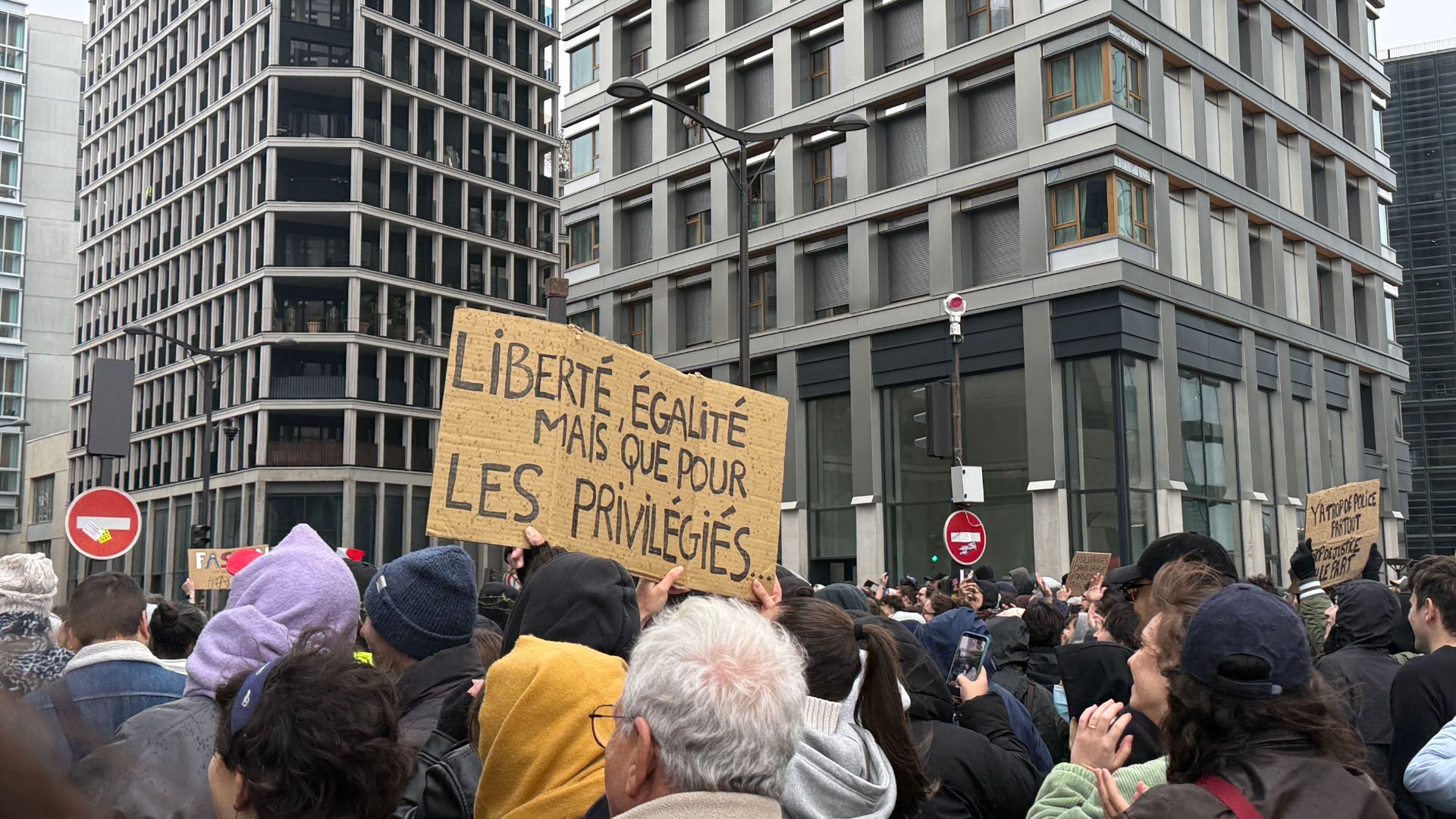
A sign reads “Liberty, equality, but only for the privileged” at a protest in Paris, 24 October 2026. (Photo by Maria Krasinski)
“How are you? We’re watching the news and all this rioting in France.”
“Hope Paris is calm where you are. Incredible what’s going on.”
“Making sure you’re doing OK over there.”
I received a slew of messages like this from friends and family, from United States to Belgium to Slovenia, following the widespread student protests across France on 17 October, that spiraled into violence and destruction.
I was actually in New York City at the time. I felt a mix of pride and solidarity, then outrage and despair watching my adopted city from afar, with a lot of the scenes of smashed windows, burning bikes and clouds of tear gas taking place just in front of my apartment.
But I was back in Paris on 24 October, when protesters took to the streets again for “Act II,” and this time I was out with them. I felt emotional again, now feeling mainly inspiration and awe at the masses of young and not-so-young people standing up for better school conditions, a more affordable cost of living and a more equitable society.
A masked protestor sits atop a stoplight, while a protester below holds a sign reading, “Pas la peine d’étrangler nos collégiens, ils étouffent déjà dans les salles de classe” — “No need to strangle our middle schoolers, they’re already suffocating in their classrooms.” Paris, France, 24 October 2026. (Photo by Maria Krasinski)
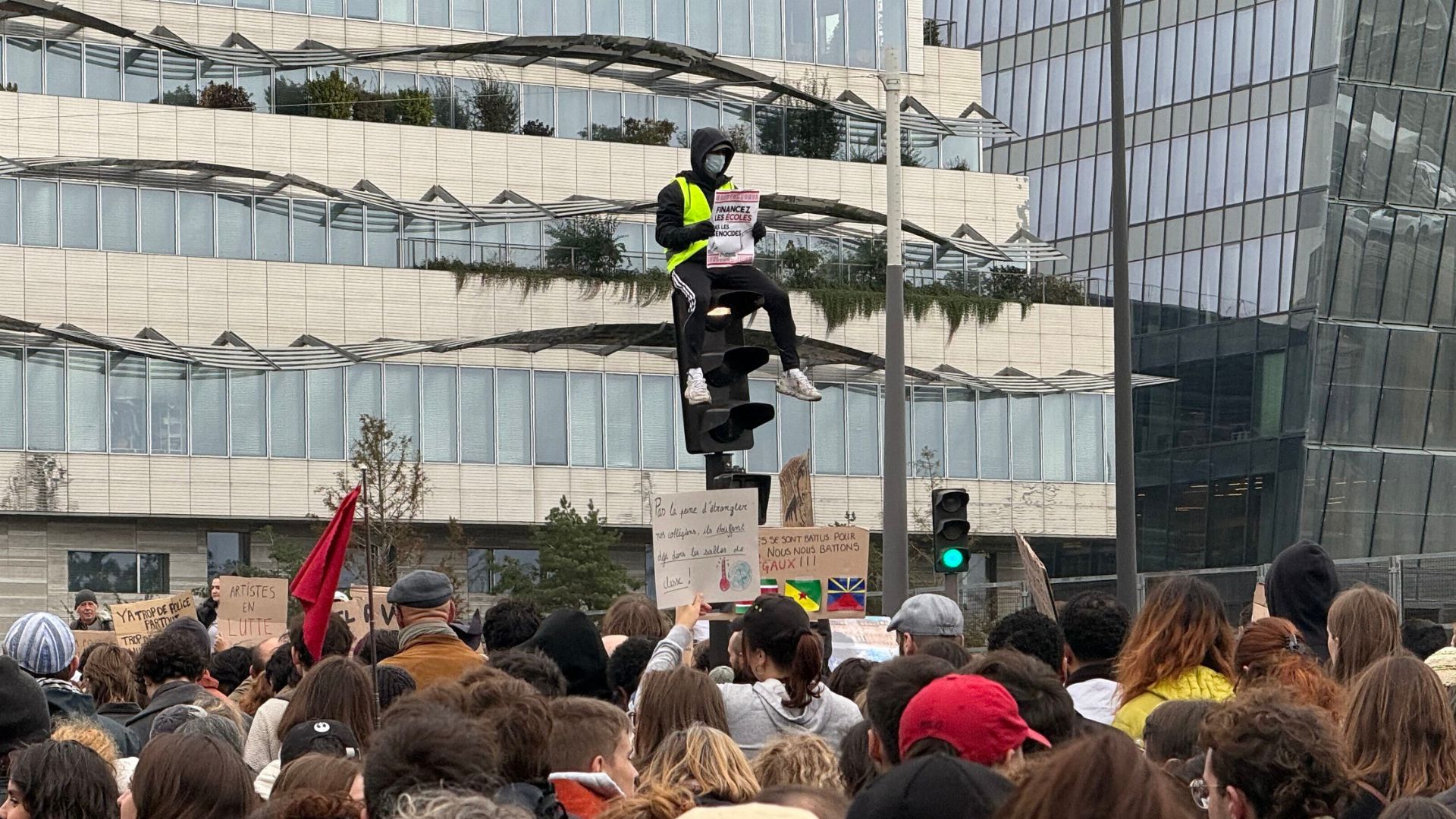
The atmosphere was peaceful, calm and clearly youth-led, with chants erupting every few minutes — mostly initiated by young women in the crowd.
“Abat l’état, les flics et les fachos!” (“Down with the government, the cops and the fascists!”)
“Siamo tutti antifascisti!” — “We’re all antifascists,” a slogan that originated in 1920s Italy against Mussolini.
One young demonstrator’s sign read, “Macron t’es foutu ma maman est dans la rue (même si elle est flippée)” — “Macron, you’re screwed, my mother’s out in the streets (even though she’s freaking out).” And just beside, a woman, presumably the student’s mother, held a sign, “Daronne en colère (et flippée)” — “Angry Mom (and freaked out).”


Marching the 5-kilometer route from Porte d’Italie to Porte de Vincennes, the energy never let up and I started to think of my own first moments of civic activation, when I started noticing what is happening in the world and how I might be able to get involved. I was thinking how for a lot of the young people around me, this might be their first protest, their first time stepping out and taking action. Or maybe it was a parent’s first, like the mother “freaking out,” and they were able to be there together.
The day before the protest, a racially-motivated shooting took place in the town of Trappes in the near Paris suburbs, killing one and wounding five, including a 12-year old girl. I think it galvanized a lot of people to come out to protest for the kind of country they want — and don’t want.
Walking towards Les Halles today, cafés are full and tourists abound. It feels like business as usual, until you see the boarded-up storefront windows and grenade caps littering the streets.
“Act III” of the protests will take place 31 October and a general strike is planned for 5 November.

The protest crowd — estimated at 110,000 by the Ministry of the Interior and 250,000 by the CGT trade union — marches down Boulevard Masséna in the 13th arrondissement of Paris, in what organisers called “Act II,” 24 October 2026. (Photo by Maria Krasinski)

Maria Krasinski is News Decoder’s managing director. In her spare time, Krasinski is book illustrator. Her latest book is “Welcome to the Afterlife” authored by Taryn Delanie Smith. Previously, Maria served in the Peace Corps in Tbilisi, Georgia, where she worked with a civil society NGO on fundraising, digital storytelling and youth citizen journalism projects. As Vice President of WorldChicago, a partner of the U.S. State Department, Maria convened local and global leaders to share knowledge and build connections, and founded Youth Diplomats to offer substantive global experiences for teens.