
Many people are turning to AI for medical advice, yet the wait times for doctor’s appointments are getting longer. The bot might be hurting more than it helps.
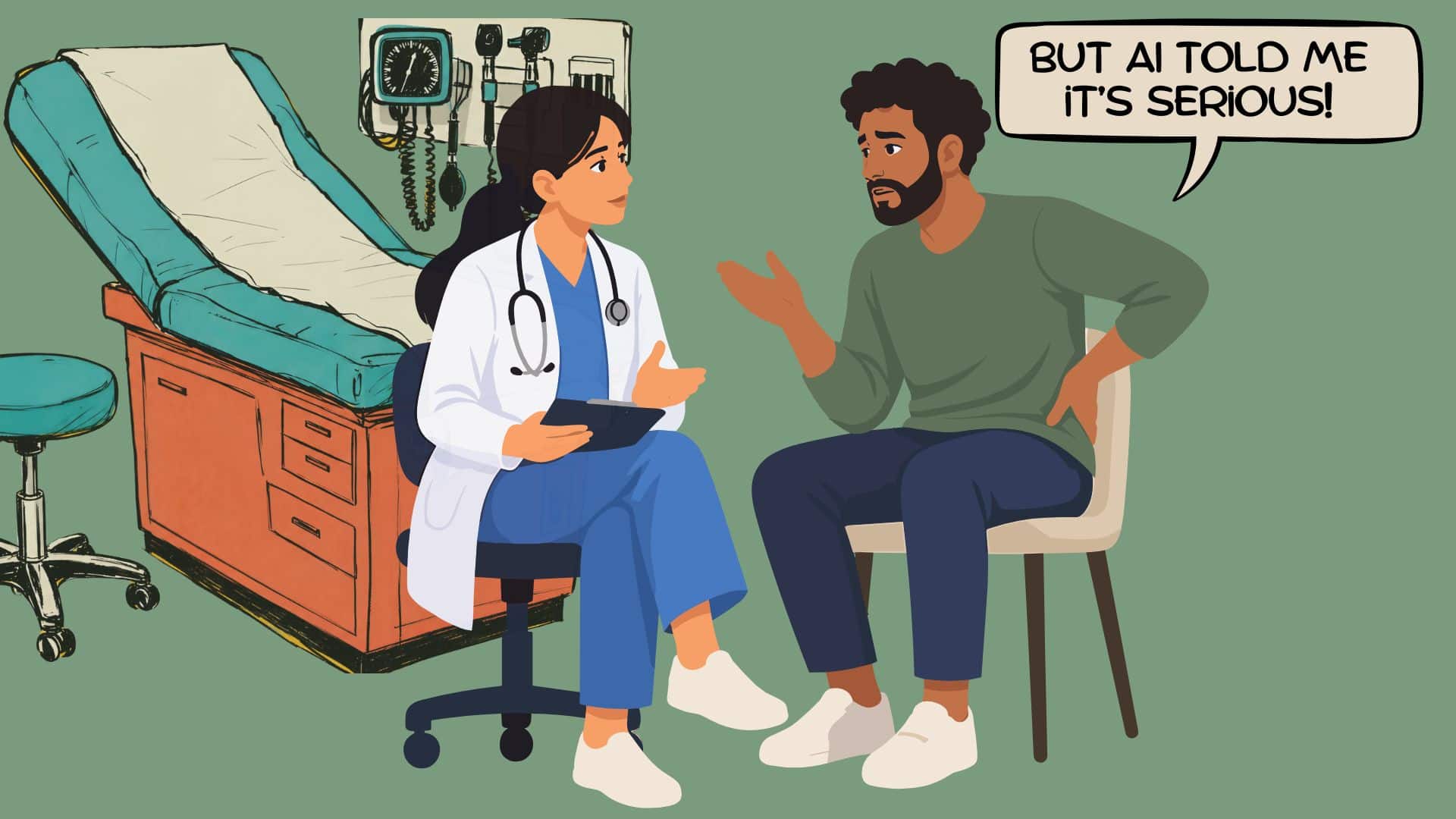
A patient tells a doctor he used AI. (Illustration by News Decoder)
Two people typed almost the same thing into the same chatbot. Both described a terrible headache. Both said their neck was stiff and that bright light hurt their eyes. One of them added four words:
“It came on suddenly.”
That person was told to seek emergency care immediately. The other was told to rest in a dark, quiet room, drink water and take a painkiller.
Both had described bleeding around the brain. It kills about a third of people who have it and survival depends on how fast you reach a hospital. One word decided which answer each person received and neither of them knew how much that word mattered.
These are not imagined examples. They are real conversations, recorded in a study published this year in the journal Nature Medicine. And they point to something happening in doctors’ offices around the world.
Because I’m interested in how medical and healthcare decisions are made, I founded NeuroEconSolutions, a team of scientists and researchers that applies neuroeconomic principles to improving patient outcomes and experiences. So you might say that I have a particular interest in how people interact with both AI and their doctor.
From symptoms to verdicts
Patients used to arrive at the doctor’s office with symptoms. Increasingly, they arrive with a diagnosis.
“It’s harder than it used to be,” said Dr. Manav Vyas, a neurologist and scientist at the University of Toronto. “You spend more time un-explaining,” more time telling patients what they do not have.
Dr. Alexandra Muccilli, another neurologist and the director of the Stroke Program at Unity Health Toronto, sees about 20 patients a day. At least one tells her directly that they consulted an AI chatbot first. She believes more of them do, from the printouts they bring and the shape of the questions they ask.
For example, a patient asks the chatbot to diagnose “fatigue, difficulty concentrating and tingling in their hands.” The chatbot answers: “multiple sclerosis.” The patient arrives, intent on proving or disproving it, Muccilli said.
The chatbot is not lying. Those symptoms do occur in multiple sclerosis. But they also occur after a stroke. And they occur in a great many people with nothing wrong with them at all. The machine may offer one frightening possibility without highlighting ordinary ones.
Why AI might get it wrong
The Oxford researchers behind those headache conversations gave some 1,300 people in the United Kingdom a medical situation to work through and a chatbot to help them. Another group was given nothing but the internet they would normally use.
When the study group fed the same situations straight into the chatbots, the machines named the right condition almost every time — about 95%. When ordinary people used those same chatbots, they reached the right condition less than 35% of the time.
The chatbot was not hiding the answer. It usually mentioned the right condition somewhere in the conversation. But it offered two or three possibilities at once, only about a third of them correct, and left the person to choose. Most picked wrong.
More striking, in half the conversations the researchers examined closely, the person left out something important in their very first query — as the headache pair did.
That is the gap. And doctors say they ask questions to fill that gap because patients cannot be expected to know which details matter.
Peter, a patient and a scientist who has used chatbots for his own symptoms, put it simply: the chatbot “never asks you more questions and it has never met you before.”
Same patient, two systems
Here the story changes depending on where you live. Your access to healthcare is based on many factors — primarily your coverage and geographic location.
Across 10 wealthy countries surveyed by the OECD, just over half of people waited a month or more to see a specialist. Canada and the United Kingdom, both with public systems, were the only two where more than one in 10 waited over a year. An Ipsos survey of more than 1,100 Ontario residents found over 50% waiting over three months to see a specialist for the first time.
Every health system in the world is short of doctors. What differs is how the shortage is shared out. Canada makes everyone wait in the same line. In the United States you might move to the front if your insurance is good enough and be turned away if it is not.
Neither is a golden path. In a public system the problem is the wait time. In a private one it is cost — and sometimes a list of doctors that does not really exist.
In 2024, researchers writing in the medical journal JAMA phoned 320 mental health clinicians listed as available to patients on Medicaid, the public insurance program in the United States for people with low incomes, in four large cities.
Fewer than one in five could be reached, accepted the insurance and had an appointment to offer. Your insurance hands you a list of doctors and four out of five of the names on it will not see you.
For most of the world, neither picture applies. The World Health Organization projects that by 2030, 67 countries will not have enough health workers to meet their populations’ needs.
What it costs
Doctors are already 13 times more concentrated in Europe than in Africa. In much of the world there is no queue to join and no insurance to buy, because there is no doctor within reach. There, the chatbot is not filling a gap in the system. It is standing in for one that was never built.
Consider one who arrives at a Canadian clinic.
She arrives wanting the scan the chatbot suggested. The doctor says no, because the test is not needed. Three things can happen next. She accepts it and waits. She pays a private clinic. Or she finds another doctor who will order it.
Meanwhile that conversation took 15 minutes the doctor did not have. The next patient waits a little longer, in a system where most people already wait more than a month to see a specialist.
Where the test is billed to an insurer or to the patient, there is no reason to refuse. The AI answer becomes a purchase.
From public to private
Each refused request is a small argument for the private option. Artificial intelligence did not cause the shift toward private medicine, which has a long history of its own. But it generates a demand that a public system is designed to turn down and that demand has to go somewhere.
Canada has spent more than a decade pushing the other way. Choosing Wisely Canada, launched in 2014, is a campaign that asks doctors and patients to order fewer unnecessary tests.
Its Canada chair and Professor of Medicine at the University of Toronto, Dr. Wendy Levinson, said the task has become harder.
“Debunking misinformation is more challenging now because it is online and in social media,” she said. “My own family doctor said he sees patients who went to Buffalo for a total body MRI and come back to him to manage all the incidental findings.”
That sentence holds the whole problem. A patient crosses the border, pays privately to have their entire body scanned and comes home with a list of harmless oddities that someone in the public system must now investigate.
The test was private. The consequences are not, Levinson said.
Knowledge is healthy.
Dr. Muccilli said that it is good when patients come informed. Patients now read their own results online and sometimes they notice what the medical team missed — a small finding on a scan that could have become something serious. Technology, she points out, protects doctors from their own mistakes too.
Let’s be clear. Almost none of this has been measured. While doctors describe a pattern they are seeing — that AI is reshaping the relationship between clinics and patients — it is not a trend anyone has documented.
What the doctors describe is a loop that closes on itself.
Poor access sends people to a chatbot. The chatbot does not remove their uncertainty; it hands them a possibility and no way to judge it. The questions that it produces make the eventual appointment longer. And longer appointments make access worse for whoever is waiting behind them.
Somewhere in that loop is a person with a sudden headache who did not know the word “sudden” was the one that mattered.
Questions to consider:
1. What is one problem with people turning to an AI chatbot for medical advice?
2. In what way is it helpful for people to come in to a doctor’s office having first researched their symptoms?
3. When was the last time you saw a doctor and what was that experience like?

Dr. Gustavo Saposnik is a professor of medicine (neurology) at the University of Toronto and director of the Clinical Outcomes and Decision Neuroscience Research Unit at St. Michael’s Hospital, Unity Health Toronto. He produced this story as part of the Dalla Lana Fellowship in Journalism and Health Impact at the University of Toronto.