
It’s not enough to play songs non-stop or watch every match on TV. If you don’t pay for tickets and merch, how much of a fan are you?
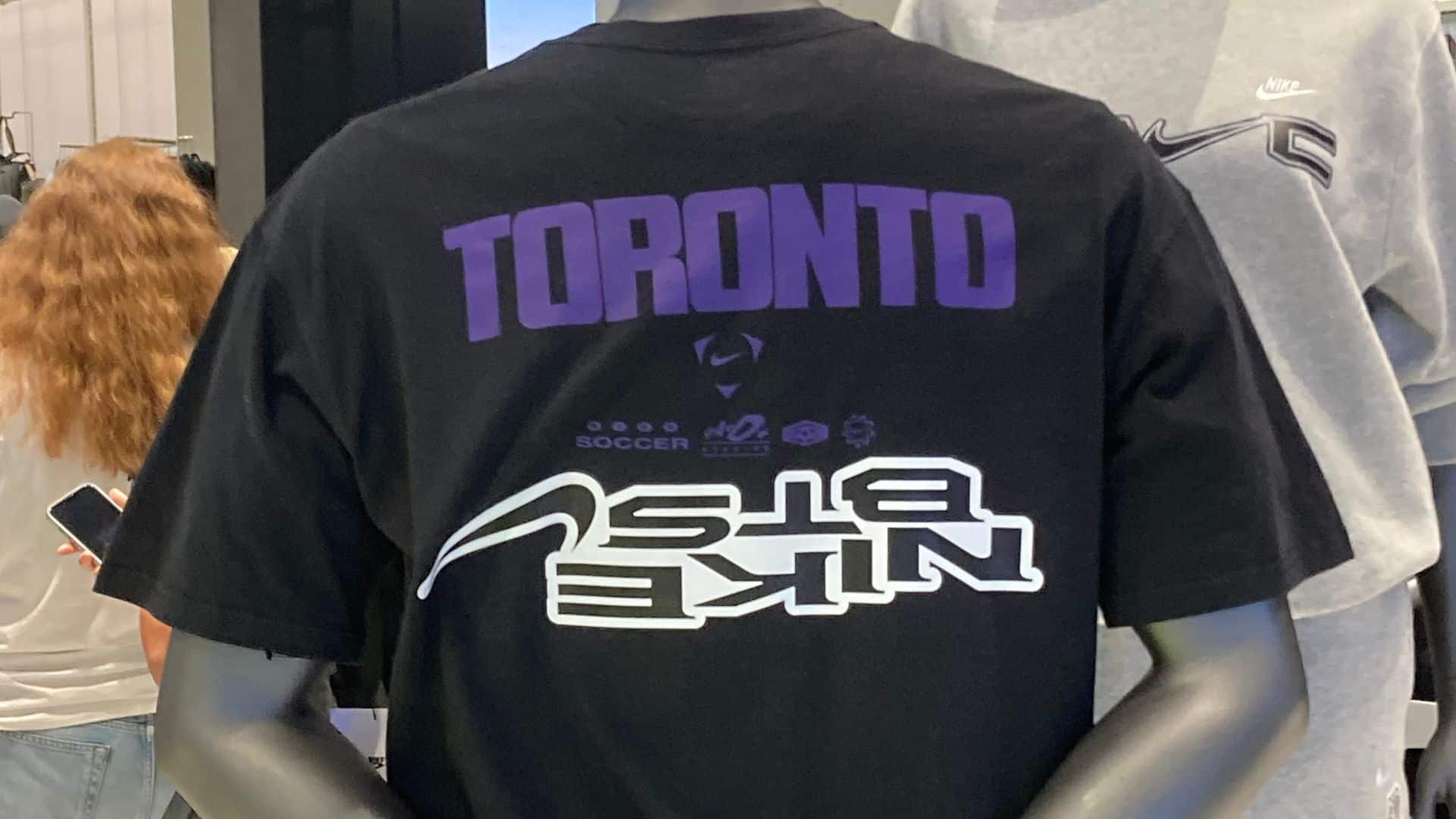
A Nike BTS shirt on a mannequin. (Photo by Norma Hilton)
This article was produced exclusively for News Decoder’s global news service. Through articles like this, News Decoder strives to provide context to complex global events and issues and teach global awareness through the lens of journalism. Learn how you can incorporate our resources and services into your classroom or educational program.
How much are you willing to pay to see your favourite artist or team?
Aura, 27, has been standing in line in front of the Toronto Eaton Centre Nike store since 12 p.m. It’s 3 p.m. now. She’s wearing an all-black outfit with hot pink accents and a smile. She’s also propping up crutches under her arms.
“I hurt my knee,” she said. And yet, she keeps standing in line for the new BTS x Nike collaboration, where fans can customize their t-shirts with signature BTS artwork and typography.
Since the BTS pop-up, this store has seen at least a hundred people a day, said one Nike store worker. Fans line up come rain, shine or the horrors of a weekday rush hour. The city is bursting with BTS related promotions, photo opportunities and merchandise. Their music spills over from every shop, restaurant and grocery store in town. And their fans are warm, friendly and beaming with joy.
So, for a fan like Aura, this is just one of the stops on her trip. She and her two friends hopped on a train from Montreal to see BTS live on 23 August in Toronto. For just a few days downtown, they spent CA$3,000 — on train tickets, concert tickets, food, fun and accommodation.
“We’re celebrating a birthday, too,” she said, smiling warmly.
Is it loony to pay all those loonies?
The cost might seem meteoric. But it’s worth it for many fans. During the pandemic most people were cooped up in their homes with no way to really socialize or travel. Now, fans want to go to live events like concerts and sports games. They want to be there — breathing in the same air as their favourite artists, feeling the electricity of other fans chanting their team’s mantra, waving one hand around while holding a phone in another.
Aura is a part of a core group of supporters called superfans that make up the foundation of any artist’s fandom. Superfans spend 80% more on music each month than casual fans, according to Luminate, a music data company. If live events catered to these superfans, the industry could earn an additional US$4 billion per year, according to a 2025 Goldman Sachs report.
Sports fans are also spending big. During the 2026 FIFA World Cup, fans spent anywhere from a few hundred dollars to $3,400 for a ticket to the final, according to The New York Times.
Ticket prices have soared, with concert tickets now costing more than 50% more than they did in 2019. But the skyrocketing demand from fans is only part of the reason.
Live Nation and Ticketmaster control most of the box offices of major venues. That means less competition and higher prices. Then, under dynamic pricing, prices go up in real-time as demand spikes. When fans find themselves priced out of the ticketing websites, they buy tickets on resale sites, which can still cost three, five or even 10 times their original price.
Everyone pays.
Meanwhile, the costs of putting on a big show have also skyrocketed. Multi-country events like the FIFA World Cup or the BTS world tour are gargantuan feats of managing logistics, equipment and large crews all the while putting on a show that’s beautiful to watch in person and on screens.
Then there’s travel, accommodation and food. Fans make these experiences the centre of a trip. They get to see a new city or visit a friend and family they haven’t seen in a while. And when you’re flying across the world, staying downtown like Aura and her friends did, that all adds up.
So why do fans care enough to shell out the cost of a small mansion?
There’s love for an artist. “I’ve waited 10 years to see them,” Aura said. Being a BTS fan means going to their concerts. It means buying their merchandise, streaming their music, voting for them during award shows.
There’s love for a team. For an Argentina fan traveling to the World Cup, it’s a chance to be there if they win, and seeing Messi play, which is something you’ll talk about for the rest of your life.
A priceless experience
In an article published by the University of British Columbia in June, UBC Sociology Professor Neil Armitage said that some fans feel a deep sense of belonging that may have started in childhood. Going to a stadium to see a match with a parent or someone close to you builds an emotional connection, he said.
In the same article, UBC Psychology Professor Jessica Tracy said that as humans, we tie our sense of self to something bigger than ourselves. “There’s what we call a collective self, which is your identity at a much broader level,” she said. “One of the groups that become really easily tied up in people’s sense of collective self are teams that represent communities such as your university, state or country.”
Spending on merch is a measure of your dedication and that dedication ties you to the community. The more you shell out, the more dedicated you are, the firmer your ties to the community.
But it can lead to negative feelings.
When a YouTube user posted a tearful video about having to give up one of her 10 tickets, her comments section was flooded with angry messages. Some expressed sadness. Others criticized her for crying because there’s millions of fans who did not get a ticket.
The comments read:
“Proper first world problems. I can’t even watch BTS live at all. Can’t afford to travel to another continent for it. Certainly not something to cry about. If you can get to 1 show you are already ahead of the majority… People often don’t realize how good they have it.”
“I had tickets to both Arlington dates and realized I literally would not make enough money this summer to pay for my fall semester so I sold front row 100 tickets.”
And yet fans return, year after year, season after season. Tracy pointed to the community that forms around shared experience, including shared suffering. “It makes us feel part of our environment and less alone,” she says. “There’s probably solidarity with other fans who are going through the same thing.”
Questions to consider:
1. What does it mean to be a “superfan”?
2. Why have ticket prices soared since 2019?
3. Name one celebrity, musician or team you are a fan of. How much money and effort would you spend to see them in person?

Norma Hilton is an independent journalist covering music, politics and the systems around them. She’s covered everything from K-pop to murder-suicides and worked in Canada, the United States and Australia.