
A massive revision to the election rolls in India mistakenly determined that many voters were dead or had moved. Why is it hard in many places to cast a vote?
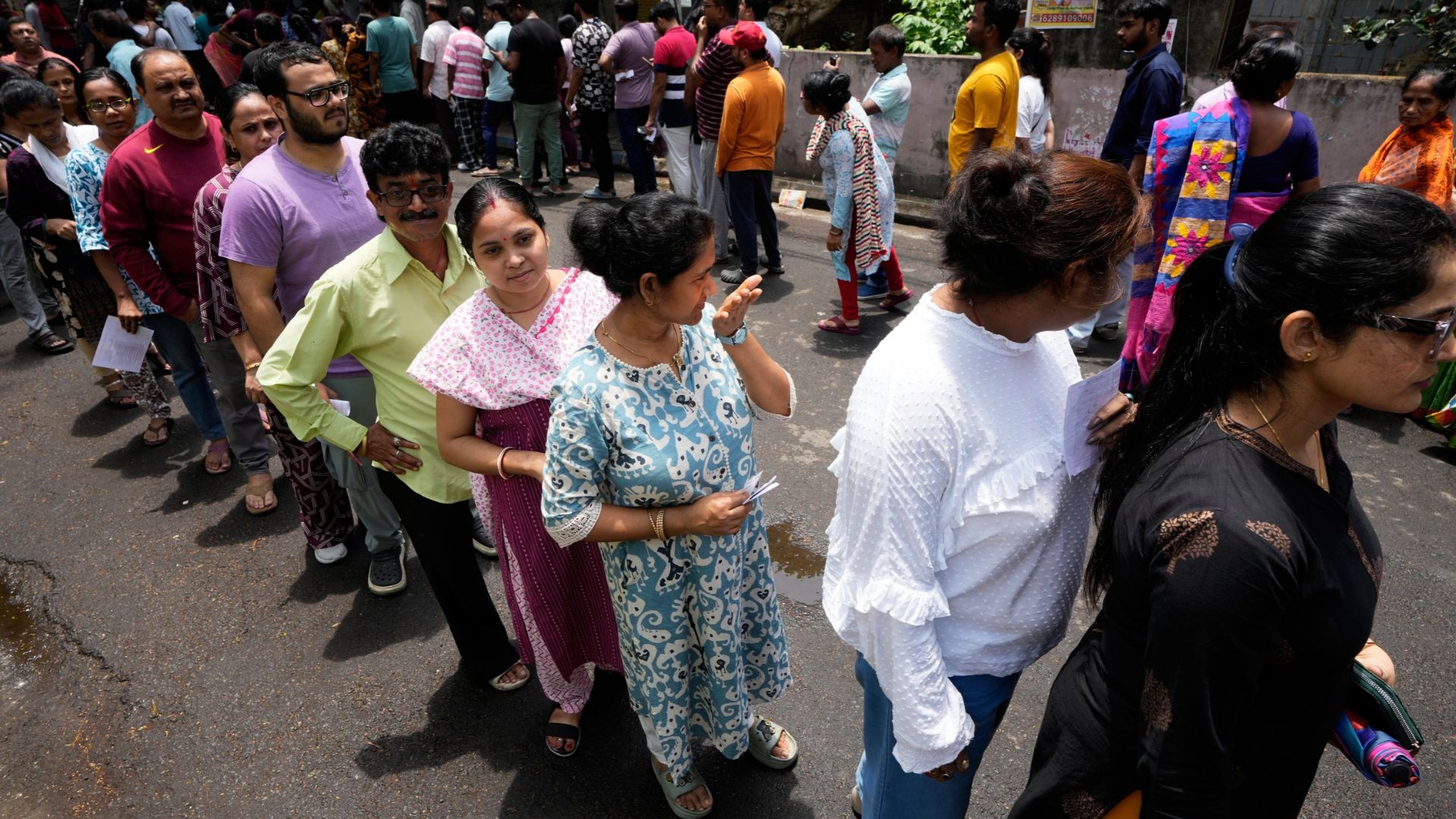
People stand in queue to cast their votes outside a polling station during the second phase of elections in West Bengal state, Kolkata, India, 29 April 2026. (AP Photo/Bikas Das)
This article was produced exclusively for News Decoder’s global news service. Through articles like this, News Decoder strives to provide context to complex global events and issues and teach global awareness through the lens of journalism. Learn how you can incorporate our resources and services into your classroom or educational program.
For Majid Khan, the problem is not simply that his name has disappeared from India’s electoral rolls. He has been classified as dead.
Nishant Kapoor faces a different problem. His name has been marked as that of a migrant, a classification he says does not reflect his circumstances.
Their cases point to a question at the heart of India’s contentious Special Intensive Revision of electoral rolls: what must a citizen do when the official record used to determine their right to vote contradicts their own account?
For someone recorded as deceased, the challenge is to establish that they are alive. For someone classified as having migrated, it might mean establishing their residence in the relevant constituency.
Both face a problem that goes beyond finding a missing name: understanding how the classification was made, identifying the appropriate procedure for challenging it and securing a decision from the authorities.
Proving you can vote
For young voters, registration can be the first direct encounter with the administrative machinery that determines ballot access. Political interest and willingness to vote are not enough if the person’s eligibility seems to evaporate.
The cases come amid a nationwide revision that has removed around 130 million names from draft electoral rolls, according to recent reporting. To put that into context, that equals the entire population of Mexico.
The Election Commission of India says the exercise is intended to improve the accuracy of voter lists by identifying deceased voters, duplicate entries and people who have shifted residence. Opposition parties and activists, however, have questioned the scale of the removals and the safeguards available to eligible citizens who find themselves excluded.
The figure does not establish that every person removed was wrongly excluded. Electoral rolls need to be updated, and voters who have died or permanently relocated must be accounted for. But the accuracy of the final list depends not only on identifying ineligible entries. It also depends on whether the authorities can recognise and correct mistakes.
For Khan and Kapoor, the central question is what happens when the system’s record does not match the circumstances of the person concerned.
Bureaucratic hurdles
A separate case in Delhi illustrates how consequential an incorrect classification can be.
Kamta Prasad, a 53-year-old tailor, was recorded as deceased in the electoral rolls. He has been trying to restore his voter status, turning an error in an official record into a bureaucratic struggle.
To correct the problem, Prasad, and anyone facing a similar problem, must first establish the reason for the omission and then determine how to challenge it.
To determine if a classification on an electoral roll is correct requires examining the underlying records, the verification process and official explanations.
It gets complicated because the same administrative system must deal with very different circumstances. A deceased voter, a person who has permanently moved, a duplicate entry and a living citizen whose details have been incorrectly recorded require different responses.
Filling out forms
When the categories are applied incorrectly, the burden of seeking a correction can fall on the very person the system is supposed to recognise.
The Election Commission provides different forms for electoral registration and changes to voter details. Form 6 is used for inclusion in the electoral roll, Form 8 for changes such as shifting residence and correcting particulars and Form 7 for objections to inclusion and requests for deletion.
Lawyer Nilotpal Datta and members of his family approached the Delhi High Court after their names did not appear in the draft electoral roll. They had not completed the required enumeration process within the prescribed period and wanted to correct or restore their previous entries through Form 8 (for changes) rather than apply through Form 6 (for inclusion).
Their concern was that Form 6, ordinarily associated with new voter registration, did not reflect their circumstances because they had previously been registered.
The Election Commission maintained that Form 6 was the applicable route for inclusion in the new roll being prepared through the revision. The dispute exposed a practical difficulty. The system requires them to register as if they had never voted before in order to be included in the revised roll but the voter, having previously voted, believes their existing registration should be carried forward.
Knowing what to correct
The issue is not merely whether an application form exists. It is whether people can identify the correct procedure, understand the declarations they are being asked to make and receive clear information about what happens next.
The Election Commission’s voter services portal provides online facilities for checking electoral records and submitting applications. But the availability of an online service does not mean every applicant can use it or that every disputed case will be resolved promptly.
For someone unfamiliar with electoral administration, even identifying the right form can become an additional task. For someone who must take time off work, travel to an election office or seek assistance completing an application, correcting an official error can carry costs beyond the paperwork itself.
Meanwhile, it isn’t clear how the omissions occurred in the first place.
Khan’s reported classification as deceased raises questions about the verification of death records. What information was used to make the determination? Was an enumeration form collected or was the entry placed in a category indicating that the voter could not be found?
Correcting the problem
Kapoor’s classification as having migrated raises a different set of questions. Does the entry indicate that officials believe he has permanently shifted residence, or does it reflect a failure to contact him at the address recorded in the roll? Has he been asked to establish where he ordinarily resides? If his address has not changed, what procedure is available to challenge the classification?
These are not interchangeable cases. The reasons behind the classifications may differ, as may the evidence required to resolve them. Yet both illustrate why the people omitted need to know the reasons for the omission.
The challenge is particularly acute when a person does not know whether their name is missing because of an error, a failure to complete enumeration or a decision about residence. Without a clear explanation, it can be difficult to know how to correct the problem.
Timing is important. Someone who discovers an error well before an election may have time to investigate the omission, gather the necessary information and pursue a correction. Someone who discovers it too close to polling day won’t have that time.
To rectify matters, the Election Commission has directed a special drive to enrol voters left out of the rolls in states and union territories where the revision has been completed. Delhi’s Chief Electoral Officer has also published information about the revision, including the draft roll, lists of electors whose enumeration forms could not be collected and the procedures for filing claims and objections.
From paperwork to protest
These measures provide routes for affected citizens to seek inclusion. The remaining question is how effectively those routes work.
Delhi, for example, had to process more than 4 million Form 6 applications for inclusion — these include both new registrants and those trying to correct the revised record.
The controversy raises a question that extends beyond India: how can election authorities maintain accurate voter registers without creating unnecessary barriers for eligible citizens?
Attempts to revise electoral systems elsewhere have also caused chaos and confusion. In the recent midterm elections in the United States, for example, the seat for U.S. Senate in the state of Mississippi took eight days to call because changes to the electoral rolls had marked thousands of voters as ineligible, forcing them after the election to show up to a government office to verify their votes in person.
In Ireland, passage of the The Electoral Reform Act in 1922 was meant to create a nationwide registration database. It allowed people to register themselves for the first time, and their registrations would automatically be sent to their local election authority. But the rollout of a national database took more time and so initially, local authorities could not determine if a voter was also registered elsewhere. That resulted in confusion for voters and administrative hurdles.
Politics and the polls
In India, the revision has become a national political flashpoint, with the youth-led Cockroach Janta Party (CJP) making electoral accountability a central demand.
The group has called for the resignation of Chief Election Commissioner Gyanesh Kumar and accused the authorities of undermining voting rights. Its allegations reflect a wider dispute over the scale and implementation of the revision, but the claims of protesters must be distinguished from independently established evidence about individual registrations.
Sumit Bagraw, a 24-year old from New Delhi, linked the dispute to concerns about the credibility of India’s democratic institutions.
“It’s unfortunate that India is claiming to be the world’s largest democracy but within the country the vote theft is being done by Prime Minister Narendra Modi and his election commission,” Bagraw said.
His accusation reflects the anger among protesters, but it does not independently establish that the revision was designed to alter an election outcome.
The legitimacy of an election
For Khan and Kapoor, the decisive questions remain: what steps have they taken to resolve their registration problems, what responses have they received, and have the disputed classifications been corrected?
A voter should not need political connections or public attention to obtain a fair hearing. The process should provide clear instructions, accessible procedures and a meaningful opportunity to challenge errors.
The protests have brought the electoral roll revision into the political spotlight. But the experience of an individual trying to establish their eligibility offers another measure of the process: whether the system can recognise an eligible voter without leaving them trapped in an unresolved chain of applications, verification and appeals.
Countries use different systems for voter registration, identity verification and electoral administration. Their laws and procedures are not directly interchangeable. But the underlying challenge is shared: a system must establish eligibility while providing a practical way to correct mistakes.
The ultimate question is not simply how many names have disappeared from the rolls. It is what happens when a citizen asks for their name to be restored, and whether the system gives them a fair chance to cast a ballot.
Questions to consider:
1. Why would a government make massive changes to its of voters?
2. Why do you think most governments require citizens to register to vote?
3. Imagine you are in charge of elections. What requirements would you impose on people for them to be able to vote?

Shafiya Rather is a freelance journalist based in India, with four years of experience in sub-editing for a monthly magazine.