
One high school student took it on herself to show children how climate change affects people throughout the world.
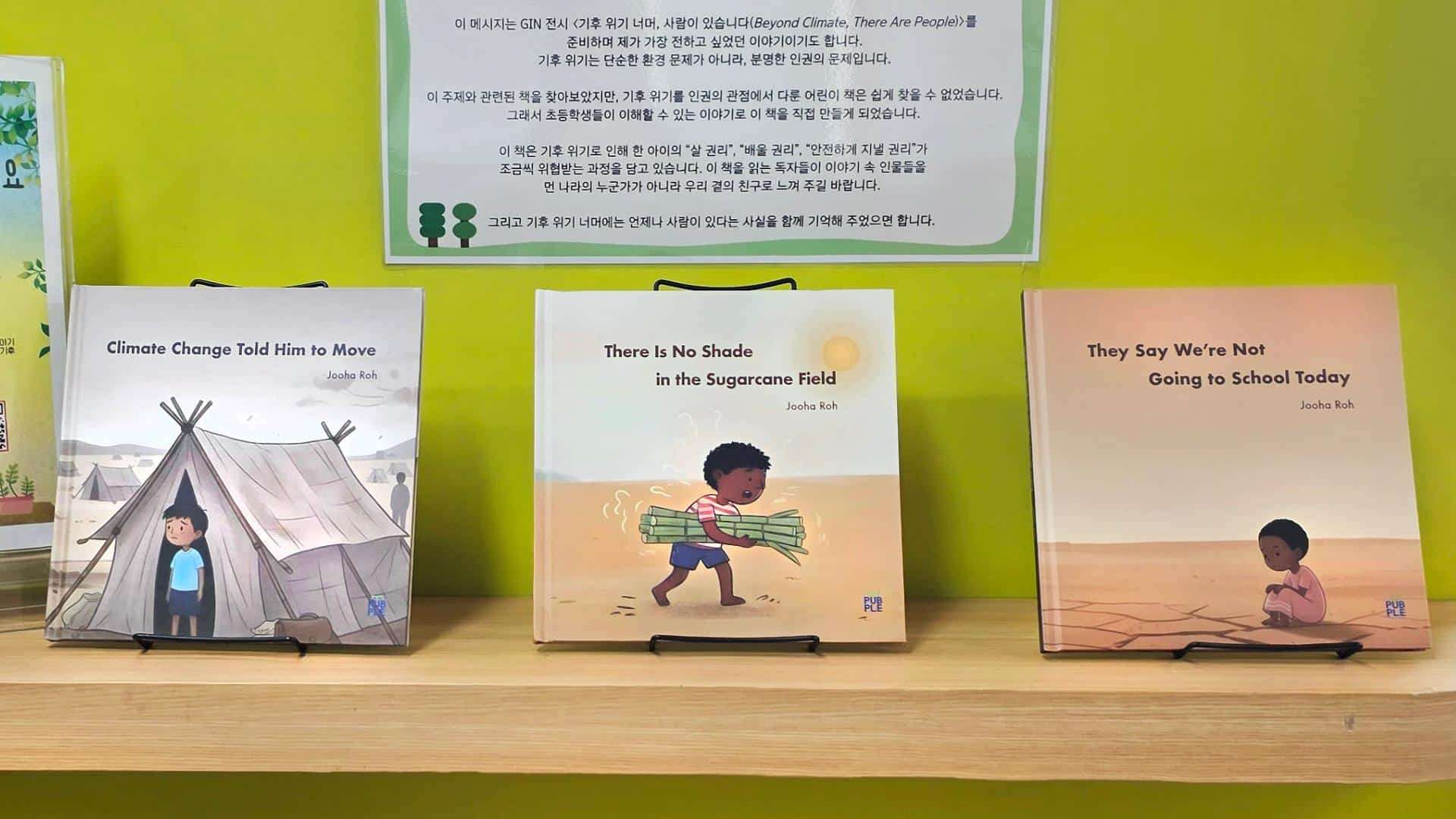
Three pages of a children’s book about climate change by high school student Jooha Roh. (Photo courtesy Jooha Roh)
I grew up largely partaking in actions such as bringing reusable tumblers instead of plastic bottles to school and joining campaigns to protect polar bears on Earth Day. Even now, volunteering with my service club, we collect used milk cartons and batteries every month to donate to the local welfare center.
However, practicing the textbook method of protecting our environment has its limitations. I started to realize that instead of stopping to think about how and why my actions truly mattered, I had carried them out without a second thought.
I came across an article that introduced the effect of climate change on women’s rights. It shed light on a perspective of the climate crisis that I had not considered. Girls were forced to abandon their education due to prolonged droughts caused by extreme weather. Families with failing harvests had no other choice than to marry off their daughters; women workers lost autonomy over their bodies.
I realized that I had always been taught climate change was solely an environmental problem, and never through the perspective of the lives of people who suffered because of it.
This realization soon became reality. In the summer of 2022, record-breaking floods swept across Seoul, claiming the lives of a family living in a banjiha, a semi-basement of apartments and a type of housing commonly associated with low-income households.
Climate change inequality
In Korea, banjiha symbolizes much more than just a type of housing. As the award-winning film “Parasite” brought it to global attention, it has become a symbol of the country’s economic and housing inequality.
What made this incident especially shocking was not just the flooding itself, but the way it revealed that climate-induced disasters struck the socially vulnerable first. Moreover, this event occurred in a location that was at the heart of the city, a place that had not been previously known for any flood damage.
Until then, I had thought of climate justice as something that concerned distant places and people. But this incident made me realize that even the areas near me that had remained unaffected by climate change were not safe anymore.
Since then, I have come to see climate change as an issue of human rights and social inequality.
This led me to the question: How can I help others understand social issues like climate change not as facts, but as actual human stories?
Data over people
Statistics existed everywhere, from the rate of carbon emissions to rising global temperatures and the constantly arising sea-levels. These numbers explained the crisis, but kept the people living through these changes largely overlooked.
Around that time, I often visited my father’s workplace. Inside the warehouse, mountains of used cardboard shipping boxes were stacked against the walls. Each box had once been used to wrap something valuable, but after its purpose had been fulfilled, were discarded without a second thought.
What if the stories of people living through the climate crisis were being discarded just as easily?
This vision turned into the “Beyond Climate There are People” exhibition. Our Global Issues Network (GIN) club created artworks solely out of cardboard and other recycled materials, using marginalized supplies to raise awareness about marginalized communities. Slogans, such as “The seawater engulfed our dignity” and “When crops fail so does her future,” painted pictures of families forced to abandon their homes after floods, and girls forced into early marriage to sustain their family crops.
I hoped that these sentences would leave a lasting impression, compelling the audience to confront the human stories that so often disappear behind statistics.
Stories about people
For two weeks, we led student tours, guiding classmates and teachers through the exhibition. Eventually, the exhibition expanded beyond our school and was displayed at local libraries and youth centers. While researching for the exhibition, I also learned that although there were many books explaining the science behind climate change and its environmental impacts, there were very few children’s books that told the stories of the people living through it, especially the children themselves.
This encouraged me to create a three-book picture book series that would invite children to view the climate crisis through the storytelling of others’ lives.
That was how three children came to life: Rahim, who was forced to leave his home because of flooding; Hawa, who was pressured into early marriage after a long-term drought destroyed her family’s crops; and Arjun, who had to work in the sugarcane fields under relentless heat.
I wished children could hold hands with Rahim, Hawa and Arjun before they heard the term “climate refugees or victims” and were introduced to statistics.
After publishing the series, I organized reading workshops at schools and at local libraries and created classroom resources. My goal was to help others, especially children, understand the climate crisis by viewing it through the eyes of those affected by it.
Climate change storytelling
Most recently, I came across podcasts and articles about News Decoder’s “EYES on Climate” initiative.
Listening to conversations with Amina McCauley and Matthew Pye, I was deeply inspired by their discussion of how journalism and storytelling can help young people understand the systems behind the climate crisis while empowering them to imagine solutions.
What struck me was the realization that although we had taken different approaches, we were guided by the same philosophy and driven by the same question.
Knowing that others were asking the same questions that I was gave me a renewed sense of purpose.
The podcast Jooha Roh heard that gave her a renewed sense of purpose.
Looking back, none of my projects began with a meticulously crafted plan. Instead, it originated from the plain question: Why do we learn about the climate crisis without learning about the people living through it? And how can we move people beyond simply knowing about social issues to actually feeling them?
As a high schooler, I have simply tried to answer those questions in ways that were available to me. I am still searching for the answers, but one thing has become clear to me during the process: People remember other people longer than they remember statistics.
This is why I want to keep finding ways to put stories before numbers and people before problems. When someone thinks about the climate crisis, I hope that it’s not just a problem of rising temperatures and carbon emissions, but a problem that affects the lives of people like Rahim, Hawa and Arjun from my picture books — people who are living through its consequences.
This is the connection that I hope to continue building.
Questions to consider:
1. How can stories help people better understand climate change?
2. What was wrong with the stories that the author first found?
3. If you were going to tell a story about climate change, what would you focus on?
Jooha Roh is a fourth year high school student in South Korea. She is interested in reading and writing about global issues and is particularly passionate about climate change and human rights, exploring them through storytelling. Outside of writing, she enjoys going for a run.