
An invisible glue holding the universe together and launching telescopes into orbit: Those ideas came from women who elbowed their way into astronomy.
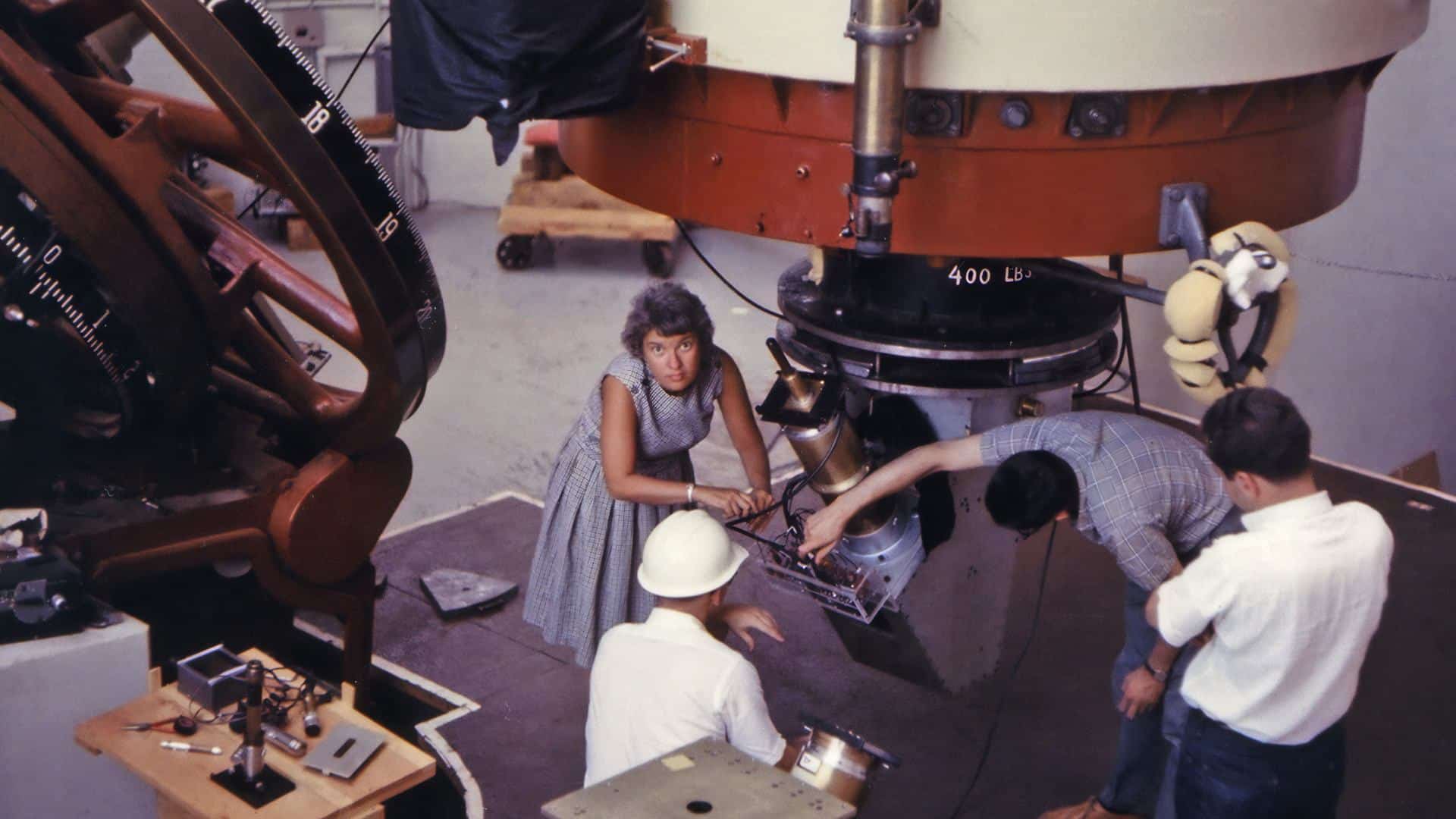
Vera Rubin and other astronomers work on a telescope at Lowell Observatory in 1965. (Photo courtesy of Carnegie Science)
At the end of August, NASA will launch a remarkable telescope into space. The Nancy Grace Roman Space Telescope is a fitting tribute to a woman who was NASA’s first chief of astronomy and the first executive at the space agency.
On 1 August, the world celebrates Woman Astronomers Day to reflect on all the women who have turned their eyes to space.
Nancy Grace Roman’s path to astronomy was challenging. Born in Nashville, Tennessee in 1925, she discovered astronomy at age 11 and promptly started an astronomy club. She was encouraged by her parents, one a geophysicist and the other a music teacher, to study science but discouraged at school and university. Still she persevered.
In 1949, Roman gained a doctorate in astronomy from the University of Chicago and worked with a series of observatories, always pushing the limits of what was technically possible.
She urged the use of computers for data analysis at a time when computers were considered to be an unwieldy gimmick. Her work in radio astronomy, a new field of study, led to her appointment at NASA in 1959, the year after the formation of the agency.
Telescopes in space
Roman encouraged and enabled decades of astronomical research at NASA, but she may be best known for her proposal in 1959 to place a telescope in space outside the distortion of earth’s atmosphere to detect exoplanets.
That proposal was the genesis of the Hubble Space Telescope which was launched in 1990. Hubble’s dramatic images of the universe have since inspired many careers in astronomy and space.
Like Nancy Grace Roman herself, the space telescope which carries her name will break new ground. “Its surveying capabilities are over 1,000 times faster than Hubble and can chart 200 times more sky in a single image,” said NASA administrator Jared Isaacman.”What would take Hubble 2,000 years to process, Roman can do in a year.”
The first of August was chosen as the day to celebrate women astronomers in honor of Maria Mitchell, born on 1 August 1818. Mitchell was the first female astronomer and the first American astronomer to discover a comet.
Like many early women astronomers, Mitchell’s passion in astronomy, and her choice of it as a profession, was encouraged by her family. Her father taught her to use navigation and astronomical instruments and believed in education.
Gaining recognition
Following Mitchell’s discovery of a comet in 1847, which became known as “Miss Mitchell’s Comet,” her celebrity led to a European tour where she met other astronomers and scientists.
Later she became the first professor of astronomy at Vassar College in 1865, which at the time was a women’s college.
When Mitchell toured Europe, one of the places she visited in England was the observatory created by Caroline Herschel and her brother William. Born in 1750 in Germany, Caroline moved to England at an early age to join William. One of his interests was astronomy and he pressed his sister into service as an assistant.
Initially reluctant, Caroline grew to love astronomy and excelled at observing and discovered eight comets over the years. Her catalogue of astronomical objects exceeded 2,400 and her work impressed King George III who granted her an annual salary of £50.
Caroline Herschel not only was the first woman to be paid as an astronomer, but she was also recognised by the Royal Astronomical Society with the prestigious Gold Medal in 1828. Although she died before Mitchell visited England, both women now have craters named for them on the moon.
Discovering dark matter
Even as astronomers around the world wait for the first images from the Nancy Grace Roman Space Telescope, they are already processing images from the Vera C. Rubin Observatory, captured by the world’s largest camera.
Situated in the exceptionally clear observing conditions of northern Chile, the telescope is named to honour a woman whose work in dark matter helped change how the motion of galaxies is understood.
Rubin was born in 1928 and tried to build her own telescope at age ten. She went on to study astronomy at Vassar College where Maria Mitchell had taught years before. Like many other women who wanted to pursue a career in science, she repeatedly encountered sexism. She was once denied a position at an observatory on the grounds that the facility lacked toilets for women.
In the end, Rubin worked in the Carnegie Institution of Science as well as Palomar Observatory near San Diego and maintained an association with the Vatican Observatory outside of Rome.
Rubin discovered evidence that stars were orbiting faster than previous calculations predicted. She proposed that there was unseen mass in the galaxy that explained the unexpected motion, which is now known as dark matter.
For that work, Rubin became the second woman after Caroline Herschel to be awarded the Gold Medal by the Royal Astronomical Society. Despite being championed for the Nobel Prize by many fellow scientists, Rubin never received that accolade.
One wonders what Herschel, who painstakingly polished lenses to build better and more powerful telescopes in the English countryside would think of the Vera C. Rubin Observatory surveying the galaxies with the world’s largest camera or the Nancy Grace Roman Space Telescope able to survey vast areas of space in a single image.
Questions to consider:
1. What are some things that have made it difficult for women to enter scientific fields like astronomy?
2. In what ways have women contributed to the field of astronomy?
3. Can you think of a profession that interests you that people tell you would be too difficult to go into?

Tira Shubart is a freelance journalist and media trainer based in London. She has produced television news and trained journalists across four continents for international broadcasters, including BBC News, Canadian Broadcasting Corporation and Al Jazeera, over several decades.