
It seems like a no-brainer: People should get paid the same for the same work. So why do women around the world still have to fight so hard for that?
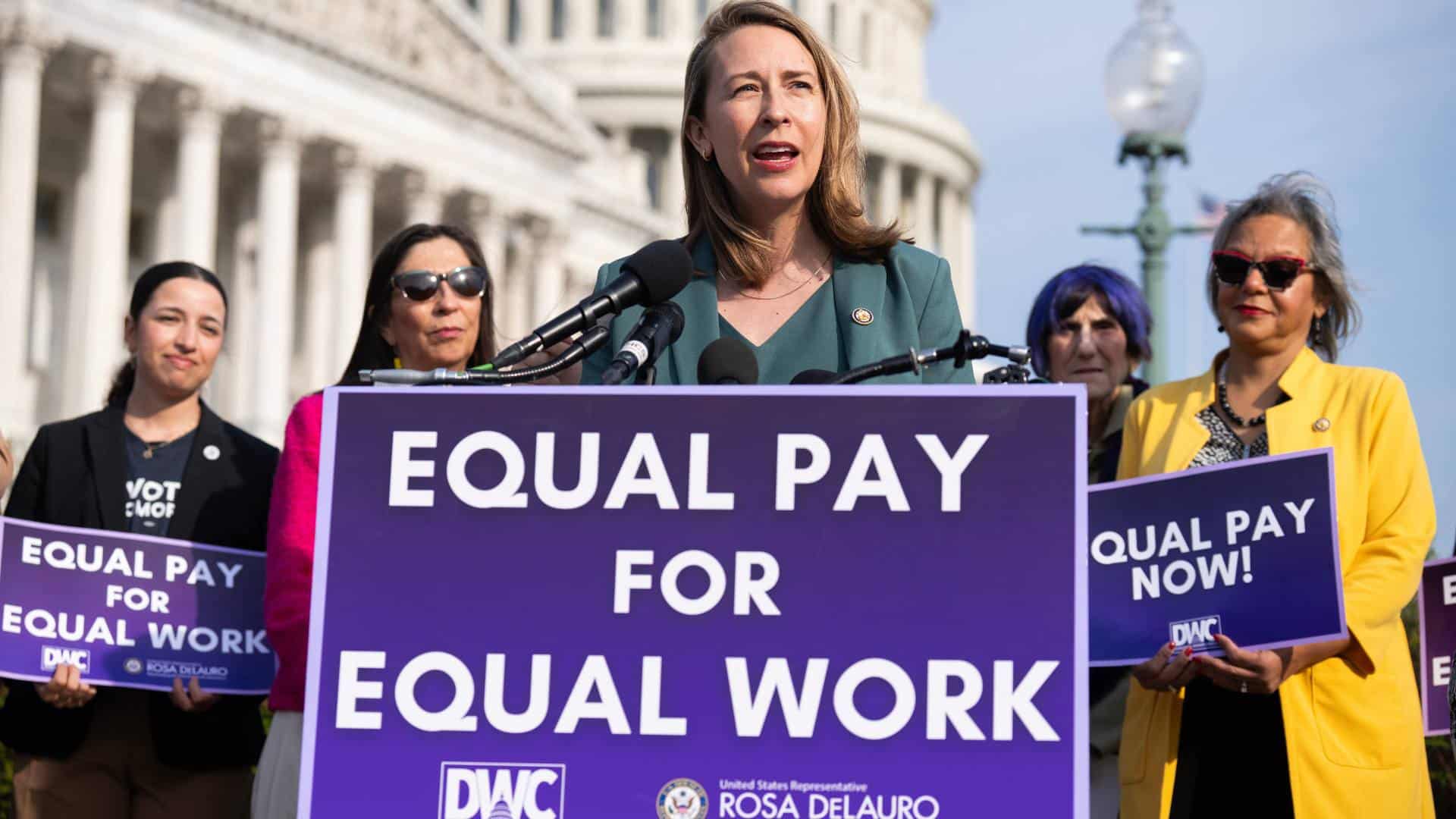
U.S. Representative Hillary Scholten of Michigan speaks during a news conference outside the U.S. Capitol to call for “equal pay for equal work,” 26 March 2026. (Tom Williams/CQ Roll Call via AP Images)
This article was produced exclusively for News Decoder’s global news service. It is through articles like this that News Decoder strives to provide context to complex global events and issues and teach global awareness through the lens of journalism. Learn how you can incorporate our resources and services into your classroom or educational program.
One August day in the waning months of the first World War, a group of female bus and tram conductors in North West London went on strike.
They had been denied a war bonus granted their male counterparts and decided to walk off the job without the approval of their union.
Within days, they’d been joined by thousands of others and the queues of hot and annoyed passengers grew daily. Finally, 13 days after the strike began, the government gave in to their demands.
It was, arguably, the first successful strike for equal pay but still, sweet as this victory must have seemed, though, at the time, it did not trigger a revolution.
It wasn’t until 1951, following the end of World War Two, that the International Labour Organisation issued the first global call for gender-equal pay.
A global movement for equal pay
The radical-for-its-time 1951 Equal Remuneration Convention obliges ratifying countries to work toward a world where men and women earn the same wages for comparable work. There are now 175 countries that have committed to the agreement.
As of 2025, 98 of the world’s 190 economies had adopted some sort of equal pay legislation. But only 35 of these require companies to report remuneration gaps and impose penalties on those that do not comply.
Even when they are formally employed, women around the world today still earn 20% less than men on average. That doesn’t factor in the injustices in the informal sector, which in developing countries is often dominated by women.
And there are signs that even the halting progress made since 1951 may be slowing.
By many measures, women are doing better than ever before.
Progress made
Women make up 42% of the global workforce, hold 25% of executive posts and 29% of board seats. More than nine in 10 corporate boards now include at least one female director, although just 5.2% are chaired by women.
While there are regional differences, in two-thirds of the world’s nations, as many girls as boys are enrolled in school. And in colleges and universities, female students outnumber male. Women’s sports, meanwhile, are attracting record crowds and revenues after decades of being relegated to the sidelines.
There are women at the helm of the European Central Bank, the European Commission and 29% of the 200 top-ranked universities in the world.
In the past year alone, they have taken command of such institutions as the UK’s Secret Intelligence Service (that’s MI6 to James Bond fans), The Church of England, China’s financial watchdog and the Australian army. While it might be tempting to ask what took so long, these are remarkable milestones.
On the work front, women now run a record 11% of Fortune 500 companies and hold senior leadership roles at 19% of the world’s financial institutions.
Obstacles in the path
Even so, the road to true gender equality looks set to be a long one — many experts say more than a century long — and new speed bumps have begun to appear.
The 2026 Women in Work Index, a gauge of progress toward equality in OECD countries put together by accounting firm PwC, rose at its slowest pace since the pandemic.
In the United States, the Trump administration’s backlash against corporate programs to promote diversity, equity and inclusion (DEI) has prompted some companies and institutions to rebrand or scrap policies designed to support the progress of women and other disadvantaged groups.
This pullback has come despite evidence that companies with more diverse leadership have happier workforces and are more financially successful.
“The rolling back of DEI programs denotes a reinforcing of male cultures in organisations — in my view this is the most important negative aspect — and this could really impact women’s position in organisations,” said Shireen Kanji, an honorary professor and an expert in workplace and social inequality at Brunel University in London.
Half-hearted effort for full pay
Only half the companies surveyed in Women in the Workplace 2025, an annual reality check by consultancy McKinsey and women’s advocacy group LeanIn.org, said they were making a special effort to promote career advancement for women.
The report also cited another worrying trend: women in the poll for the first time showed less appetite for promotion than men.
According to the latest U.S. Census Bureau data, the national gender pay gap widened in 2023 and 2024: the first two-year downtrend since tracking began in the 1960s.
The DEI backlash isn’t the biggest obstacle facing working women, just the latest. Cultural and structural barriers have littered their paths to success from the start.
Women carry the majority of responsibility for caring for children, the ill and the elderly. This forces many to take career breaks and curtails the hours they can work, which not only hampers their rise up the corporate food chain, it reduces how much they save for retirement.
While that may seem a distant problem, it is worth noting that in the UK, the gap between male and female pension savings begins to open as young as 28.
Pulling two jobs
In part because of their caregiving responsibilities, women are often trapped in lower-wage and part-time work and receive less career backing from higher-ups.
And while they are making inroads into senior management, female senior executives are still more the exception than the rule. Remember, if 11% of Fortune 500 companies have women CEOs, that means 89% are run by men.
Cultural, societal or, in some countries, religious barriers can also make it hard to get ahead.
Even when they strike out on their own, women face an uphill battle. Globally, all-women teams who set up companies receive only about 2% of available investment capital. Yet studies have repeatedly shown that women-led companies deliver more bang for the investment dollar.
One thing that seems to play a role is unconscious bias — unintentional preference or stereotyping by well-intentioned people. In one London School of Economics study, investors were found to favor proposals from male-run teams over female ones, even when their pitches were identical.
Trouble with advancing tech
The final barrier is one posed by the newest technology on the block: artificial intelligence.
AI poses a three-pronged threat to working women. First, they hold most of the clerical and administrative jobs at risk of AI-driven automation. Second, they are underrepresented in science and technology, where AI is expected to create rather than destroy jobs.
Finally, there is evidence that AI systems that increasingly guide hiring decisions are being tainted by the very biases women have been working for years to overcome.
Yes, there is a lot to overcome. But today’s women are not facing this alone. Generations of advocates — both male and female — have worked for more than a century to raise awareness and build unstoppable momentum toward gender equity.
The world abounds with private- and public-sector programs designed to support women innovators and entrepreneurs.
All benefit when pay is equal.
Increasingly, advocates are also changing the narrative, reminding the world that equity is an economic good, not just a moral one.
The World Bank estimates that erasing gender employment and entrepreneurial disparities could boost global gross domestic product by as much as 20%.
Women executives are making a difference too. A recent analysis from Corporate Women Directors International found that companies run by women have significantly more diverse leadership teams and boards.
Brunel’s Kanji points out that many companies in the UK and EU are holding fast to their diversity programmes, as are some multinationals.
There is more that corporations can and should do, however. They should acknowledge and correct workplace norms that disadvantage or exclude women, such as after-hours meetings and informal networks that help men get ahead.
Changing the paradigm
To help talented women with care-giving responsibilities stay in the game, companies can introduce job-sharing and make higher-grade jobs available on a part-time basis.
Women have power. Where possible, they should capitalise on government or corporate offers of training to upgrade their skills. Enrolling in STEM programs, particularly in fields driving innovation, can help future-proof their careers and put them in line for higher pay.
And like the Willesden bus and tram conductors, every woman, young or old, should be ready to speak out whereever and whenever they perceive injustice.
As UN Secretary-General António Guterres told the 70th Commission on the Status of Women in March of this year: “Not a single step forward for women’s rights has ever been given. It has been won. Won by generations of women and girls, advocates and activists, community leaders and justice seekers. Won by you.”
Questions to consider:
1. Why in most places do women earn less than men for the same job?
2. Why might it be in a corporation’s own interest to work towards gender equality?
3. Can you think of a time when you felt that someone was treated better than you for seemingly no reason?

Sarah Edmonds is a former Reuters journalist who has worked in seven countries on three continents, variously as a financial markets and economics correspondent, news editor, bureau chief and news operations manager.
Read more News Decoder articles about economics:
Sarah Edmonds does great work…. Watch for her novel, coming out in January…