
To really understand the world you have to go out in it. Sometimes that means traveling far and telling the stories you find to the people back home.
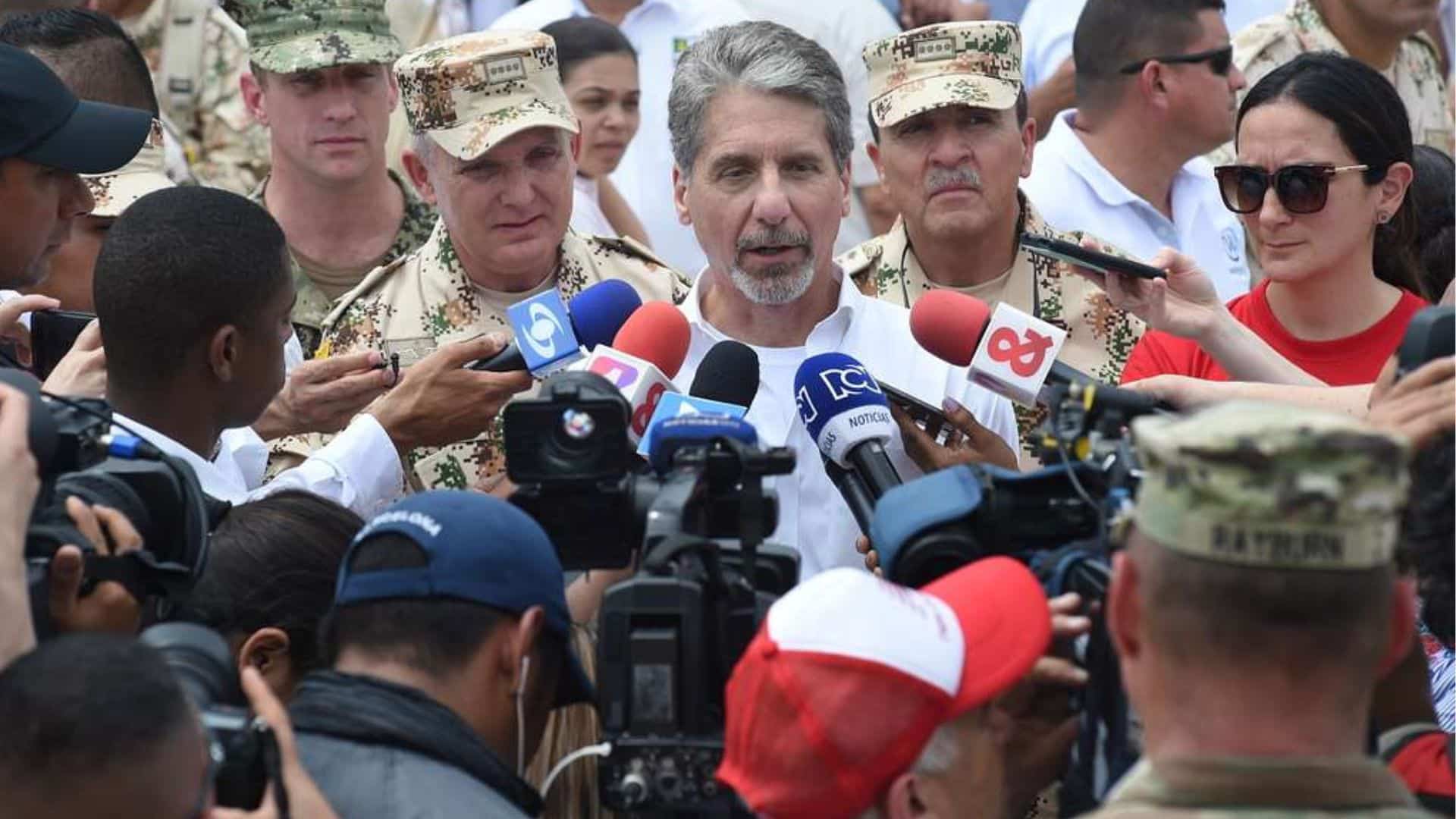
Members of the press corps surround U.S. Ambassador to Colombia Kevin Whitaker at the completion of a project to provide water to La Guajira, Colombia, 3 October 2018. (U.S. Navy photo by Mass Communication Specialist 1st Class Grant P. Ammon)
This article was produced exclusively for News Decoder’s global news service. It is through articles like this that News Decoder strives to provide context to complex global events and issues and teach global awareness through the lens of journalism. Learn how you can incorporate our resources and services into your classroom or educational program.
News Decoder, now 11 years old, is premised partly on the notion that to be a true global citizen — tolerant, empathetic, broad-minded, keen to pinpoint solutions to problems — one can learn a great deal from foreign correspondents.
That’s because the best foreign correspondents embrace the world in a way that enables them to feel at home just about anywhere. They are adventuresome, gregarious and quick to spot problems but careful not to jump to conclusions.
Their eagerness to get out and about, to see things at firsthand, to speak to people with differing viewpoints and from vastly different backgrounds can appear old fashioned in a high-speed age of digital tools and artificial intelligence.
But no social media platform or large language model can do what an experienced foreign correspondent does: push the boundaries of knowledge that otherwise remains hidden behind borders, stereotypes, ethnic animosity and geopolitical conflict.
I contacted five experienced News Decoder correspondents, past and present, to learn more about what motivates them and what they have learned in their international careers.
For them, there was no single, tried and true path to the profession. But they all drew strikingly similar lessons from their experiences — lessons that are still relevant in the digital age, with AI looming over us and speed at a premium.
Why report abroad?
David Schlesinger started his journey, which led to his being editor-in-chief of the Reuters news service, while poring over ancient Taoist texts in a graduate seminar.
“I didn’t have the patience or tolerance for long, endless pondering of imponderables,” Schlesinger said. “I needed closure. I needed to use my knowledge of China and Chinese in something more immediate, more tangible.”
So he screwed up his courage and submitted a reworked academic paper on Chinese politics to the Far Eastern Economic Review. To his surprise, the highly-regarded magazine published his piece and sent him a check.
“In that instant, I had a clip, money and a new profession,” he said.
Bernd Debusmann, who has reported from more than 100 countries and was shot twice in the course of his work, wanted to emulate Austro-Hungarian journalist Egon Erwin Kisch and, later, Ernest Hemingway.
Wanting to witness world events
Tom Heneghan, who roamed the world for four decades at Reuters, “wanted to know how the world worked, but didn’t know how.” During a year studying in Germany in 1972, as events shook that country and his native United States, he took to reading the International Herald Tribune in a local store — which eventually banned him from entry.
“‘You always look at the American newspaper but never buy it,’ the man at the cash register said,” Heneghan said. “It was clear to me what I was interested in and I decided then and there to be a foreign correspondent.”
The lessons the correspondents learned share more similarities than their divergent paths to the profession. Several underscored the importance of getting out to witness events in person and to speak to people.
“I once had an editor on a local paper who would berate anyone sitting around in the office without some good excuse,” said Harvey Morris, who at different times worked for British news organizations Reuters, The Independent and the Financial Times. “He said you wouldn’t find any stories there, so we should get out on the street and meet people. Better advice than ever in an era when we’re chained to our computers. Getting out and about is the best training for a journalist.”
Most of Debusmann’s posts pre-dated the age of 24/7 connectivity, search engines and smartphones. “Which made face-to-face contact with sources essential and taught me the importance of talking to as many people as possible on either side of a war or conflict,” he said. “Telephone interviews tended to yield less information than personal conversations. This still holds true, but there has been a growing tendency to google or use ChatGPT.”
Mingling with a mix of people
Alan Wheatley, former global economics editor at Reuters, said his career taught him to be open-minded. “To that end, you need to research as much as you can and speak to as many people as you can,” he said.
Tiziana Barghini, who during two decades at Reuters reported on popes, mobsters, fraud and political crises, said she learned it is important to mingle with those of different cultures and to make local friends. “If you do not love them, it is difficult and almost impossible to understand them.”
Here’s how Morris put it: “Human beings are eerily similar despite the apparent differences. Treating people with the same politeness and understanding that you would in your home country will get you a long way.”
Schlesinger learned that as a foreign correspondent, he could delve deeply into a subject, as he did at graduate school, while addressing a global audience. “It is possible to know as much as you can about a subject and write it quickly for an audience larger than the narrow community of scholars,” he said.
How do the lessons Debusmann learned traveling the world as a foreign correspondent relate to News Decoder’s mission to help young people become better global citizens?
“News Decoder’s mission of producing authoritative, insightful stories is difficult to achieve if your material is largely based on information culled from the internet,” Debusmann said. “Go out and talk to people!”
Questions to consider:
1. According to the story, what is the best training for a journalist?
2. How can human beings be “eerily similar despite the apparent differences”?
3. Imagine you are a foreign correspondent. What story would you tell to people in another country about the place you live now?

Nelson Graves is the founder of News Decoder. A dual American-French citizen, he has worked as a foreign correspondent and educator on three continents. Recently he published a memoir entitled “Willful Wanderer”. He lives in France.