
For the people who live on a central Indonesian island, rising sea levels aren’t theoretical. Constant flooding has washed away homes, communities and livelihoods.
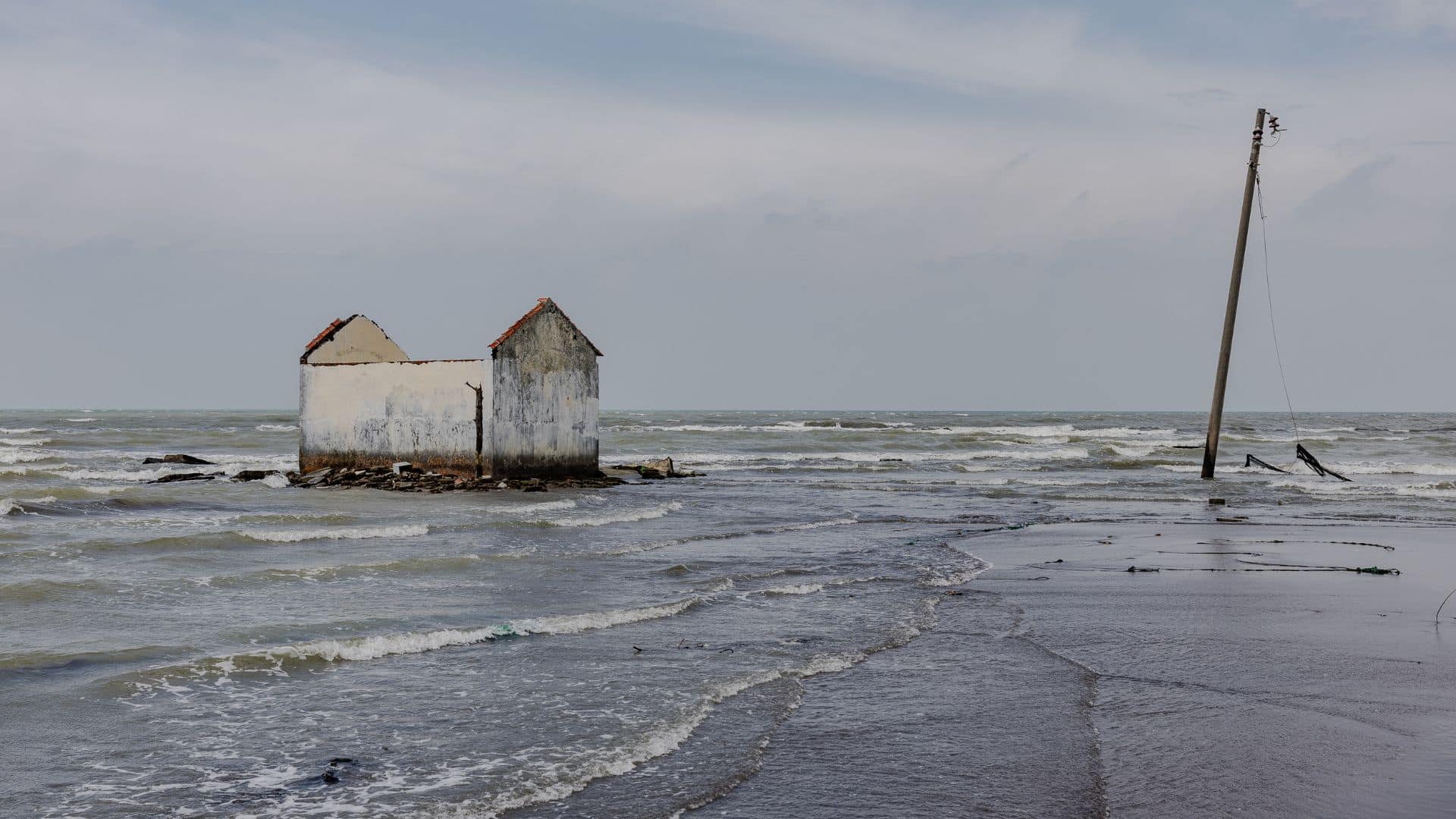
A house that sank due to rising sea levels and was abandoned by residents in Simonet village, Pekalongan, Central Java, Indonesia, 4 February 2026. (Photo by Garry Lotulung)
This article was produced exclusively for News Decoder’s global news service. It is through articles like this that News Decoder strives to provide context to complex global events and issues and teach global awareness through the lens of journalism. Learn how you can incorporate our resources and services into your classroom or educational program.
At age 65, Latifah sits on the terrace of her house in the quiet village of Bogorame in Central Java, Indonesia, one afternoon in late January, watching the current in the river in front of her home getting stronger.
“Recently the water has been rising quite fast, but fortunately it is not as high as it was two weeks ago,” she said, pointing to flood stains on the wall that reached knee height during the last major inundation and soaked her bed.
Seawater begins flooding the road in the late afternoon and lingers until the following morning. In bad weather, the water will enter houses and remain there for days.
Inside, Latifah must walk slowly while lowering her head to avoid hitting the ceiling. “It used to be around four meters high,” she said. “We lived comfortably until the first tidal flood came in the mid-2000s and began gradually eroding my home and others in the village.”
She has moved her belongings and clothes to the top shelves of her wardrobe to keep them dry. Neighbors helped raise parts of the house.
Encircled by the sea by Garry Lotulung by News Decoder
School submersion
Five minutes’ walk from Latifah’s house is an Islamic boarding school partially submerged in water. The bamboo bridge that serves as the only access from the village road to the school has broken in the middle.
Sa’dullah, 74, who lives across the road in an elevated house, has served as a teacher and administrator at the school since it was first established in 1974.
“It has been almost a week since the school was forced to close because the bridge access was cut off,” he said.
“I still remember that in its first year, the school accommodated 185 students,” Sa’dullah said. “Now there are only about 27 students left, with five teachers including myself.”
The only remaining road that can still be used runs directly along the sea and begins flooding with strong waves every afternoon until the following morning — posing serious risks for anyone unaccustomed to crossing it, as the surface is covered with sharp, slippery stones. The disaster does not follow a predictable seasonal pattern.
Staying above water
During droughts, tidal surges can become even more intense. During the rainy season, tidal floods mix with rainwater, producing even greater inundation.
Half an hour from Bogorame, Rohimah chewed betelnut by what used to be the back door of her late sister’s house — now the main entrance — in Sriwulan Village. The road in front of the house has disappeared.
“Seawater began entering the inland areas of Sriwulan when large-scale housing developments in West and North Semarang expanded rapidly in the 1990s,” Rohimah said.
Much of the house is partially submerged, though some rooms — such as the kitchen and one bedroom — have been elevated so they remain usable.
She refuses to leave, despite repeated requests from her son Nurhadi, 43, who now lives with his own family directly across from her.
The 70-year-old woman insists on caring for her late sister’s home. “The most difficult time is when it rains, because the water rises higher and the air feels colder,” Rohimah said. “Sometimes my legs feel stiff when I walk.”
Communities washed away
Sriwulan, Bogorame and other villages and hamlets in Sayung District along the coast of Java stand as stark examples of how climate change has intensified the impact of rising sea levels in recent decades.
Thousands of residents have witnessed firsthand how vast stretches of land once covered with green rice fields have gradually turned into open sea over the past 30 years.
Research conducted by Gadjah Mada University (UGM) estimated that tidal flooding in Demak last year reached as high as 1.63 meters (64 inches). This situation is compounded by a significant rate of land subsidence — when land settles or sinks — in the same area, measured at approximately 0.06 to 1.15 meters (2.4 to 45 inches) per year.
This trend has contributed to the loss of mangrove forest cover in the region, a process that has been ongoing since 2000 — corroborated by data from Wetlands International, which shows that nearly 80% of the area’s original mangrove forests have disappeared.
Damage increased sharply within a single year, 2011-12, when mangrove degradation rose by 14%, with the coastline retreating up to two kilometers from its original boundary.
Raising homes
The consequences have been profound. Many villagers have abandoned their homes taking with them whatever memories and belongings they can salvage to higher, safer ground. A small proportion remain, largely because their limited incomes are insufficient to afford even basic housing in less vulnerable areas.
Residents who choose to remain must periodically elevate their homes with soil and cement in order to keep the interiors dry. Nurhadi has raised the house where his mother now lives twice.
“Every five years, residents here raise their houses by at least one meter,” Nurhadi said. “It feels strange — we are like tenants on our own land. Of course, we would move if circumstances allowed.”
In Timbulsloko, for the past eight years, the entire two-kilometer stretch of road through the hamlet has been rebuilt using wood and bamboo, replacing the asphalt road that became permanently submerged when the tides stopped receding.
The only remaining sand road serves as the entrance from the main village highway to the first house, which also functions as the village gate. This sand road doubles as a makeshift embankment to prevent tidal water from spreading further inland. However, it frequently collapses, unable to withstand the persistent flooding.
Government help is limited.
The bamboo road also connects Timbulsloko to a public cemetery located just behind the remaining settlements. As the Muslim holy month of Ramadan approaches, residents visit the burial complex — raised five times over the years — to perform pilgrimage rituals and pray for their ancestors. Some rely on a dead tree standing at the edge of the cemetery as a marker to locate their family graves.
The bamboo walkway providing access is frequently submerged by tidal floods. Yet for the community, the graves serve as a vital link between the living and their family histories.
“We are grateful that this cemetery can still be elevated, so we are able to pray for them in person,” said Sonhaji, a resident of Timbulsloko.
Adaptation efforts extend beyond road access. Beginning in 2024, the Central Java provincial government iintroduced floating houses for residents in Timbulsloko affected by tidal flooding, each valued at approximately Rp 50 million (around US $3000).
Targeting 111 households, these homes are constructed on plastic barrels that function as flotation devices, using a combination of concrete and glass-reinforced concrete designed to be lightweight yet durable. The design allows the structures to rise and fall with water levels.
Even so, the lifespan of these floating houses is estimated at only 10 years.
Pumping the water
The help has also extended to basic utilities such as electricity and water management. At the end of last year, the Central Java provincial government began operating a solar-powered water pump system in Sayung, Demak, with a total capacity of 2 x 125 liters per second.
The system is supported by 74 solar panels with a combined capacity of 66 kilowatt-peak, representing an investment of Rp 1.4 billion (approximately US$90,000). The project is described as an efficient and environmentally-friendly initiative. Several organizations have also donated solar panels directly to affected communities.
For Wanto, however, stricter quality control is necessary to ensure optimal performance. He noted that some panels fail to generate electricity due to poor quality, while others become completely unusable.
At the same time, local initiatives have emerged. Since 2000, Pasijah, 56, has worked to protect her home in Rejosari Senik Hamlet by planting mangroves — long before tidal flooding permanently submerged the area that once housed around 200 families.
She recognized that flooding was becoming more frequent and saw rice and corn fields turn into ponds before disappearing entirely. The mangrove seedlings she planted slowly began to grow, but the sea did not allow enough time for other residents to follow her example. Many chose to leave.
Ceding the land to the water
The first major exodus occurred between 2006 and 2007, when seawater permanently inundated the village. Residents lost road access to Semarang and surrounding areas and eventually requested relocation.
But Pasijah and her family continued planting and maintaining their home as best they could. Today, her house is the only one that remains standing and inhabited.
Sometimes, her husband and son help her collect mangrove seedlings but they require sufficient time to mature. She said that they planted around 15,000 seedlings in 2021, for example. “The next morning, when I checked, they had all been washed away by the waves,” Pasijah said. “It took an entire day to plant them.”
A similar collective effort has taken place in Sriwulan, where Maryati, 56, mobilized her neighbors to plant sea pine and mangroves around the village. Cypress seedlings have also been planted along the village road, which was recently reconnected after being cut off last December due to tidal flooding and continuous rainfall.
She understands that similar or even more severe conditions may occur again if no vegetation is present to slow the force of the currents.
Planting trees
Similar initiatives have been undertaken by various institutions, including government agencies, which have repeatedly planted erosion-resistant vegetation along affected coastlines.
Mangrove restoration is often presented as a solution, but it does not automatically resolve tidal flooding. Susan Herawati, secretary general of the People’s Coalition for Fisheries Justice, said that each area faces distinct causes of tidal flooding that must first be properly identified.
“We need to reassess governance and spatial planning in these areas,” she said.
Without long-term commitment, restoration efforts risk becoming unsustainable. Mangroves and other coastal vegetation require ongoing maintenance and monitoring. Additionally, erosion and shifting soil conditions in coastal zones can hinder plant growth and survival, further complicating recovery efforts.
Land along the northern coast of Central Java is projected to shrink significantly by 2030 due to a combination of coastal abrasion, soil erosion and climate-related disasters.
Meanwhile, the people of Central Java struggle to survive day by day. Back in Bogorame, the flooding has also gradually washed away Latifah’s livelihood.
In the past, she would cycle 10 kilometers to Sayung Market at midnight to purchase fresh fish to sell. But the fastest route connecting the hamlet to Sayung has been submerged and impassable for the past three years. Now, she depends on money sent by her children who have migrated to other villages and cities. One of them once asked her to move in, but she did not want to become a burden.
“Actually, I still feel strong enough to cycle and sell fish every day, but the journey is now much longer because I have to detour through the next village and pass the Semarang–Demak highway,” Latifah said. “Large vehicles such as trucks and buses travel very fast there. Perhaps that is why my children no longer allow me to go — the risk is simply too high.”
Questions to consider:
1. Who is at risk when climate changes causes seawaters to rise?
2. What are some things the people of Central Java are doing in response to rising sea levels?
3. How has climate change affected the cities and communities where you live?

Garry Lotulung is a freelance photojournalist and documentary photographer based in Jakarta. Lotulung has specialized in stories about the human condition, social change and environmental crises. Lotulung joined the international news agency Anadolu Agency in 2022 and has been a regular contributor and stringer since.