
Are online trends that get people to adopt customs and traditions from other countries appropriate, or is it appropriation?
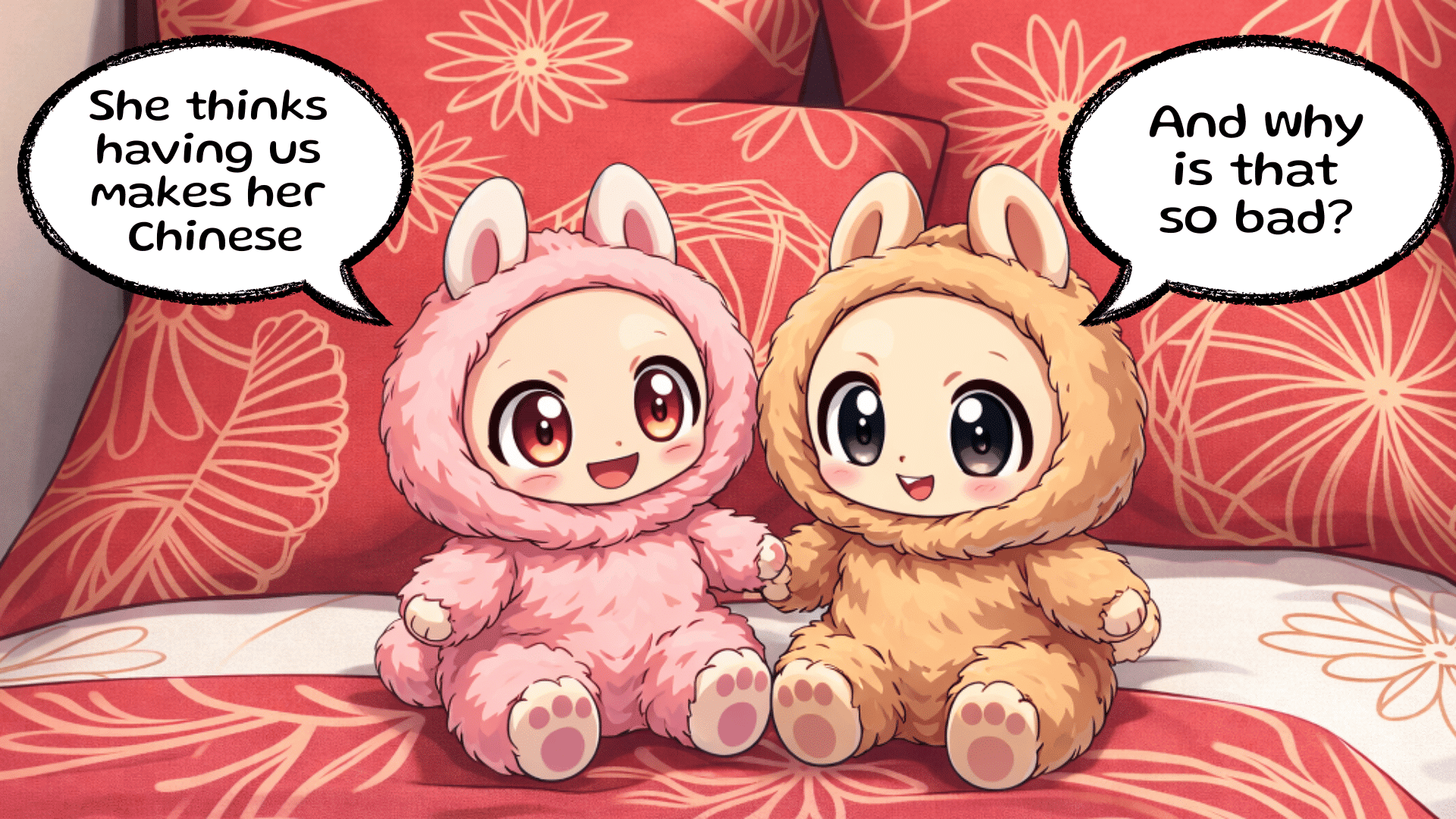
Two Labubu dolls discuss the China-maxxing trend. (Illustration by News Decoder)
Approach a boba or bubble tea vendor in just about any city in the Western world and you’ll find endless options. These are drinks that originally belonged to Taiwanese and Chinese culture but have been transformed and realigned to attract Western tastes with flavors like Biscoff, banana toffee, strawberry or Oreo slush,
Even within Southeast Asia, cuisine items such as bubble tea have been modified and specialised towards Western audiences and tourists; drinks topped with marshmallow fluff and M&Ms and dumplings filled with chocolate lava instead of meat.
International exchange of cultures is hardly new, but over the last couple years, online platforms have propelled certain Eastern customs across Western culture.
As markets globalise, so do cultures, with shifts in both appreciation and appropriation. Now, people in the United States and Europe seem fascinated and excited about Chinese culture and products, under the online movement of ‘China-maxxing.’
It is one of the latest Internet trends popularising aspects of Chinese culture, with social media users ‘maximising’ their interactions with Chinese culture. From Labubus — a plush toy sold by Chinese retailer Pop Mart — to bubble tea, mahjong and even seven-floor clubs with a different theme on each level, the internet has exploded with global enthusiasm for Chinese commodities and participation in Chinese ‘lifestyles’.
Cultural power
So what effect have these trends had on China’s international power?
Chinese influencers such as Sherry Zhu on TikTok began the trend in 2025, prescribing Chinese lifestyle habits to Western audiences and declaring, “If this video has shown up on your feed, you’re now Chinese.”
Westerners have been encouraged to try Chinese Internet-prescribed habits and share them, by drinking apple-boiled water, for example, or wearing slippers indoors or using the Chinese healing technique known as gua sha. By posting proof of participation under captions such as “I’m China-maxxing” or “You’ve met me at a very Chinese time in my life”, this increases the exposure of lesser-known cultural practices.
Interested in learning more about the trend from an analytical perspective, I connected with journalist Yawen Xu of the China Global Television Network by email. Born and raised in Xi’an and currently based in Beijing, Xu has long watched China’s political, cultural, economic and social activity.
“On one level, it fits perfectly into meme culture and online youth communities,” Xu said. “But beneath the humour, there is something more meaningful: many young people in the West are looking for healthier, less stressful and more convenient ways of living.”
Crossing cultures
Xu describes social media trends such as China-maxxing as a “low-barrier entry point” for cross-cultural understanding — a way to casually introduce foreigners to Chinese culture. This can stimulate initial interest to encourage further cultural exploration.
Other experts we spoke to were more skeptical about long-term cultural impacts. I spoke to one China analyst based in Europe, for example, who said it shows a superficial appreciation; that people don’t really understand much about modern China.
Many who do have a deep appreciation for Chinese culture believe that China-maxxing has led to a simplification or misrepresentation, where individuals who are not ethnically Chinese might adopt a few habits such as drinking hot-apple water first thing in the morning, or using a gua sha, and then call themselves “Chinese”.
Some believe that this has given cultural values that have developed over thousands of years the appearance of a micro-trend, to be temporarily entertaining and then dismissed.
When Chinese and Taiwanese cuisine items become popular and are taken up by Western-based producers and customised to Western palates, they often lack financial connections to China and do little to promote authentic culture.
Serious appreciation or superficiality?
Xu acknowledged that short-form viral content often simplifies culture. “Social media favors quick, visual and easily digestible messages, which means the deeper historical background and philosophical meaning behind certain Chinese traditions can sometimes be overlooked,” she said.
But superficiality isn’t necessarily a bad thing. “For many young people, a 30-second video can be the first moment of curiosity,” Xu said.
Foreignised Chinese cuisine provides little direct economic benefit to China. Habits such as the wearing of house slippers or drinking hot water aren’t marketable and offer little political or financial benefits to China other than providing cultural exposure.
However, the trend has also promoted consumption of Chinese commodities and themed products, such as with the Tang jacket by sportswear company Adidas, which fused Chinese-style design elements such as pankou knot closures with streetwear functionality.
Originally a limited-edition product selectively sold in China and Taiwan, global virality led to continued sale and movement to stores in the United States and Europe. Initially retailing in China for the equivalent of around $133, popularity and hype led to massive price inflation by resellers.
The popularity of Chinese brands
Other examples of Internet-popularised Chinese products include the plush toy Labubu. The Wall Street Journal reported that by the end of 2025 Pop Mart boasted a total revenue of around 37.12 billion yuan — the equivalent of around $5.4 billion, 38% of which came from its “Monsters” collection, under which Labubus reside.
Overseas markets contributed to more than 40% of that total revenue. Internet trends have brought Chinese-based brands both exposure and direct revenue. That’s one way in which they might be viewed as increasing China’s power.
Even for those who are not actively participating in China-maxxing, trends have helped increase the general popularity across the West of Chinese brands such as Temu, Shein and Taobao.
Although they had firmly established their presence before China-maxxing, the recent popularity of specific Chinese goods creates greater demand and thus exposure for Chinese online shopping channels.
Some critics of China-maxxing acknowledge that while the economic benefits feeding back to China might not be significant, China benefits by improving its public image among a Western public that has long seen China as a villain.
In that way it is part of a larger effort by China to rebrand itself.
A more welcoming China
China now allows tourists from 50 eligible countries to enter without a visa. This, said Xu, allows people to experience the real China.
“Global audiences bypass Western media’s biased filter and access real, vivid snapshots of modern China’s infrastructure, urban development and ordinary civilian life through short-video platforms,” Xu said. “This kind of people-to-people exchange provides a more diverse and multifaceted picture of China.”
China’s visa waivers increase the number of people travelling to China, at a time when the United States and Europe are making travel and immigration more difficult.
Even if China has gained little economic benefit from the growth of its increasing cultural Internet popularity, has China-maxxing provided significant political benefits?
Trends promoting Chinese culture feature against a backdrop of increasing disillusionment with the West, particularly the United States.
The soft power of social trends
A temporary nationwide ban on social media platform TikTok in the United States in 2024 led to a rush of rebellious “TikTok refugees” to Xiaohongshu, known in English as RedNote, which is a platform even more centrally Chinese.
Some have interpreted the ‘China-maxxing’ trend to be a message of public disillusionment against Western socio-political difficulties and developed, issued by Western social media.
The cultural analyst I spoke to linked China’s Internet strategy to “soft power” — ways that powerful nations use foreign aid and diplomacy to create a reputation for world leadership and gain international allies.
Xu suggested that the China-maxxing trend and its encouragement of cultural exchange might be a road towards healthier international relationships and less-biased media.
“China-related content attracts readers and, as global companies continue to engage with the Chinese market, media outlets also have an incentive to cover China in a more pragmatic and balanced way,” she said.
She said that China-maxxing won’t fundamentally change those narratives overnight. “What it can do is gradually broaden the conversation by creating more space for nuanced, people-centered and evidence-based reporting on China,” Xu said.
Getting around government messaging
Previously, it was government messaging and mainstream media that shaped interpretations of societies and nations, but now social media and personal online communication systems foster more intimate cultural exchanges that allow individuals to come to more independent conclusions.
“Instead of asking which model [China-maxxing or the American Dream] has ‘won’, perhaps the more meaningful question is what countries can learn from one another to improve people’s everyday lives,” Xu said.
Consider the American YouTuber and live-streamer Darren Jason Watkins, Jr., known as IShowSpeed, or Speed, one of the main public individuals to engage in China-maxxing and promote China’s technological advancements.
Speed conducted month-long tours of China during 2025 with the support of the Chinese government, broadcasting activities and products to Western audiences and his international fanbase, which counts 59 million subscribers on YouTube alone.
During his visit to the city of Shenzhen, he engaged in activities promoting China’s cultural and technological features — driving a flying car, ordering food via a delivery drone, cheering on dancing robots — all the while making comments such as “China’s got it!” and “China’s different!”
He also promoted Chinese luxury products. He purchased and unboxed three Huawei Mate XT trifold flip phones — phones which can be folded into three separate screens — on live-stream, each valued at around 20,000 yuan ($2,950) at the time of the broadcast.
He declared his personal enthusiasm for China’s advancements: “This is the future, right here!”
Questions to consider:
1. Why might some criticise the China-maxxing trend as being superficial?
2. Why do some trend watchers think China-maxxing is a good thing?
3. What internet trends have you participated in and what attracted you to them?

Isabel Wen is a News Decoder summer intern. Having grown up in both England and Taiwan, her interest in global affairs and cultures means she is never in one place for long. Currently studying English Literature in Trinity College Dublin, she will also be studying at Columbia University. She has been exploring different literary programs and organisations from across the world, spanning from Oxford to Amherst to Taipei to the basements of the New York Times. When she’s not hopping around the literary world, her time is otherwise occupied with long hikes or training sessions as a target-shooting athlete.