
Despite their simplicity, memes can both inspire new political voices and reinforce false narratives, and are affecting online discourse around the globe.
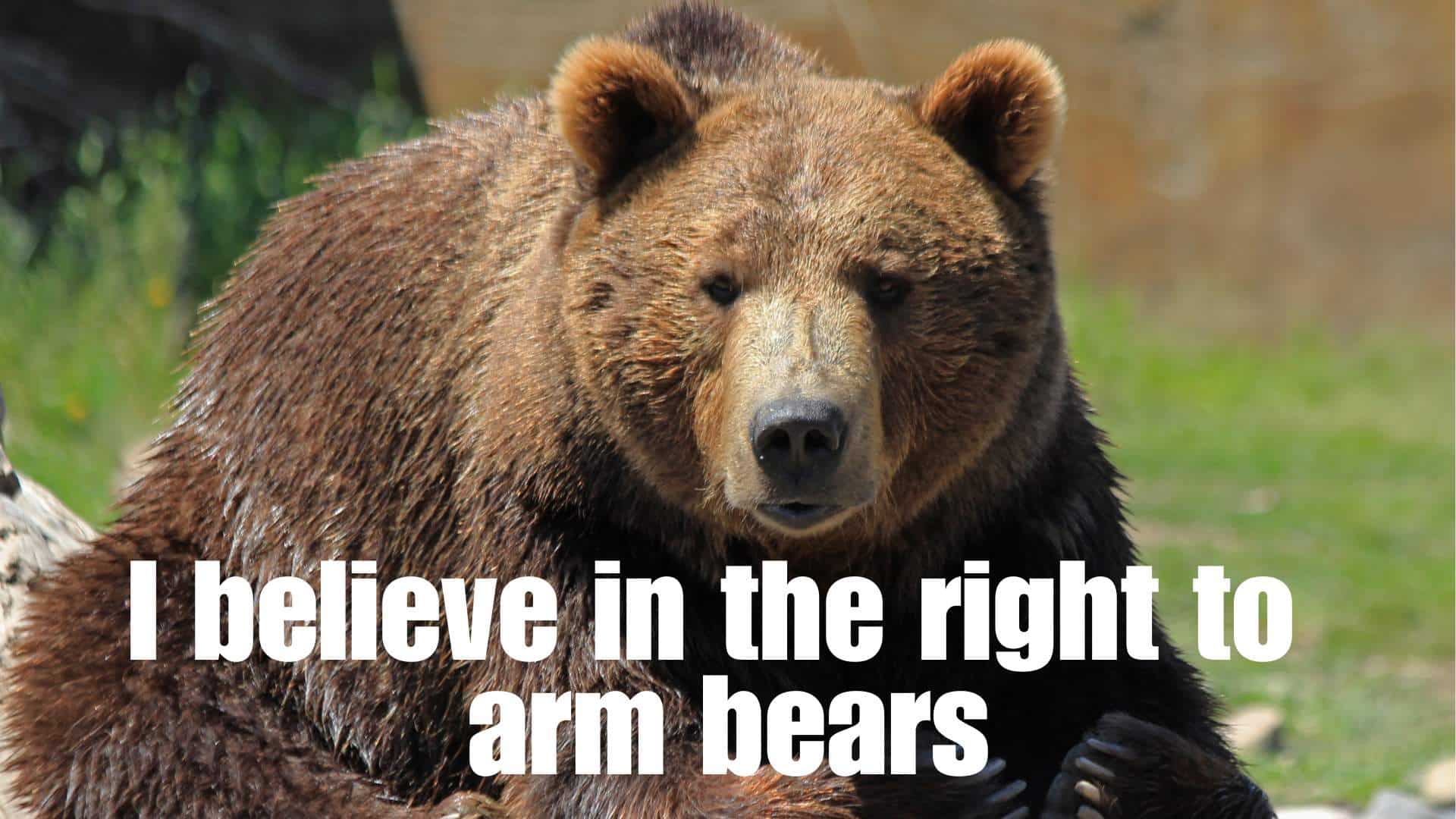
A social media meme that pokes fun at the intense debate over the right to bear arms. (Illustration by News Decoder)
This article was produced out of News Decoder’s school partnership program. Max Martire is a student at the Tatnall School in the United States, a News Decoder partner institution. Learn more about how News Decoder can work with your school.
Those funny political memes that constantly come across your feed when scrolling on social media aren’t only making people laugh: it turns out that they are also spreading across the globe and adding to different kinds of political divisions.
There is one that went viral late last year of U.S. Vice President J.D. Vance with his photo altered so that he had long curly hair and was obese.
As they broaden in scope, political memes like that one are having an effect on online political discourse, not just in the United States but around the globe. Despite their simplicity, they hold the power both to inspire new political voices and reinforce false narratives within ideological echo chambers.
The meme of Vance is a variation of one posted on the White House’s official X page and was exposed to the feeds of over 1.5 million people. Like a fire, political memes generally begin within small communities but often spread, instantly influencing massive populations. I found the Vance meme on the site of the Hindustan Times, a news organization out of New Delhi.
Despite their large presence, it is tricky to define what a meme is. The term “meme” was coined in 1976, but its definition has evolved over time.
Politics and humor
According to a 2025 study by researcher Mohammed Awad AlAfnan at the American University of the Middle East in Kuwait, memes are pieces of easily shareable media that carry ideas and opinions, drawing on short, clever and humorous messaging to communicate the author’s goal in an impactful way.
Even though they may be shunned for lack of substance, political memes are influential in countless ways, allowing for greater political awareness and participation, while simultaneously magnifying divisiveness.
Jennifer Lambe, an associate professor of communication at the University of Delaware, said that memes are powerful. “[They are a] way of reaching people, especially people who are trying to avoid news,” she said.
Memes introduce people to content that they may not have seen and they have created a new wave of people who are not apathetic, but tend to be hands off when it comes to learning about news, Lambe said.
Rosemary Leader is the director of marketing and communications at The Tatnall School in Wilmington, Delaware, where I attend school, so I thought she’d have a take on memes. “Everybody now feels like they have to have an opinion about something,” Leader said, “They have to chime in on something.”
Memes spread.
Memes serve this purpose because of their shareable nature. AlAfnan’s study found that memes are able to simplify complicated topics into understandable bites, bringing politics to a broader audience.
Leader pointed out, however, creators often sensationalize as they push out content to appear up to date with issues. “If it’s not sensationalism, it’s not going to be relevant to people,” Leader said.
This is another significant effect of political memes, as they often dramatize facts to promote an agenda.
This problem is exacerbated by the fact that memes are often shared repeatedly within partisan “echo chambers.” Limited engagement with opposing views heightens polarization and contributes to immense political division.
Lambe pointed out that memes can also be used effectively by hate groups.
Memes can aggravate and agitate.
AlAfnan’s study revealed that this reality leads to memes having tangible impacts on political movements across the country. Comparable to a wildfire in a dry forest, political memes often burn through, aggravate and agitate online groups, serving to heat up our already blazing discord.
Political memes are not just affecting political discussions in the United States. Pakistan, for example, is also experiencing a boom in the use of memes.
According to a 2025 study by researchers in Pakistan, there has been a significant increase in the use of political memes to express opposing viewpoints and resentment because it is legally and socially unacceptable to criticize Pakistan’s political and military powers.
By creating and sharing political memes, younger generations can regain their political power through “collective laughter.”
One Pakistani political meme in the study that I found powerful features a scene set in a fiery countryside. The study notes that the words ‘Be hopeful’ are combined with a calm-looking image of Imran Khan, the former Prime Minister of Pakistan, staying confident in the face of the wall of fire behind him. This meme, the study notes, represents destruction and catastrophe and encapsulates a form of resistance, as it is not overtly condemning policy but merely calling for unity.
Even though memes can be analogous to a fire at times, fire is not always harmful. Fire can be used to sustain life in times of dire need and can strengthen ecosystems in the case of controlled burns. In Pakistan, political memes might be playing a similarly energizing role.
Memes can misinform.
But due to their easily shareable nature, political memes can also be potent pathways for misinformation.
Many people have questioned whether social media platforms can and should regulate content, but it is difficult to force corporations like Meta or X to do so, particularly when it comes to memes.
Lambe said that in the United States, the regulation of Internet service providers is guided by something called Section 230 of the 1996 Communications Decency Act.
“What it says is that Internet platforms can’t be held legally responsible for things that are posted on their platforms,” Lambe said.
It is hard to find an aspect of online culture as widespread as political memes. Rife with humor and wit while being easily shareable, memes are beginning to change the way people interact with politics around the globe. Stirring emotions within audiences across the political spectrum, memes will undoubtedly remain an integral part of global discourse for years to come.
Questions to consider:
1. What makes an image a meme?
2. How can a meme be informative and how can it spread misinformation?
3. Describe something you have seen or created on social media that could be considered a meme.

Max Martire is in his final year at the Tatnall School in Wilmington, Delaware, in the United States. He will be attending the University of Michigan next year, where he will compete in track and field. Max loves weightlifting, watching sports and solving Rubik’s Cubes, and has a passion for science and math.