
You scream for your team and nation during the game. But when the final whistle blows, it’s time for hugs and handshakes all around.
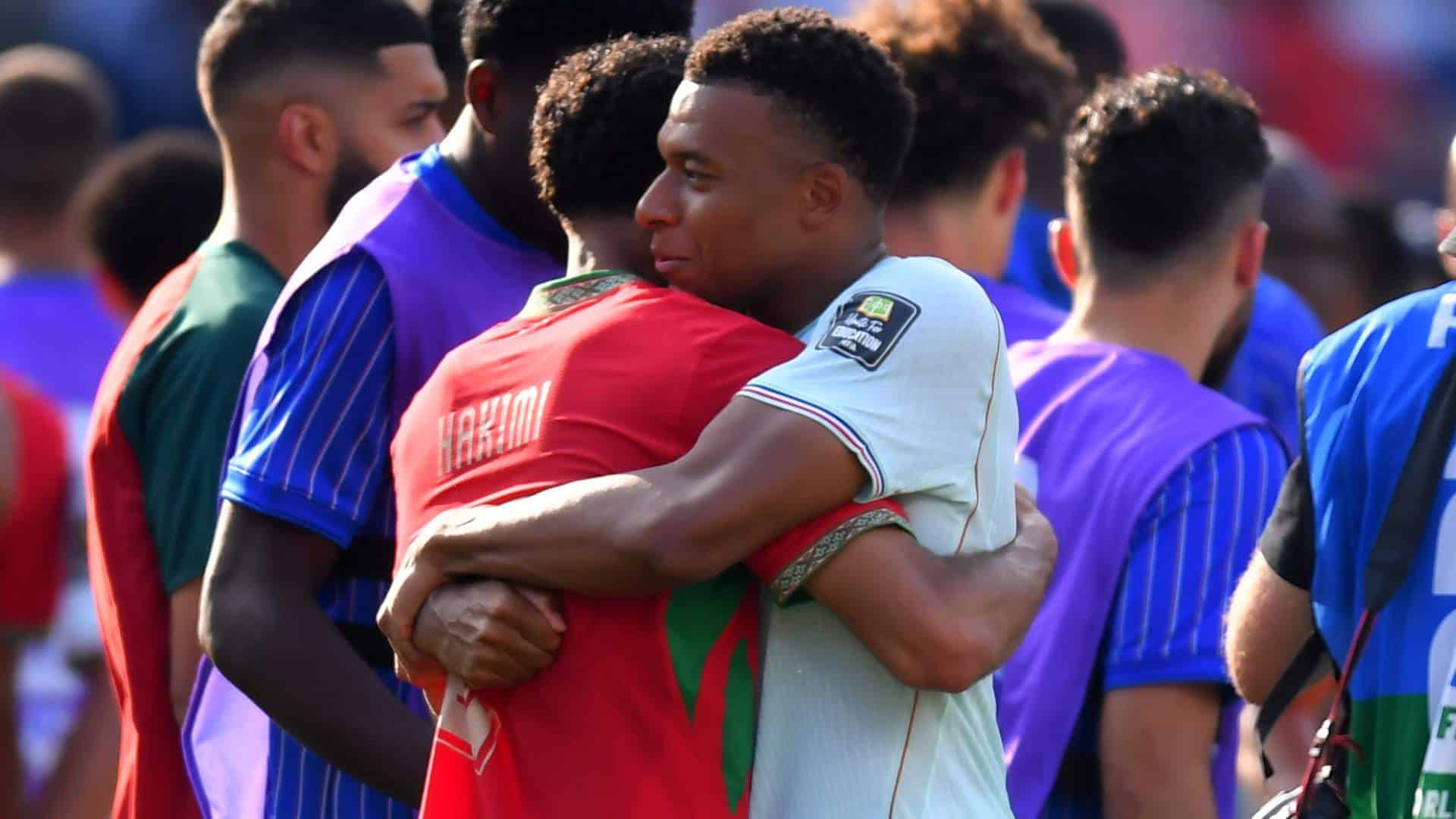
Morocco’s Achraf Hakimi and France’s Kylian Mbappe hug after the soccer World Cup quarter final, 9 July, 2026. (AP Photo/Steven Senne)
Like millions across the globe, I have spent most of my days recently watching nonstop football.
Every four years, the International Federation of Association Football (FIFA) holds one of the most prestigious tournaments on Earth, the World Cup. For the past few weeks, 48 teams have competed in sold-out stadiums across the United States, Canada and Mexico, and somehow, each game feels better than the last.
As a young American, I will admit that I am not the most avid soccer fan. But as recent trends have indicated, more and more Americans are investing in and watching soccer, and this year’s tournament showed that.
To understand what makes the World Cup so captivating, I decided to ask a few friends what it meant to them. The answer is far bigger than a soccer ball.
Rémy Ouahnoun has spent most of his life in the Canadian city of Montreal. I assumed he would cheer for Canada. Instead, his family is Moroccan, and though he was not born there and nor does he speak Arabic, he was supporting the Atlas Lions, Morocco’s national team.
“I don’t fit what the average Moroccan is,” Ouahnoun said. “Not religiously, not linguistically and not looks-wise.”
A sense of belonging
When Morocco beat the Netherlands in a penalty shootout, Rémy jumped and screamed with the Moroccan fans at a Canadian sports bar.
“This made me feel like, hey, this is who I am,” he said. “I do fit into this even if I don’t fit the mold.”
Otto Everke had a similar experience watching the France–Senegal match in New Jersey. In a sea of French fans, Otto and his friend wore Senegal jerseys and found some other Senegalese fans in their section. “Even though we were obviously not Senegalese in any which way, they completely welcomed us into their group,” Everke said.
Even staunch enemies, in the most tense moments, come together during the World Cup. James Hart, who is British, watched the England–Mexico match at his summer camp, surrounded by Mexican staff members.
“Although we were rivals for two hours, we all came together and watched as a collective,” he said. That, he said, is a sentiment the World Cup exemplifies.
The power of music
Uniting all the fans is the music played during warmups, goals and most importantly, the post-match celebrations.
After the United States’ first win, the song that came on was John Denver’s Take Me Home, Country Roads, a classic folk song. Tens of thousands of fans joined in singing together.
For Liat Nahman, who was born and raised in Johannesburg, South Africa, the song that resonated was Shakira’s Waka Waka (This Time For Africa), which South Africa still plays 16 years after it hosted the 2010 World Cup. The song shows pride, unity and encouragement as South Africa unites to support its team, she said.
Everke’s favorite song from the World Cup is “Tage wie diese,” which translates to “days like this”. It was played everywhere when Germany won the World Cup in 2014 and it came back briefly this summer before Germany went home early.
The song, he said, is about how long people have waited for a night like this to happen.
‘The beautiful game.’
If there is one moment that sums up this year’s World Cup for me, it is the ending of the unforgettable England–Mexico match on 5 July.
Though up two goals to one in the 54th minute, the referee handed English defender Jarell Quansah a red card after a high slide tackle. That left England down a man for nearly 50 minutes of the match. The team managed to hold off a nonstop barrage of Mexican attacks, winning in front of 80,000 fans at the Azteca Stadium in Mexico City.
The momentum and the atmosphere was against England the whole time. I was cheering for Mexico.
But then, standing shoulder-to-shoulder, arms around each other and almost in tears, the England players, staff and coaches sang their hearts out to the Oasis hit song Wonderwall to the smaller crowd of English fans. Watching from my couch, rooting against them, I had goosebumps anyway. It was a scene like no other.
To Everke, the World Cup is not just a celebration of differences, but also a celebration that everyone can come together as one group of people, to celebrate the “beautiful game.”
Einav Malka reminded me that, although FIFA’s motto is ‘FIFA unites the world,’ unity comes from people. “Humans unite the world,” Malka said. “The World Cup just gave us the perfect place and the perfect time to do so.”
Einav is right. Nobody needed FIFA’s permission to cheer for their players and teams. But the sight of fans and players balling their eyes out or of sworn enemies hugging each other after the game can only be found at the World Cup.
James Hart called the World Cup the Holy Grail for all. “Small countries wish to qualify, larger nations aim to win it,” he said. “But both are grateful for their opportunity.”
Questions to consider:
1. How can sports bring people together?
2. In what ways does sport evoke out national pride?
3. What sport do you follow most closely and why?

Joshua Glazer first joined News Decoder in 2023 as a student ambassador while studying abroad with School Year Abroad in Zaragoza, Spain. A native New Yorker, he earned his high school diploma from Avenues: The World School, and is pursuing a degree in Economics and a minor in Spanish at Emory University in the U.S. State of Georgia. He is also a staff writer for the Opinion section of Emory’s student newspaper, The Emory Wheel. In his limited free time, you can usually find him on the golf course, blasting country music.