
A new massive exhibition by Chinese dissident artist Ai Weiwei asks us to reflect: What are the costs of mass production and global trade?

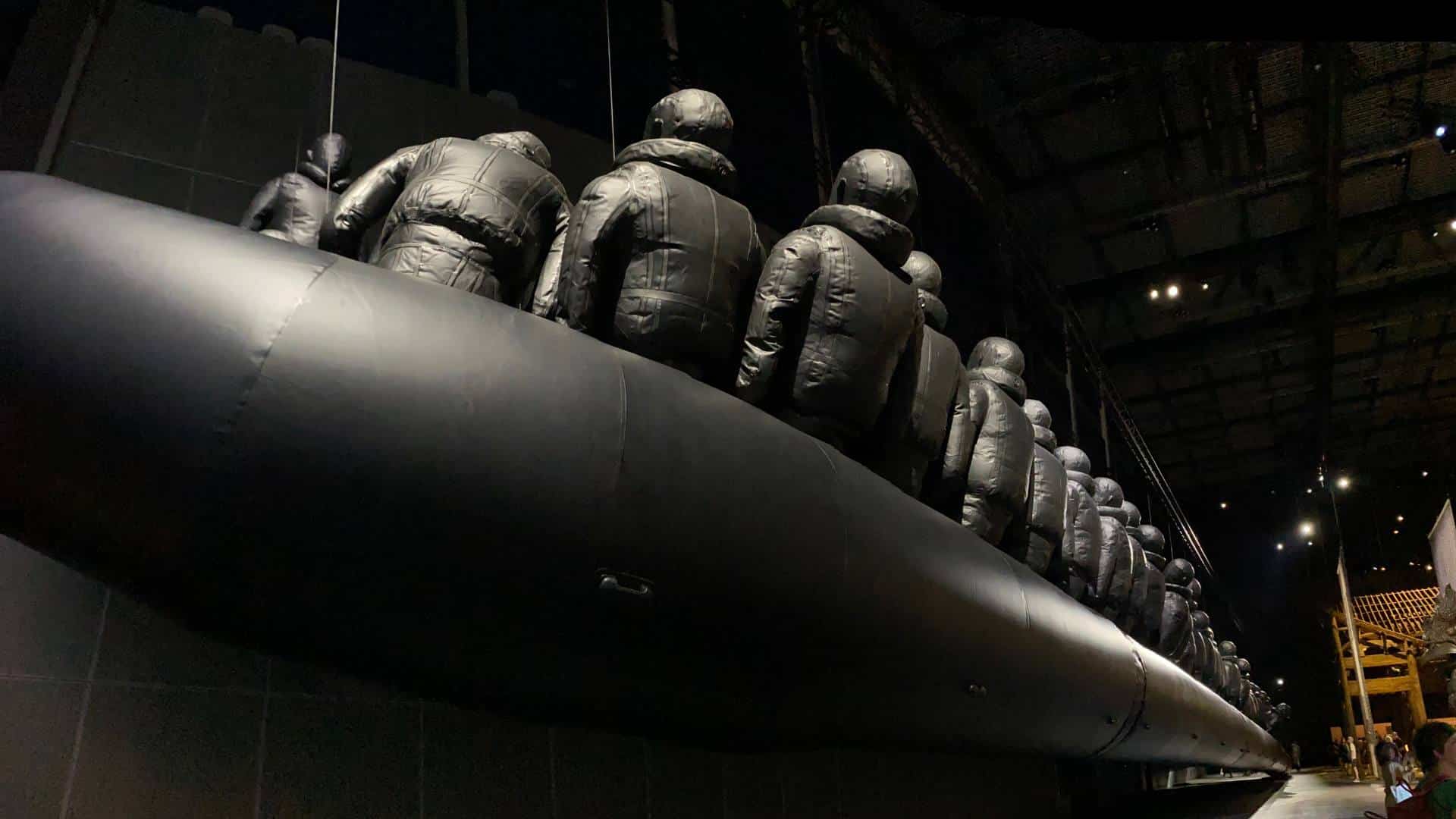
A giant raft filled with refugees all made of polyurethane at Factory International at Aviva Studios in Manchester, England, part of Ai Weiwei’s Button Up! exhibition. (Photo by Marcy Burstiner)
What do Manchester, England and Ningbo, China have in common? Hundreds of years of intertwined colonialism, warfare and exploitation. That’s one message from an extraordinary exhibition by Chinese artist-in-exile Ai Weiwei this summer.
Weiwei was invited to do a site-specific showing in a large space at Aviva Factory International in Manchester, a site that was previously home to media company Granada Studios and, before that, was a pile of rubble from repeated bombings during WWII. The result is Button Up!
That history is important. Weiwei designed the exhibition centered with Manchester in mind, a city proud of its heritage as the birthplace of the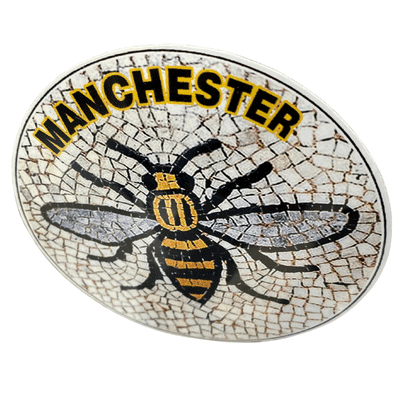 Industrial Revolution that has adopted as its symbol the “bee” for industriousness. Shops in Manchester sell all kinds of bee-themed souvenirs, such as the one shown to the right. Still, little manufacturing takes place in Manchester today, as it has long been exported to places like Ningbo.
For Weiwei, the Industrial Revolution was the beginning of dehumanization that resulted from mass production of goods, global trade and modern warfare.
These connections are articulated in the exhibits: A history of bombs made up of tiny mass-produced bricks that were laid out by hundreds of individuals; a giant life raft filled with refugees all made out of polyurethane; a monstrous black chandelier composed of skeletons made from some 2,000 pieces of hand-blown Murano glass from Italy; flags of eight countries that attacked China and forced it to open its market to foreign goods and made out of mass-produced buttons.
Weiwei also used the toy bricks to recreate and reimagine two famous images: Napoleon crossing the Alps on a rearing horse and The Great Wave off Kanagawa by Japanese artist Katsushika Hokusai. In Weiwei’s versions, the image of Napoleon is upside down and he rides a zebra, to symbolize France’s colonization of Africa, and in The Wave, Weiwei inserted two small boats carrying refugees being throttled by the water.
Destruction, mass produced
A giant wall depicts the history of bombs and shows 50 different conventional bombs and weapons of mass destruction, the year of their introduction and their country of origin.
It is made out of a million small Lego-like bricks that were compiled by over 300 volunteers, merging the ideas of mass production with individual and collective creation.

In the images below, we can see how Ai Weiwei used something familiar and benign — little toy bricks — to juxtapose the ideas of childhood innocence, mass production and warfare and killing. Left: By looking at the side of the wall that depicts the history of bombs, one can see the individual bricks that make it up. Center: A representation of a famous painting of Napoleon on horseback is shown upside down and on a zebra. Right: An iconic Japanese painting of a great wave is shown in Ai Weiwei’s version with two boats packed with refugees.


Weiwei said he chose the portrait of Napoleon, not just because it is famous but because it famously misrepresented the history. Instead of Napoleon courageously leading his troops across the Alps on a horse, he followed them on a mule. He chose the image of the wave because it is one of the most copied images in the world.
Media and mass media, Weiwei is telling us, is often used to misinform us and we become oblivious to nuances of our history and what really happened in the past, what is really happening in the world around us and how the past and present are connected.
Below, giant flags of Russia, Japan, France, Germany, the United States, Italy, Austria-Hungary and the United Kingdom — the eight-nation alliance that invaded China in 1900 during the Boxer Rebellion to force China to open up its market to foreign goods — are made up of millions of mass-produced buttons.

“Britain, Europe and the USA got rich making clothes,” Weiwei wrote in explaining his button flags. “It was the textile industry that drove the slave trade, with Africans picking the cotton. The history of this industry thus takes us through slavery, colonialism and then into globalisation.”

At left, a chandelier of skeletons made up of 2,000 pieces of highly-valued, hand-blown black Murano glass from Italy juxtaposes the values we place on life versus beautiful objects.
Ai Weiwei currently lives with his family in Europe and cannot return to China, where he was born and raised. The government there imprisoned him in a secret facility for 81 days in 2011 and then put him under house arrest until 2015, when he was allowed to leave the country.
Below, a giant raft filled with faceless refugees, all made of polyurethane, connects the ideas of mass production of oil and plastic and the disposability of human life.
Questions to consider:
1. How can art make us see something in a completely different way?
2. Why do you think that governments or people in power might see art as dangerous?
3. Can you think of a piece of art, whether it be visual or something like music, that made you think about something in a different way?

Marcy Burstiner is the educational news director for News Decoder. She is a graduate of the Columbia Journalism School and professor emeritus of journalism and mass communication at the California Polytechnic University, Humboldt in California. She is the author of the book "Investigative Reporting: From premise to publication."