I helped put nature conservation on the global agenda. But now I fear for Earth’s future. Will the next generation save us from disaster? Climate change, conceptual illustration (Photo by SCIENCE PHOTO LIBRARY via AP Images) This story by News Decoder...
It’s been 50 years since humans walked on the Moon. Now, the U.S. is launching a costly program to return there and possibly pave the way to Mars. NASA’s Space Launch System rocket with the Orion spacecraft aboard at NASA’s Kennedy Space Center in Florida,...
Five decades after humans walked on the Moon, the U.S. space agency NASA is leading an international endeavor to return there at a cost of $93 billion. Correspondent Natasha Comeau decodes the Artemis project, a series of missions to build a long-term human presence on the Moon. The 21 nations that have signed the Artemis Accords for space exploration reflect today’s political divisions. Missing from the collaboration are China and Russia, which plan to build a lunar station of their own. It was competition with the then Soviet Union in the 1960s that spurred the first space race and resulted in the historic 1969 moon landing. Now, a host of private corporations are funding their own space initiatives.
Exercise: In teams, have students form their own private space exploration company. Were they able to successfully build their own rocket that could take people into space, what would be their mission? What would they hope to get out of their space exploration ventures? Have each team come up with three things they think space missions could accomplish.
A conflict between Armenia and Azerbaijan is heating up as the war in Ukraine prompts geopolitical realignments, with implications for outside powers including the West and Russia. Azerbaijani soldiers carry portraits of soldiers killed during fighting over...
“It is easy to pay little attention or to even ignore regional conflicts, but they can hold the key to understanding larger political currents in the world.” Correspondent Bryson Hull’s words remind us of why a simmering conflict in the Caucuses between Armenia and Azerbaijan has potential implications for all of us. News Decoder is premised on the notion that young people know a great deal, through headlines on their screens, about what is happening in the world but, because they are young, can have difficulty connecting the dots and understanding why far-away events matter to them. Hull offers a clear explanation of why fighting over Nagorno-Karabakh appears periodically in those headlines, and then disappears, only to reappear some day, like so many other intractable conflicts in distant places.
Exercise: Ask your students to identify a regional conflict that became a proxy for armed competition involving stronger powers.
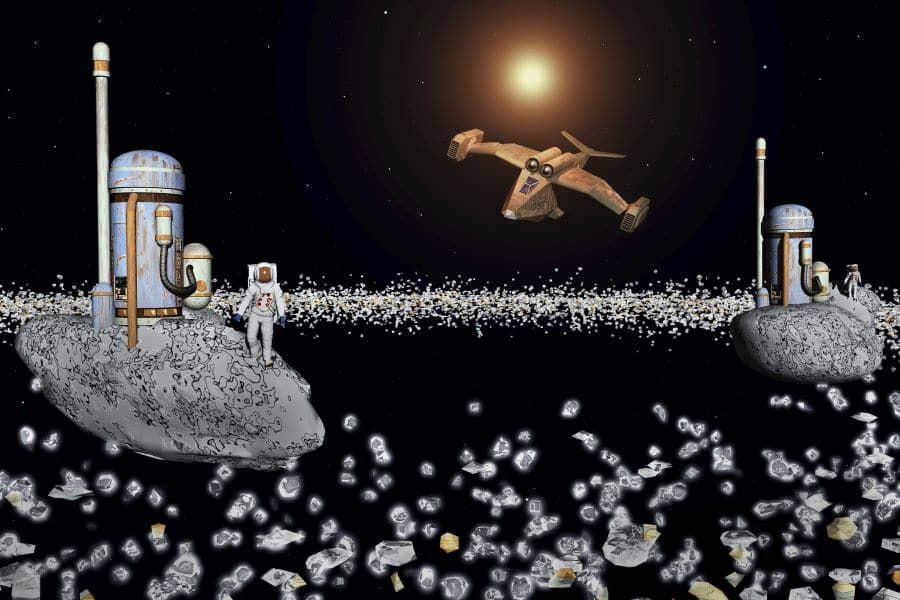
Technology depends on rare earth minerals, but their extraction can harm our planet. Asteroids offer a plentiful source of valuable elements. In the future, mankind will go to the asteroid belt between Mars and Jupiter to mine for the vast wealth that is within the...
Inflation is one of the biggest worries for Gen Z and Millennials. Here’s why you need to care about rising interest rates — and what you can do. A tip box is filled with dollar bills, New York, 3 April 2019. (AP Photo/Mark Lennihan) For the first time in more...
On the same day the U.S. Federal Reserve raised interest rates by another 0.75%, News Decoder correspondent Sarah Edmonds delivered a decoder breaking down an economic issue that has an impact on us all, especially young people. Using engaging and informative language, Edmonds walks the reader through the history of interest rates, how we got to the position we’re in now and what options lie ahead. In a time when nearly half of Gen Z and Millennials live paycheck to paycheck, this decoder provides concise advice for smart financial planning.
Exercise: Ask students to look up the average cost of a house and the average interest rate in the year they were born. How does that compare to today’s averages?
Questions about Pope Francis’s health are stoking speculation about who might succeed him one day as head of the powerful Roman Catholic Church. Pope Francis arrives in a wheelchair at The Vatican, 5 May 2022. Francis, 85, has been suffering from strained...
I am interested in carbon credits — permits that offset greenhouse emissions. So I bought a tonne of carbon. Here’s what I learned. (Photo courtesy of Cory Willis of Willis Farms, Inc. in Tennessee, United States) Anyone with a credit card and the inclination...
Climate change is an existential challenge that resonates particularly strongly with young people, but much of the debate around how to limit global warming to 2 degrees Celsius remains abstract. Carbon credits are considered part of the solution, but just what is a carbon credit? Monica Kidd, a Global Journalism Fellow at the University of Toronto Dalla Lana School of Public Health, asked herself that same question, but instead of simply consulting a text book, she went out and bought a tonne of carbon for $15 and then listened to the farmer who made the sale explain how it works and why carbon credits are not a silver bullet in the climate fight. Understanding the complexities of problems is the sine qua non to pinpointing solutions.
Exercise: Break students into groups and ask each group to buy a tonne of carbon and then explain how they have contributed to the fight against global warming and why it is not enough.
Efforts to combat global warming can clash with our addiction to economic growth. Even the global benchmark of success, GDP, is flawed. (Photo courtesy of the Bennett Institute of Public Policy/@kazuend) Mixed and often contradictory messages are turning the task of...
Three decades after the collapse of the Soviet Union, Russia’s invasion of Ukraine has revived dormant fears of a catastrophic nuclear war. Russian missile launchers, capable of firing nuclear warheads, in Red Square in Moscow, Russia, 9 May 2016 (AP...
The world’s optimists thought the era of Mutually Assured Destruction was over with the collapse of the Soviet Union, but Russia’s invasion of Ukraine has stirred fears of nuclear war – anxieties that many young people around the world have never experienced. Harvey Morris takes a horrific topic – what he calls “a suicide pact between the superpowers” – and examines the irony of the nuclear age: that to ensure there would be no nuclear war, the United States and the Soviet Union both had to have weapons of mass destruction. He offers a highly readable introduction to the harsh realities of the nuclear age – realities that all generations are compelled to live with.
Exercise: Ask your students to debate the resolution: “The best way to ensure there will never be nuclear war is to ensure adversaries have recourse to nuclear weapons.”
Russian President Vladimir Putin has said the fall of the Soviet Union was a catastrophe. What was the USSR, and what does Putin really want? Russian communist party supporters commemorate the death anniversary of the founder of the former Soviet Union, Vladimir...
It’s next to impossible to fathom why Russia might have invaded Ukraine without understanding the Soviet Union and Vladimir Putin’s attachment to the notion of an empire led by Moscow. Few are better placed than Julian Nundy, whose links to Ukraine go back more than half a century, to explain the complex relationship between Russia and its western neighbor. In his decoder, Nundy takes the reader from the upheaval of the Russian revolution to the collapse of the USSR and, with it, Russia’s loss of buffer states – for Putin, an intolerable affront.
Exercise: Ask your students to choose a revolution – if their country had a revolution, then that should be their focus – and to assess the good that may have come out of it, and the bad.