
When you go to a country that speaks the same language, understanding people and being understood may not be as easy as you think.

A passport with the seal of Arsenal Football Club. Illustration by News Decoder
This article was produced exclusively for News Decoder’s global news service. It is through articles like this that News Decoder strives to provide context to complex global events and issues and teach global awareness through the lens of journalism. Learn how you can incorporate our resources and services into your classroom or educational program.
I was sitting near a counter trying not to bother anyone in Emirates Stadium in London before the kick-off of a match that pitted my beloved Arsenal against Wolverhampton. An old man sat next to me.
After one bite of his sandwich, with a side of baked beans, he turned to me.
“Mmm, this is nice,” he said. “You’ve got to try it. They’ve changed the menu. It now tastes like food. Are you ready for the game? The Wolves can’t see under the floodlights, that’s a win for us?”
I said: “You reckon?”
He nodded and told me he had watched Arsenal since he was a boy, and had recently managed to pay for a VIP ticket to the women’s game with his wife, which comes with entry to exclusive club lounges and restaurants.
“Oh boy, it was fun,” he said. “I’d never been there. It’s bloody expensive for the men’s games.”
“Is it?”
“Yeah, but we all watch the same players, innit? Just flashy geezers up there,” he said.
It was time for the game. I realised, for the first time, I had talked to a stranger who hadn’t asked for my nationality.
Where you are from matters in Britain. I’m a journalist turned behavioural scientist from Uganda and I was spending a year studying at the London School of Economics.
The meaning of generosity
In March, the Home Office abruptly halted student visas for nationals from conflict-torn states like Sudan.
A Sudanese friend also studying in the UK now had to apply for asylum and cannot return home to see family. If he did, returning to the UK would be impossible and would mean abandoning employment opportunities.
Shabana Mahmood, the Home Secretary at the time, said she was refusing visas to those “seeking to exploit our generosity.”
I was in the country for the year precisely because of British generosity. A scholarship from the AKO Foundation offered through the Departments of Psychological and Behavioural Science and Political Science at LSE paid for my tuition. But I still wouldn’t have been able to afford the year of study without the help of my mentor Helen Womack and her family, who offered to pay my living expenses and started a GoFundMe campaign.
The Womacks are not rich people and do not live in London. An ordinary British family and their friends were paying for someone else’s year in one of the most expensive cities.
Preconceptions
My brother is a crazy Arsenal fan, so he was happy for me to be in London for the year. But he warned me to be careful. On television, London was a place of knife crime.
I landed thinking I’d see rowdy gangs bustling around with knives. Instead, I was welcomed by autumn’s beautiful colours.
I would spend the year reading situations one way and finding them to be another. Britain spent the year doing the same with me.
At Gatwick Airport, I exchanged Ugandan shillings for pounds. We are cash-heavy back home. But when I tried to buy a book with a 20-pound note the man at the register looked at it as if it were an ancient relic.
“When I went to Crimea during Covid,” he said, unprompted, “I returned with three hundred quid in 2022, and them geezers weren’t taking cash. Bollocks. Forced into this card thing. Get a card, mate.”
I got a card.
The reality of mediated images
The bus to the university would cross the Thames via Waterloo Bridge. From the top deck I watched the sites you see in movies and on the telly: the BFI IMAX Cinema, the National Theatre, the London Eye, the Shard, the Palace of Westminster.
In films, the Thames looks like a fancy river with high towers along it. But I couldn’t help comparing it to Uganda’s River Nile which leaves Lake Victoria as fresh water, and at Murchison Falls it forces its way through a gap in the rock as narrow as London roads. Hippos and crocodiles live along its delta banks.
Because someone had told me that the Thames is a giant open sewer, I was reluctant to walk its bridges, expecting it to stink. But one day the bus line stopped and I had to cross the Waterloo Bridge to the Strand.
The bridge was full of people taking selfies and the river smelled fine. A family asked me for directions.
Navigating language
I speak English, as it is the official language back home. But London accents took some work. It turned out, so did mine.
One night after an event, I stopped for a shawarma. It was one in the morning on New Year’s Day, minus one degree and there were no buses. I asked for it non-spicy. It took me 11 tries of saying non in different ways before he finally understood.
The shawarma was partly dinner and partly something to warm my hands as my thick gloves didn’t seem to do the trick. As I paid, a group of girls passed by wearing short skirts and crop tops.
In contrast, I cooked in the heatwave that came that summer. It was the first time I’d experienced such heat, packed into un-air-conditioned London buses to travel to un-air-conditioned buildings.
In London, space is a luxury. Flats are small with little storage and no place to park. You learn to only acquire household items that are necessary. Back home, most of us buy things to fill rooms.
The food, that looked as if it had spent some time on market shelves, took some getting used to. I learnt to freeze food for the week and then microwave it. At home that would be frowned upon, because it is easy to get fresh food for the next meal.
Fruit seemed to have travelled too far. The first pineapple I bought was the last and the mangoes were sad. I resorted to apples, since as the saying goes, an apple a day keeps the doctor away.
Levels of ignorance
Well, the apples didn’t. I fell sick, probably because my body wasn’t used to the cold. Because I couldn’t get a timely doctor’s appointment through the National Health Service, which would have been free, I went to a private hospital. The consultation cost 300 pounds. In Uganda, the most I would have paid would have been about 30.
I wanted to go to a gym, but that too was expensive, so I walked home on days I felt energetic. I saw people living in underground passages that reeked of urine.
I started riding a bike at night for exercise and mind reset and found empty streets, a brightly-lit city and cool breezes. At home, I would not risk it. In Kampala, people will grab your bag or phone and the drivers are crazy.
That was until I saw a cyclist snatch a girl’s phone along New Kent Road. Perhaps traveling at night is risky wherever you are.
If I was out late, I would order an Uber. One time, a Nigerian driver asked where I came from.
He didn’t know where Uganda was. That happened several times. One German historian knew Uganda only through the dictatorship of Idi Amin — and that ended almost 50 years ago! Still I couldn’t blame him, as we know the world through the history we are taught. Every time I got a chance to talk to someone German I’d ask about Hitler — it was all I knew, from my history classes.
Education outside of class
I learned all kinds of unexpected things.
When Andy Burnham replaced Keir Starmer as prime minister on 20 July, Burnham became Britain’s seventh prime minister in 10 years. In Uganda, anyone born after 1986 has only lived under the rule of President Yoweri Museveni. I believe the UK will likely see another prime minister before Uganda changes its leader.
Helen hosted me in Filey, a coastal town in North Yorkshire where I seemed to be the only Black person, in contrast to London, where I was one among many.
At a bus stop one night, I saw two women kissing, intimately and unhurried. In Uganda, that is against the law.
I was on my way to join a group of other students at a bar to mark the end of the Programme for African Leadership. My master’s degree in behavioural science still had months to go, but the evening still felt like a milestone.
At the bar, I had asked for a mocktail, something with lemon. The waiter disappeared for longer than the order deserved. When he came back, he said they weren’t serving mocktails but offered me a coke.
Beside me, my friend tapped his card to pay for the Guinness he was halfway through and I got ready to pay for my coke, but the waiter disappeared. When he came back, he looked at my chest and pointed to my necklace, which had the insignia for the Arsenal Football Club.
“For the Arsenal. Cheers, mate. You can have it.”
After 22 years, Arsenal had won the Premier League, and in that spirit, a stranger gave me a free drink.
It seems that in the UK, when it comes to football at least, your allegiance is what counts.
Questions to consider:
1. Why do some nations like the United Kingdom grant visas to people from some countries and not others?
2. What is it about sports that seems to unite people of different cultures and races?
3. Can you think of a time when you found it difficult to get people to understand what you were saying?
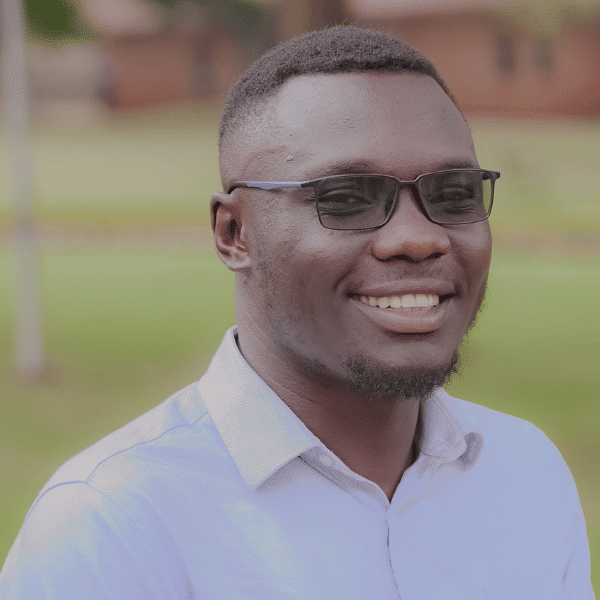
Enock Wanderema is News Decoder’s correspondent in Uganda. He has written articles about identity, the environment, wildlife conservation and politics. He loves writing and bringing complex stories to life in the simplest ways.