
The death of musician Zubeen Garg brought an entire Indian state to a standstill. When people turn stardom into selflessness they can touch millions.
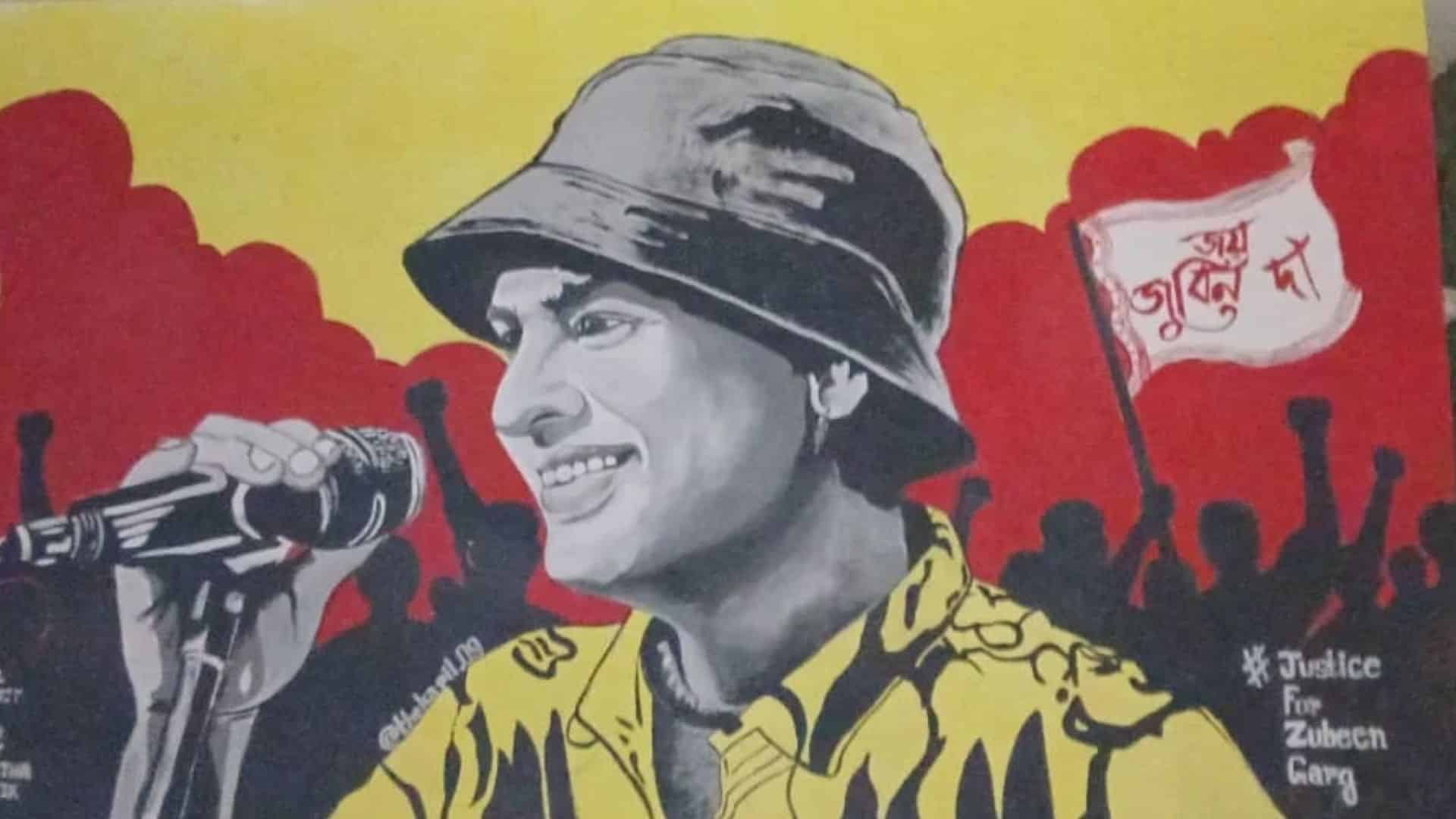
A mural portrait of Zubeen Garg. (Photo by Deeya Borpatra Gohain)
This article was produced exclusively for News Decoder’s global news service. Through articles like this, News Decoder strives to provide context to complex global events and issues and teach global awareness through the lens of journalism. Learn how you can incorporate our resources and services into your classroom or educational program.
On 19 September 2025, Zubeen Garg, a singer, songwriter, film actor and activist from the state of Assam in India, died of drowning in Singapore. He had travelled there to participate in a cultural festival celebrating the heritage of the North Eastern states of India, of which Assam is one.
As a South Indian, from a completely different state around 2,500 kilometres away who was now living in Assam, the way the events after Garg’s death panned out was astonishing.
I had been eagerly waiting for the day of my own 31st birthday, which fell on 21 September, when the WhatsApp forward came announcing that Assam’s favourite singer had passed away.
What I would not realise at the moment was that the unforgettable birthday celebration my husband was planning for me then would become unforgettable for a whole other reason.
This was because, for three or four days after the artist had passed away, the entire state of Assam came to a standstill. Shops closed, workplaces declared holidays, public areas such as gyms and cafes were closed and — even more surprisingly — app-based deliveries and taxi services too came to a grinding halt.
A change of plans
At the time, I could scarcely understand the grief being faced by an entire state. Houses, buildings and street corners had suddenly filled with his framed pictures, with flowers, candles and incense sticks in front of them. As an outsider who was unfamiliar with most of Garg’s work, my own focus then was on the fact that my entire birthday surprise, which had been meticulously planned by my husband, was falling apart piece by piece.
We were supposed to take a boat ride together to see the rare Brahmaputra river dolphins, then attend my book club meetup (which usually met the last Sunday of the month but was advanced to coincide with my birthday) and then have a dinner party for which he had invited a private chef to cook my favourite dishes.
Instead, the boat driver had said he wanted to attend Garg’s funeral, the book club was cancelled because the cafe where we were supposed to meet was closed, very few friends showed up for my dinner party because of the lack of transport and the chef, who had forgotten to buy some ingredients, had to improvise on the spot because all grocery shops were closed and he couldn’t just pop out to buy some.
In the midst of these frustrations, I had missed that something truly historic was happening around me.
The day the news of Garg’s death was received, hundreds of fans flocked to his house, singing one of his famous songs, “Mayabini,” which is an Assamese-language number that talks about love, illusion and the deep ache of separation. The artist himself had asked that it be sung at his funeral in another interview.
This song would indeed be sung at his funeral, conducted on 21 September, my birthday. The funeral procession, attended by over one million people from all over Assam, would be recorded in the Limca Book of World Records as the fourth-largest funeral procession in the world, after Michael Jackson, Princess Diana and Pope John Paul II.
Star power
For weeks after that, once I realised the extent of love people had for Garg, I found myself asking questions about what it takes for someone to be so loved and adored.
If Garg, who had recorded around 38,000 songs in about 40 different languages and indigenous dialects, could have heard about what happened, he would not have been surprised at all. He had predicted this during his lifetime. In a recorded interview, which would be the last of his life, he told the interviewer that if he died, the entire state of Assam would be closed for seven days. Garg died at the age of 52 knowing he was intensely loved by the people of his home state.
My husband, a Bihari migrant from another state who was born and brought up in Assam listening to Garg, had a lot to say about it.
“When Zubeen was alive, no one could cut a tree in Assam and get away with it.”
I thought then that he was exaggerating.
Plant a tree.
I later learnt that Garg had become deeply involved with environmental causes, joining residents and activists in protests against deforestation and speaking publicly about conservation. The visibility and legitimacy that his celebrity status afforded him was transferred to the social ideas he was passionate about.
His concern for trees was not simply something he mentioned in interviews. It was incorporated into the way he interacted with his fans.
When people gave him flowers or bouquets, he was known to refuse them and ask instead that they plant a tree in his name. After his death, that idea took on a life of its own.
Groups of Assamese residents came together to initiate afforestation projects such as the Zubeen Seuj Chapori project, which aimed to revive a rare vulture habitat on a large sandbank on the Brahmaputra, and the Zubeen Nahor Project, which aimed to plant one million Nahor trees (Indian rose chestnut) trees. Garg had released an album of music called “Nahor,” which was deeply cherished in Assam, as was the Indigenous flowering species.
Assam grieved Garg by continuing to care about the things he asked them to care about.
“He is the only true rockstar Assam had ever seen,” said my best friend. “He would climb electrical poles in the middle of his open-field concert performances to sing to his audience.”
Not idle worship
Garg was known for his “electrifying” high-energy stage presence, and these were not the only antics he got up to.
“During Bihu, an Assamese local festival, you could see him randomly singing traditional Bihu songs on the roadside stages set up with speakers and microphones,” my husband said. These performances, he told me, were often free. His community did not always have to wait for one of his concerts or pay for a ticket to hear him sing live.
There was something about this that began to explain his popularity to me. Garg did not seem to belong only to the stage or behind his veneer of celebrity. He could appear at the same roadside celebrations, community events and local spaces where the people who loved him were already gathered.
“Bihu will never be the same without him,” was a refrain I heard repeatedly in the early days after his death.
Garg had also famously given away much of his earnings and belongings whenever people came to him asking for help. He was known to step in when people needed medical expenses paid or surgeries funded, and to turn up at flood and disaster relief camps whenever he could. He had also funded school and college admissions for children from poor families, and given money towards important life ceremonies such as marriages and birthday celebrations.
Bringing people together across divisions
Garg’s philanthropy was another part of the relationship he had built with the people of Assam, a legacy that his wife now aims to continue through the Zubeen Garg Trust and the Kalaguru Foundation.
For months after his death, I continued to see people singing his music at concerts and other important events across Assam. When the ICC Women’s Cricket World Cup opened in Assam, Shreya Ghoshal, another famous Indian singer, sang “Mayabini” during the mid-innings break as a tribute to him.
The Bihu and Navratri celebrations that year, though months after his death, were muted. Even the temples and installations for the gods and goddesses sometimes had his garlanded picture, while speakers played his music alongside devotional songs.
On Diwali, the Hindu festival of lights, I had called for a taxi to go to a celebration at my friend’s house. The driver who came to pick me up stopped and did a double take when he saw my name.
“Aren’t you a Christian?” he asked, looking at me decked out in my festive salwar kameez and sparkly jewels. He was picking me up from my Muslim-majority locality of Islampur.
When I answered in the affirmative, he smiled.
“You are celebrating Diwali,” he said. “This is the kind of religious unity Zubeen da [a local term of affection for an older brother] wanted to see in Assam.”
Speaking up for what’s right
That day, I would also learn that Garg had spoken against what he considered arbitrary systems of division such as caste and religion, ideas that had long been entrenched in the social fabric around him. Slowly, after his death, I began to see people reckoning with those ideas too.
“He was bold, he was never scared of speaking up for the right thing, even against people in power,” someone would tell me later. “He used his celebrity to always help the people,” another would tell me.
As days went by, I began to see why Assam mourned him with such deep pain.
Assam considered him a perfect example of what it considered “a true son of the soil.”
And today, a year later, whenever I step into a grocery store or a medical shop and see his garlanded picture alongside the pictures of other gods and dead family members of the shop owner, I have stopped being surprised.
I have understood exactly how Assam’s darling had earned his place as a family member in every Assamese household.
Questions to consider:
1. Why do people connect so strongly to some singers and musicians?
2. How can entertainers use their stardom to do good?
3. Think of someone you idolized. What was it about that person that you connected to?

Dr. Christianez Ratna Kiruba is an internal medicine physician from India who is a patient rights advocate and is passionate about analysing public health issues through a gender lens. She is a graduate of the University of Toronto’s Dalla Lana Fellowship in Journalism and Health Impact.