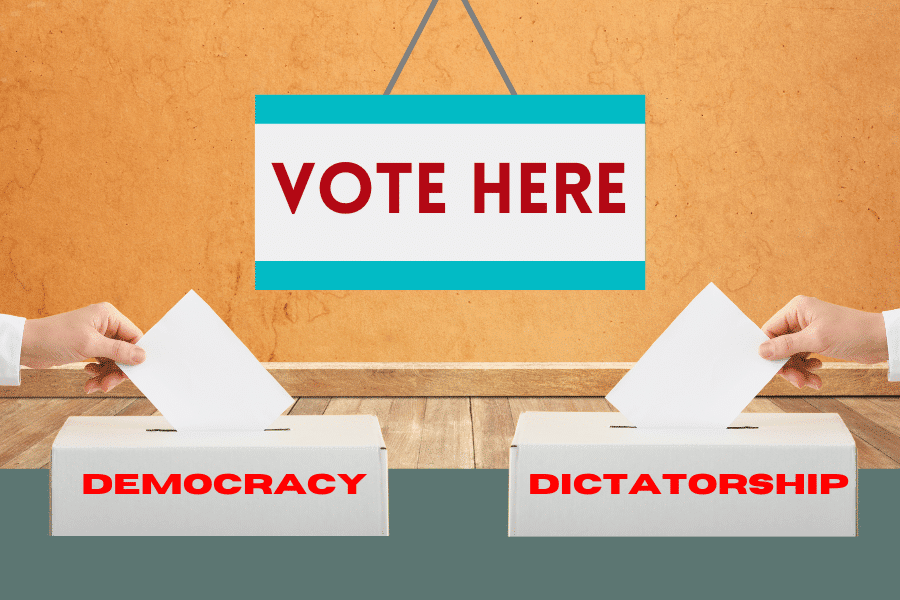
Autocrats are on the rise all over the world. Why would a voter choose one over a candidate that believes in democracy? Two ballot boxes give voters the choice of democracy vs dictatorship. (Illustration by News Decoder) Editor’s note: On 31 March 2024, voters...
The 24/7 news cycle turns every news item into a headline without context. The more we consume the news the less we understand. Can we break out of that cycle? A TV screen fills with the words “Breaking News” while headlines scroll over. (Illustration by...
In this article, ND correspondent Tom Heneghan explains the tension between the immediate and the eventual in journalistic reporting. In this vein, what is “urgent incrementalism”? Help boost students’ media literacy skills with this text and accompanying classroom activity.
Exercise: Read the article and define “urgent incrementalism” as a class. Then, have students scan today’s headlines and each pick one story to read. Does their story lean “urgent” or “incremental”? How might that change the way a reader understands the issue at hand?
The upcoming U.S. presidential election might already seem like déjà vu, but in many ways it will be unprecedented. What’s in it for the rest of the world? This article was produced exclusively for News Decoder’s global news service. It is through articles like...
Weekly protests in France are now about more than pensions. For French citizens it is about democratic ideals and a government that represents its people. Protesters in Rennes, France march over pension reforms and more, April 2023. All photos by Clover Choi. This...
When the business model for news corporations depends on blurring the lines between fact and opinion, how can we move from partisanship to problem solving? Photo illustration by News Decoder. In 2017, the political landscape collectively scoffed at Donald...
With news media inundating our feeds with content, youth guest author Skyler Kelley Duval dissects the blurred lines between fact and fiction. Central to being able to responsibly consume media is investment in critical thinking and media literacy education in schools. Are your students media literate?
Exercise: Read the article with your class, then introduce the CRAAP test to your students as a tool to evaluate media sources. The CRAAP test assesses sources for Currency, Relevancy, Authority, Accuracy and Purpose — with a goal of determining trustworthiness. You can find an example of the CRAAP test here. Consider analyzing a media source together as a class using the test.