
In the recent election, Hungarians proved that a strong-arm leader can be removed from power and that peaceful change is possible.
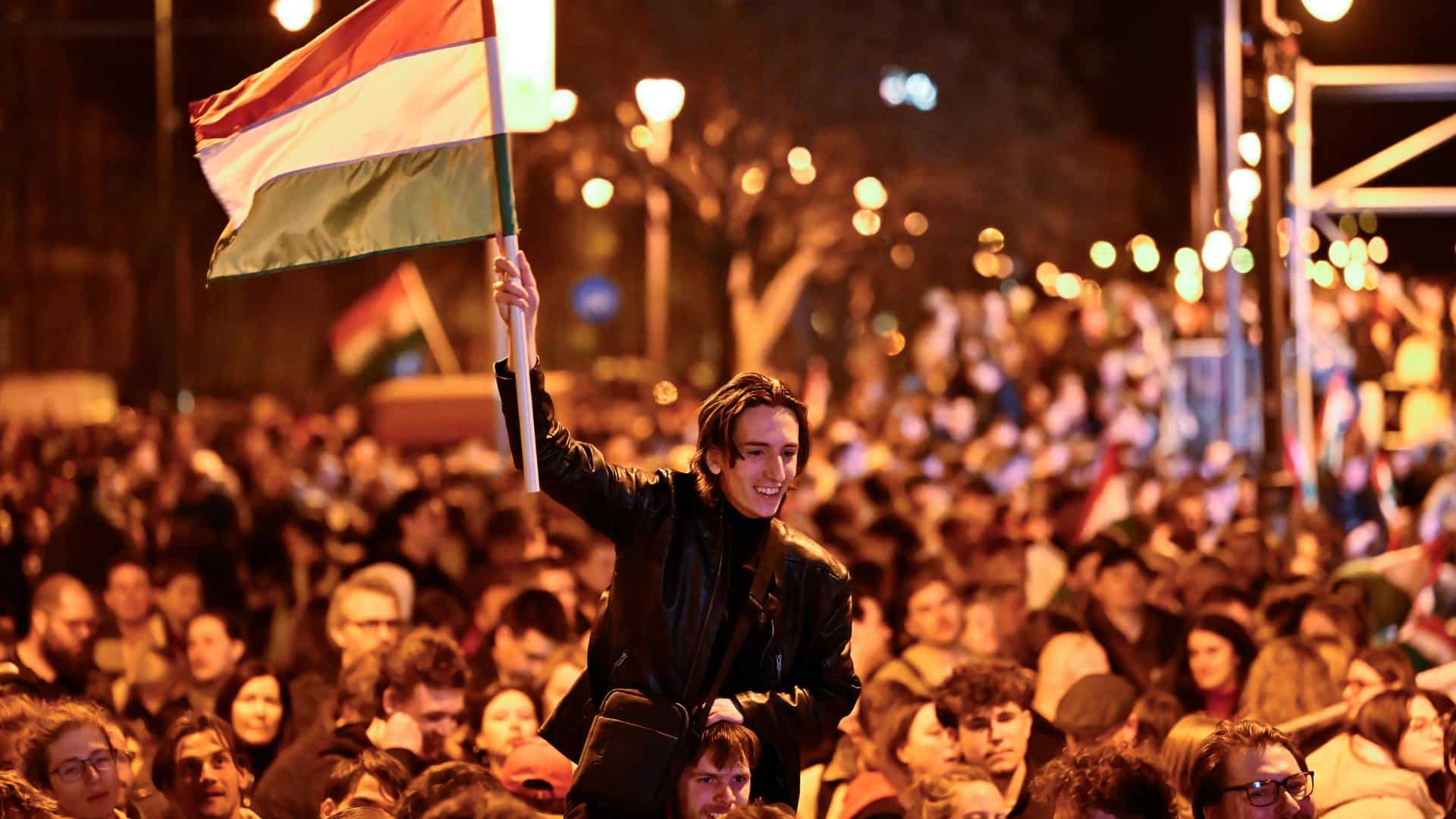
A man waves a Hungarian flag as he celebrates the results of the Hungarian election in Budapest, 12 April 2026. (AP Photo/Denes Erdos)
This article was produced exclusively for News Decoder’s global news service. It is through articles like this that News Decoder strives to provide context to complex global events and issues and teach global awareness through the lens of journalism. Learn how you can incorporate our resources and services into your classroom or educational program.
There was a letter in my mailbox from the electricity company in Hungary, where I live. I thought it was just another bill but when I opened it, I discovered it was the promise of a discount (since winter had been particularly harsh), accompanied by a portrait photo of Viktor Orbán, the prime minister of Hungary until just a few days ago.
What did this mean? It meant that Orbán was getting nervous, as parliamentary elections loomed.
After 16 years in power, Hungary’s populist, trouble‑making, Moscow‑leaning prime minister faced his first serious challenge from an opposition that had finally managed to unite behind a candidate with a chance of winning.
Péter Magyar, leader of the Tisza Party, was many points up on Orbán’s ruling Fidesz Party ahead of the vote. On 12 April, he ended up winning by a landslide.
With Orbán’s loss to Magyar, Vladimir Putin and Donald Trump have both lost a useful ally and the European Union benefits from increased cohesion and harmony. This has turned out to be a real Hungarian Spring, although a lot of work now needs to be done to dismantle the system Orbán leaves behind.
A surprising victory
Commentators agreed that Orbán wasn’t going to go easily and all kinds of dirty tricks would be tried. Nevertheless, the elections went ahead, despite some cynics predicting Orbán would find an excuse to cancel them. And the opposition leader was not jailed or poisoned (as happened in Russia).
The election results proved so overwhelming that Orbán conceded defeat, even before all the votes were tallied. No one expected it to be so easy. Fireworks went off and huge street parties lasted long into the night.
In his attempt to prolong his tenure, Orbán had used two tactics, which ultimately didn’t work. On the one hand, he tried to lure Hungarians with benefits (hence the electricity offer); on the other, he tried to scare them with bogeymen (not migrants or LGBTQ people this time but dastardly Ukrainians).
“Fidesz is the safe choice, they [the opposition] are a gamble,” was the ruling party’s slogan.
It is the tactic of all big‑daddy politicians, who count on people fearing change even as they long for it. Early on, it seemed that the big daddy tactic was working.
A sea of people called for change.
Although I have lived in Hungary for a number of years, my Hungarian is still not very good, so I asked a neighbour to help me read the letter from the electricity company. She was young and spoke English, so I assumed she was an opposition supporter but I could not have been more wrong.
She told me that she struggled financially and was grateful for the family allowances and other support that Orbán provided.
“He’s keeping the energy bills down,” she said, before telling me that the EU and Ukraine were dragging Hungary into war and that Europe ought to be talking to Russia.
It was a lesson to me not to make assumptions about people’s political opinions. But at an opposition rally on 15 March, Hungary’s national day, there was no mistaking the voting intentions of a sea of people who filled the long Andrássy Avenue all the way to Heroes’ Square.
“Enough!” and “Now or Never!” read the placards of Péter Magyar’s supporters.
The power of the vote
Magyar, who came out of the ranks of Orbán’s own party, was promising a re‑set in Hungary’s difficult relations with the EU and by extension, better support for Ukraine. His moderate nationalism and centre‑right policies helped to get the opposition message beyond liberal Budapest and out into the more conservative countryside.
“We are tired of Fidesz and Viktor Orbán,” said Sandor, a young man who works in logistics. “They say they protect kids but they don’t. They have stolen a lot of money and look at the state of our hospitals.”
“Yeah,” said Sandor’s friend Andras, who had a Hungarian flag painted on his face. “They call the opposition traitors but we are patriots too.”
“I am voting for Péter Magyar because I want freedom and peace in Europe,” said Ottilia, a retired judge.
Were they not afraid of the “Ukrainian threat”?
“Nah,” laughed Sandor, “we don’t believe Ukraine is a threat.”
The fear tactics didn’t work.
In all sorts of ways, Orbán had tried to demonise Ukrainian President Volodymyr Zelenskyy. Laughably, he had even suggested that Zelenskyy was “threatening his family”.
Fidesz put out a fearmongering AI‑generated video, showing Hungarian soldiers being executed by “Nazis” in Ukraine, which was a million miles from the truth.
Fidesz had also tried to smear Magyar, who is divorced. But a sex tape showing him having consensual sex with a grown‑up woman was so ridiculous that it backfired and disappeared from view.
Magyar’s landslide victory meant that some commentators’ fears were proved wrong. Imre Karacs had suggested that Orbán would likely challenge any victory by Magyar, by claiming the opposition campaign had been illegally financed from abroad.
But in the end, the people abandoned their fears and took a gamble on a new leader. The opposition victory was just too big and Orbán had to bow to the inevitable.
Time will tell whether the new government can make significant changes but for now, Hungarians are celebrating and enjoying their much longed-for political Spring.
Three questions to consider:
1. What does the author mean by “Big Daddy” tactics?
2. Why were many people in Hungary unhappy with the government of Victor Orbán?
3. In your country, what is one political issue that most people agree on?

Helen Womack is a specialist on former Communist countries. From 1985 to 2015, she reported from Moscow for Reuters, The Independent, The Times and the Fairfax newspapers of Australia. Since the refugee crisis of 2015, she has written for the United Nations Refugee Agency, UNHCR, about how refugees are settling in Europe. After column writing, Womack went on to write a book about her experiences in Russia: “The Ice Walk — Surviving the Soviet Break-Up and the New Russia.”
Interesting take on those tactics. Do you think they work better in some cultures than others?