
As Canada’s relationship with the United States sours, Europe looks to sweeten its ties to the Land of the Maple Leaf. Here is a taste of what that means.

Canadian Prime Minister Mark Carney holds up a bottle of maple syrup as a gift to President of the European Parliament Roberta Metsola in Strasbourg, France, 16 September 2026. (Justin Tang/The Canadian Press via AP)
On 20 September 2026, the leaders of Canada and France met in Saint-Pierre and Miquelon, a French overseas territory off the coast of Canada, to strengthen their ties. Meanwhile, the European Union has offered Canada an undefined “association membership” that promises alliances on such things as trade, defense and energy.
South of Canada’s border, the United States under President Donald Trump has threatened Canada with high tariffs. Trump released a map that envisions Canada as part of the United States. Canadian Prime Minister Mark Carney has become one of the most vocal critics of Trump and has insisted that his country will stand up to attempts by the United States to dominate Canada.
Until Trump came to power, the United States and Canada shared a close relationship. Former U.S. President John F. Kennedy described it to the Canadian Parliament in 1961 this way: “Geography has made us neighbors, history has made us friends, economics has made us partners.”
To help understand this relationship and how the frazzling of the connections affects people in Canada, we decided to republish an article by correspondent Susanne Courtney in March 2025 that looks at the production and sale of just one product: maple syrup. We launched Decoder Replay to help readers better understand current world events by seeing how our correspondents decoded similar events in the past.
When most people think of maple syrup, they think of Canada. And when they think of Canada, they think of maple syrup. Maple syrup is a Canadian love story, a bec sucré, or sweet kiss for our friends in Quebec. Canada produces more than any other country by a long shot.
My husband is a maple syrup producer. As the seasons change, our work accelerates in the sugar bush. Fall is clearing trees that have fallen on the sap lines. In January, the sugar shack is cleaned out. Filters are washed. Cans and other supplies are bought.
Last year was a record year for Canadian maple syrup production — up 91% over 2023. This year is looking to be a good year as well.
Nevertheless, these are not sweet days for Canada’s maple syrup producers.
Some 60% of Canadian maple syrup is exported to the United States. With no warning, U.S. President Donald Trump threatened in January to impose 25% tariffs on all goods imported from Canada and Mexico, including maple syrup.
\Harvesting syrup
On our farm in southern Ontario, we usually head into the sugar bush in late February to tap the trees. Armed with cordless drills and snowshoes, we carefully drill holes in the trees for the taps — one tap for most trees and two for the biggest ones.
Then, we wait for those warm days that follow the cold nights, when the sap cascades from the trees through the taps downhill through blue lines, collecting in large steel tanks.
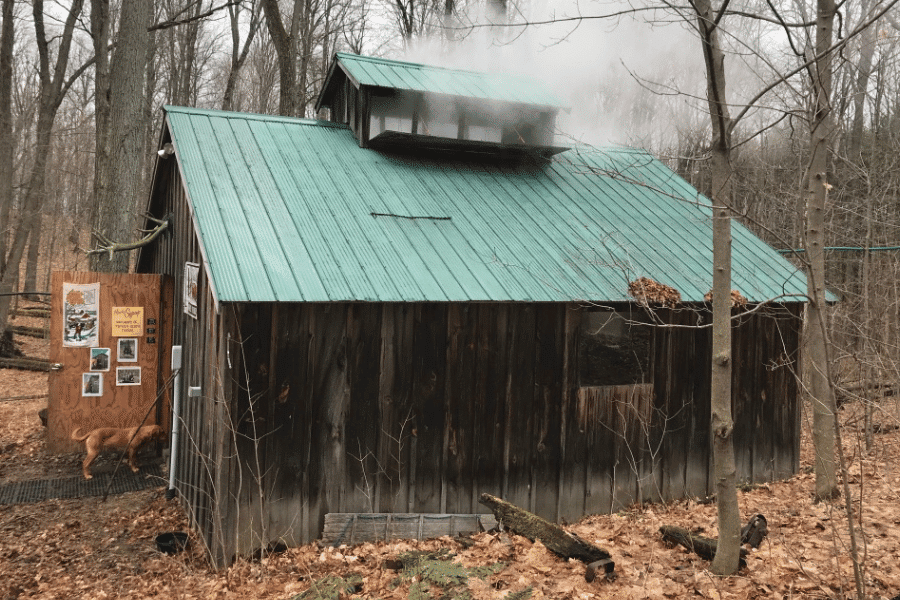
Steam from an evaporator escaping from the roof of the author’s Sugar Shack. (Credit: Susanne Courtney)
Maple sap is pumped from the tanks to the evaporator in the sugar shack, where it is boiled down to its most elemental form: sweet maple syrup. In March, the evaporator works diligently to boil sap.
Steam curls and wafts upwards from the evaporator, escaping through slats in the roof and leaving a distinct scent of maple. That scent, steamed into your pores, doesn’t wash off until the evaporator shuts down for the season in late March or early April.
Generally, you need 40 litres of sap to make one litre of syrup. The highest sugar content sap comes from sugar maples, hence the term “sugar bush” for groves of maple trees.

Kevin Jewison tapping a maple. (Credit: Susanne Courtney)
The magic happens in a chemical process called the “Maillard Reaction,” when the sap reacts with its sugar, transforming it into syrup with its unique flavours, colours, aromas and antioxidant properties.
With its moderate glycemic index compared to other sugars, maple syrup raises blood sugar more slowly than regular sugars. It is also considered high in antioxidants.
Nevertheless, it is still a sugar with the calories to prove it. While the science is still slim, in 2023, the National Institutes of Health concluded that skipping refined sugars and opting for maple syrup is healthier — in moderation.
Quebec is Canada’s most important producer. In 2024, all four producing provinces harvested 19.9 million gallons; 18 million came from Quebec.
Storing maple syrup
Yield is weather-dependent, and climate change is not helping. To stabilize prices and ensure they can meet demand in bad years, the Federation of Quebec Maple Syrup Producers (FPAQ) created the world’s only Strategic Reserve of Maple Syrup.
Housed in three enormous warehouses scattered across major producing regions, the Strategic Reserve can hold as many as 216,000 45-gallon barrels of maple syrup, enough to fill 53 Olympic-sized swimming pools.

One of the Strategic Reserve warehouses. (Photo courtesy of the Federation of Quebec Maple Syrup Producers)
According to the FPAQ at full capacity, the syrup is worth CAD $400 million (USD $277 million).
Today, the Strategic Reserve warehouses are protected by motion detectors, surveillance cameras and alarms. That wasn’t the case in the summer of 2012 when thieves brazenly stole 10,000 barrels valued at up to $18 million from a warehouse in a small town in Quebec.
Tariffs and trade
Most Ontario producers sell syrup locally, so the immediate impact of U.S. tariffs will not be significant. Quebec producers are not so lucky. According to Joel Vaudeville, communications director of FPAQ, 92% of maple syrup sold globally is from Quebec.
The balance comes from the United States. Quebec dominates the market. For example, in 2020, Quebec produced around 21 million gallons, while Vermont, the largest state producer in the United States, produced 2.2 million gallons.
Trump’s tariff threats have pushed Canadian policymakers to diversify away from the United States to new markets. However, the short-term threat to the economies of Quebec and Canada is real.
The FPAQ is working with federal and provincial governments on urgent and achievable strategies to protect producers and diversify sales domestically and to other countries.
Among other demands, the FPAQ wants the Government of Quebec to buy maple syrup for meals in schools and hospitals. They also want to ramp up consumer promotions in Europe to stimulate demand.
According to Vaudeville, maple syrup is pasteurized and shelf-stable, so it can be stored in the Strategic Reserve for 10 years and still be safe and tasty. This gives Canada a long runway to resolve the U.S. tariff problem, keep producers in the money, and build new markets — to the detriment of American consumers.
Maple syrup, like hockey, is iconically Canadian. When Canada won the 2025 4 Nations Face-Off hockey tournament against the United States earlier this month, the country erupted in pride.
It may go into overtime, but Canada is determined that maple syrup will not lose in a trade game with Donald Trump.
Questions to consider:
1. Why would Canada create a stockpile of maple syrup?
2. Why is maple syrup linked to Canada’s national identity?
3. If you were the head of Canada, how would you try to convince U.S. President Trump to not impose tariffs on maple syrup?

Susanne Courtney is a freelance journalist and writer based in Canada. A former Fellow in Global Journalism at the Munk School of Global Affairs and Public Policy, her writing focuses primarily on international affairs, international development and development finance. Recently she authored the 2021 State of the Sector Report on Canada's Impact Investing in Emerging and Frontier Markets.