Despite conflicts on Earth, satellites orbit in peace. But use of Elon Musk’s Starlink to aid Ukraine has Russia looking to the sky with hostile eyes. A rocket booster carrying three Gonets-M satellites and the first Skif-D satellite of the Sfera programme lifts...
While all kinds of international conflicts occur on the ground, up in space things have been pretty peaceful. We depend on peace in the skies because such things as social media, multiplayer video games, Google classrooms and Zoom sessions rely on satellites bouncing signals across the earth. Correspondent Tira Shubart tells us why tensions on the ground in Ukraine could disturb the tacit and explicit agreements over satellites in the sky.
Exercise: Let’s imagine that each student has been hired to draw up an international agreement to govern and protect satellites that need to cross the skies over international borders. What are the five most important considerations that would have to be included in this treaty? Some things to consider are: The citizens in every country want fast and reliable Internet; people want their privacy protected; and countries are concerned about the possible military use of satellites.
Big business is eager to show its environmental and social credentials. But how can you tell if a firm is genuine — or merely greenwashing? British cyclist Neah Evans sports a Shell plc logo on her jersey at a race near Paris, France, 16 October 2022. (AP...
At next month’s climate summit in Egypt, poorer nations coping with disasters will press wealthier states for a fund to help them ride out catastrophes. Women carry belongings from their flooded home in the Qambar Shahdadkot district of Sindh Province of...
For years, governments have engaged in marathon annual talks to try to end global warming. But they often fall frustratingly short. Egypt will host COP27 in November at the Red Sea coastal resort of Sharm el-Sheikh. Rising sea levels caused by climate change are...
The presidential election in Brazil means more than the future of the country. The Amazon and the fight against climate change could depend on it. The Itaquai River snakes through the upper Amazon basin. (AP Photo/Edmar Barros) As Brazilians cast their votes in a...
I helped put nature conservation on the global agenda. But now I fear for Earth’s future. Will the next generation save us from disaster? Climate change, conceptual illustration (Photo by SCIENCE PHOTO LIBRARY via AP Images) This story by News Decoder...
It’s been 50 years since humans walked on the Moon. Now, the U.S. is launching a costly program to return there and possibly pave the way to Mars. NASA’s Space Launch System rocket with the Orion spacecraft aboard at NASA’s Kennedy Space Center in Florida,...
Five decades after humans walked on the Moon, the U.S. space agency NASA is leading an international endeavor to return there at a cost of $93 billion. Correspondent Natasha Comeau decodes the Artemis project, a series of missions to build a long-term human presence on the Moon. The 21 nations that have signed the Artemis Accords for space exploration reflect today’s political divisions. Missing from the collaboration are China and Russia, which plan to build a lunar station of their own. It was competition with the then Soviet Union in the 1960s that spurred the first space race and resulted in the historic 1969 moon landing. Now, a host of private corporations are funding their own space initiatives.
Exercise: In teams, have students form their own private space exploration company. Were they able to successfully build their own rocket that could take people into space, what would be their mission? What would they hope to get out of their space exploration ventures? Have each team come up with three things they think space missions could accomplish.
Swiss citizens are burying cotton underpants and tea bags in their gardens and fields to help scientists assess the quality of soil in the Alpine nation. (Photo courtesy of Beweisstück Unterhose) This article, by high school student Luis Eberl, was produced out of...
Student reporter Luis Eberl of Realgymnasium Rämibühl in Zurich, Switzerland, interviewed scientist Marcel van der Heijden of the University of Zurich about an experiment to find ways to slow down or prevent soil deterioration caused by erosion, construction, pesticides and drought. The project invites citizens to test their own soil by planting tea bags and cotton underpants – two common household items – and then testing the level of deterioration. Eberl shows how scientists are engaging everyday people in climate change projects to demonstrate that individuals’ small actions can lead to global solutions.
Exercise: Interviewing an expert for a story is a great way to get information to readers that might not be reported elsewhere. Have students think of an issue that would be important to report and see if they can identify an expert who might be good to interview for a story on that issue.
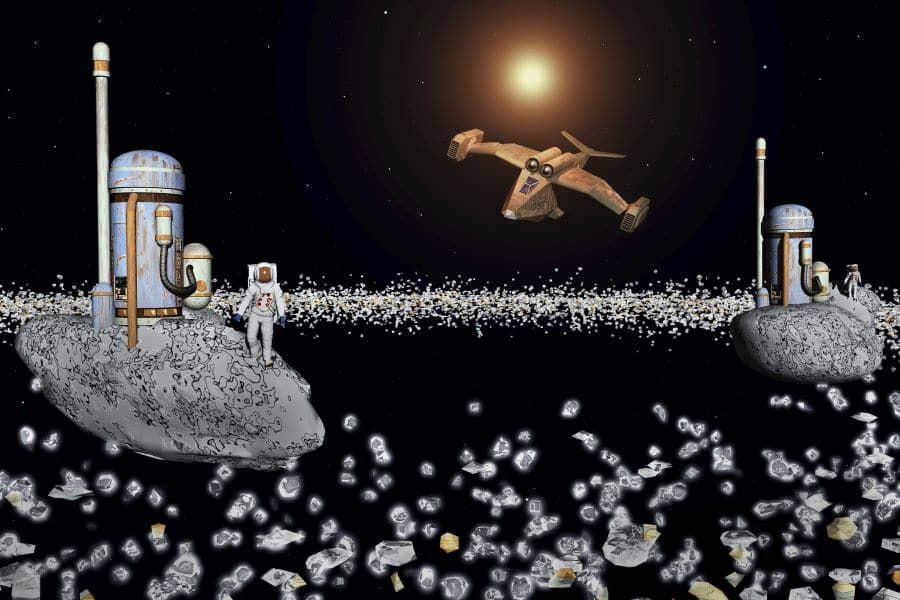
Technology depends on rare earth minerals, but their extraction can harm our planet. Asteroids offer a plentiful source of valuable elements. In the future, mankind will go to the asteroid belt between Mars and Jupiter to mine for the vast wealth that is within the...
There’s a disconnect between the urgency of climate science and the indifference of governments, media and business to act. Are we too late? Firefighters at the scene of a wildfire in Tabara, Spain, 19 July 2022 (AP Photo/Bernat Armangue) “I want you to...