
by Paul Spencer Sochaczewski | 27 Sep 2022 | Decoders, Environment, Personal Reflections, Writing's on the Wall
I helped put nature conservation on the global agenda. But now I fear for Earth’s future. Will the next generation save us from disaster? Climate change, conceptual illustration (Photo by SCIENCE PHOTO LIBRARY via AP Images) This story by News Decoder...

by Luis Eberl | 2 Sep 2022 | Contest winners, Educators' Catalog, Environment, Europe, Realgymnasium Rämibühl Zürich, Student Posts, Youth Voices
Swiss citizens are burying cotton underpants and tea bags in their gardens and fields to help scientists assess the quality of soil in the Alpine nation. (Photo courtesy of Beweisstück Unterhose) This article, by high school student Luis Eberl, was produced out of...
Student reporter Luis Eberl of Realgymnasium Rämibühl in Zurich, Switzerland, interviewed scientist Marcel van der Heijden of the University of Zurich about an experiment to find ways to slow down or prevent soil deterioration caused by erosion, construction, pesticides and drought. The project invites citizens to test their own soil by planting tea bags and cotton underpants – two common household items – and then testing the level of deterioration. Eberl shows how scientists are engaging everyday people in climate change projects to demonstrate that individuals’ small actions can lead to global solutions.
Exercise: Interviewing an expert for a story is a great way to get information to readers that might not be reported elsewhere. Have students think of an issue that would be important to report and see if they can identify an expert who might be good to interview for a story on that issue.
by Tira Shubart | 2 Aug 2022 | Decoders, Environment, Science, Space, Technology
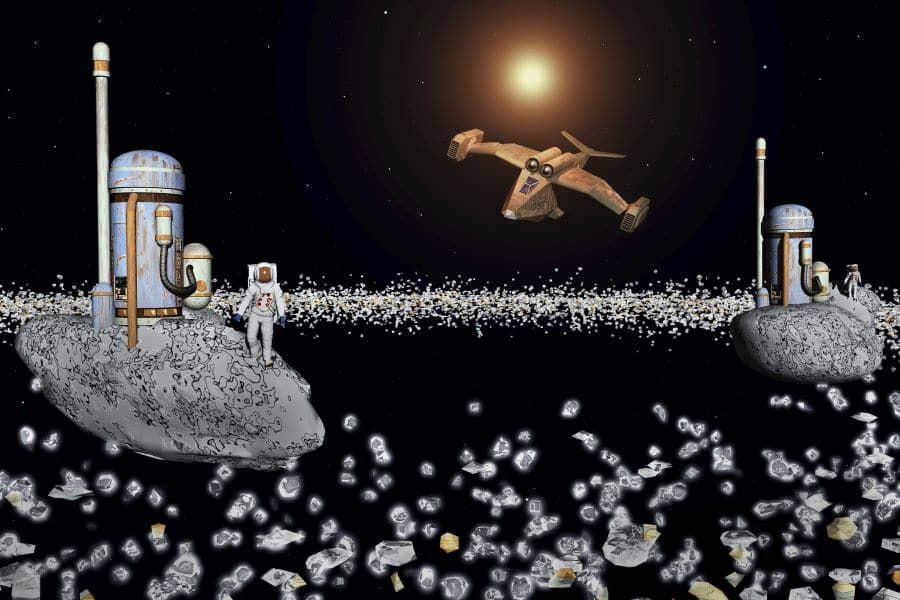
Technology depends on rare earth minerals, but their extraction can harm our planet. Asteroids offer a plentiful source of valuable elements. In the future, mankind will go to the asteroid belt between Mars and Jupiter to mine for the vast wealth that is within the...

by Jessica Moody | 29 Jul 2022 | Environment, Europe
There’s a disconnect between the urgency of climate science and the indifference of governments, media and business to act. Are we too late? Firefighters at the scene of a wildfire in Tabara, Spain, 19 July 2022 (AP Photo/Bernat Armangue) “I want you to...

by Alister Doyle | 29 Jun 2022 | Environment
Governments often set, then fail to meet, goals for fighting global warming. Do deadlines help? Or does “blah blah blah” of unkept vows hurt the planet? Climate activist Alizée tied herself to the net at the French Open tennis tournament in Paris, France, 3 June 2022....

by Monica Kidd | 22 Apr 2022 | Decoders, Economy, Educators' Catalog, Environment, University of Toronto Journalism Fellows
I am interested in carbon credits — permits that offset greenhouse emissions. So I bought a tonne of carbon. Here’s what I learned. (Photo courtesy of Cory Willis of Willis Farms, Inc. in Tennessee, United States) Anyone with a credit card and the inclination...
Climate change is an existential challenge that resonates particularly strongly with young people, but much of the debate around how to limit global warming to 2 degrees Celsius remains abstract. Carbon credits are considered part of the solution, but just what is a carbon credit? Monica Kidd, a Global Journalism Fellow at the University of Toronto Dalla Lana School of Public Health, asked herself that same question, but instead of simply consulting a text book, she went out and bought a tonne of carbon for $15 and then listened to the farmer who made the sale explain how it works and why carbon credits are not a silver bullet in the climate fight. Understanding the complexities of problems is the sine qua non to pinpointing solutions.
Exercise: Break students into groups and ask each group to buy a tonne of carbon and then explain how they have contributed to the fight against global warming and why it is not enough.

by Jeremy Lovell | 28 Mar 2022 | Decoders, Economy, Environment
Efforts to combat global warming can clash with our addiction to economic growth. Even the global benchmark of success, GDP, is flawed. (Photo courtesy of the Bennett Institute of Public Policy/@kazuend) Mixed and often contradictory messages are turning the task of...

by Tira Shubart | 23 Mar 2022 | Environment, Technology, World
Poor nations are hardest hit by extreme weather, but they can lack resources to produce forecasts that can save lives. Now something is being done. (Courtesy of the World Meteorological Organization/Sandro Puncet – Croatia) The science of meteorology focuses on...

by Richard Hubbard | 17 Mar 2022 | Asia, Economy, Environment, Technology
Australia has been slow to combat global warming. Now wealthy entrepreneurs are picking up the mantle to drive change. A mannequin depicting a child covered in coal is seen during an Extinction Rebellion Protest in Brisbane, Australia, 22 April 2021. Australia is one...

by Susanne Courtney | 11 Mar 2022 | Educators' Catalog, Environment, Politics, Ukraine, World
The Arctic has long been a region of peace. Russia’s invasion of Ukraine is jeopardizing cooperation in the vast zone threatened by climate change. An Inuit family in Quinhagak, Alaska, 2015 (Photo by Brian Adams, courtesy of the Inuit Circumpolar Council)...
War in Ukraine has unleashed a tsunami of ink – about geopolitics, military alliances, weaponry, diplomacy, history. A relatively little noticed but hugely important angle is the future of the Arctic, which has eight nations, including two nuclear powers, the United States and Russia, staking a claim to portions of the vast region. Susanne Courtney introduces us to the relatively little known Arctic Council, which is sure to assume more and more importance as global warming opens up new shipping routes and facilitates the extraction of valuable natural resources. It’s never too early to be ahead of the news curve.
Exercise: Ask your students to debate the resolution: “Seven member states of the Arctic Council acted unwisely in boycotting talks with Moscow after Russia invaded Ukraine.”
