
We absorb ideas the way we absorb language, not through argument but through immersion, until the position becomes indistinguishable from thought itself.
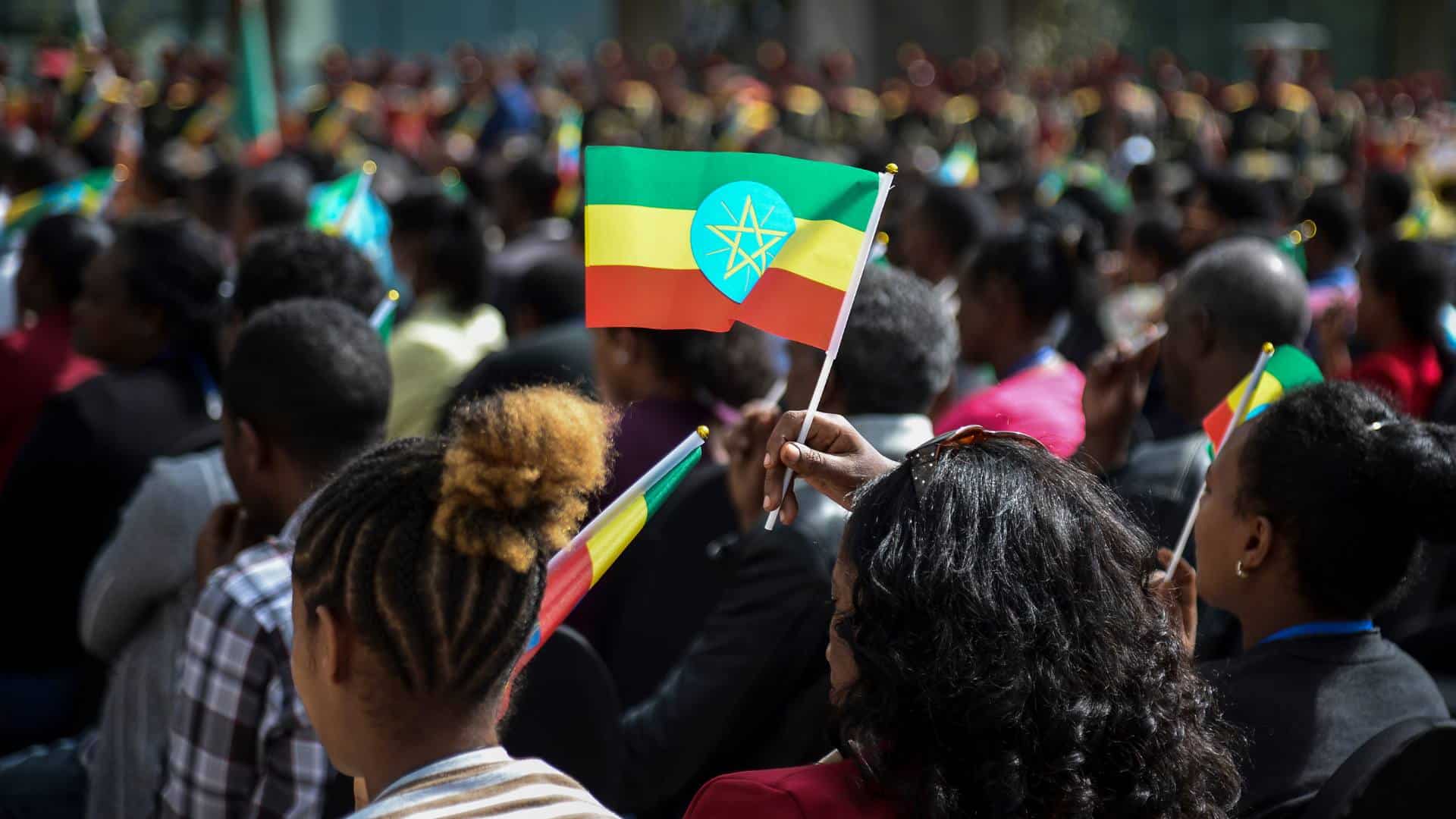
A woman holds an Ethiopian flag at a ceremony to remember soldiers who died. Addis Ababa, Ethiopia 3 November 2022. (AP Photo)
This article was produced out of News Decoder’s school partnership program. Eman Amede is a student at African Leadership Academy in South Africa, a News Decoder partner institution. Learn more about how News Decoder can work with your school.
The room was bright, institutional, the kind of neutral space that belongs to no one. We were doing introductions at a U.S. Embassy summer program in Addis Ababa, standing up one by one, saying our names, saying where we were from. When my turn came, I spoke easily. Home felt like something stable I could claim without thinking.
Then Mahlet, a young woman, stood up. Initially, her voice was controlled, the way you speak when you have learned to hold yourself together in public.
My name is Mahlet, she said, I am from Mekelle.
She talked about her city not as a location but as something living that had been irreversibly altered. About checking her phone every morning to find out whether her family was still alive. About drones. The sounds of bombs. About neighbours who were gone.
But when she spoke about the other side, something else entered her voice alongside the grief, a kind of closure. She knew who the war had happened to. She knew who had caused it. Those two things were settled for her the way they had once been settled for me, just from the opposite direction. Her suffering and her certainty had fused into a single thing. She then broke down.
She wasn’t performing grief for the room. She wasn’t even aware of what she was doing to me.
From abstraction to actuality
I felt like I had been slapped back into reality. Not corrected. Just suddenly awake to something I had been standing next to for years without ever touching. The abstraction had a face. It had a voice that wouldn’t stay steady. It was sitting four feet away from me in a plastic chair and I had no idea what to do with that.
When the Ethiopian Ethnic war began in 2020, I was thirteen. Every night at eight, someone turned on the television. It simply became part of our evening routine. There were two channels we trusted. We switched between them and listened carefully.
The narrative was clear: the government was protecting Addis Ababa and the military action was framed as the barrier between my family and violence. My family had relocated because of real threats. I believed this the way you believe in facts rather than positions. We were being threatened. The government was responding. What else was there to say?
The death tolls came on screen every night. Hundreds. Thousands. Eventually hundreds of thousands. I heard those numbers and felt something I now find difficult to name: not grief, not unease, but a kind of grim relief.
The deaths were the cost of our defence and the cost felt justified, felt necessary, felt like the only honest accounting of a situation where the alternative was our own vulnerability.
What we accept without question
I never questioned this. The belief wasn’t something I had examined and found sound. It had never needed examining because it felt so completely, obviously true. Like standing on solid ground. Like being on the right side of something clear.
There is a particular kind of belief that never announces itself as belief. It arrives quietly, through repetition and fear, and by the time it is fully inside you it no longer feels like something you chose; it feels like something you simply know. Belief formation is not a dramatic event. It does not feel like indoctrination from the inside. It feels like growing up.
The mechanism operates through the voices we are given access to, the fears those voices speak to, the distance we are kept from the consequences of what we come to believe. We absorb positions the way we absorb language, not through argument but through immersion, until the position becomes indistinguishable from thought itself.
I believe that the things we hold most passionately are often the things we have examined least. The intensity of a conviction tells us only how long it has gone unquestioned.
American philosopher Amélie Rorty argues that the intensity of a feeling doesn’t make it moral. The certainty we feel, the ease with which we defend our positions, the righteous clarity that accompanies our deepest convictions, none of it is evidence that we have reasoned our way to truth.
It is evidence only that we have absorbed something so thoroughly it has become invisible to us. We can hold positions intensely and defend them vigorously, all while never having done the work of examining whether they survive scrutiny from an angle that doesn’t already confirm what we need to believe.
Certainty imposed
What I didn’t understand then was that somewhere, another 13-year-old was also at home at eight o’clock. Except she wasn’t watching the news. She was inside the war, checking her phone with a dread I will never fully understand. But she too had deaths that felt justified.
The same mechanism had worked on her just as completely, fed by real grief, real fear, real atrocity, just aimed in the opposite direction. Neither of us had chosen our certainty. It had been chosen for us by what we feared and what we needed to be true.
This is not a story about a war. It is a story about how any of us come to believe what we believe. The war is simply where I first became visible to myself. The same formation happens everywhere, in the community that never examines its politics, in the individual who has never sat with the possibility that what feels most obvious to them is the thing they have thought about least. The content changes. The mechanism does not.
Philosopher John Rawls wrote that moral reasoning begins with lived experience, not abstract rules. But so much of what we call lived experience is mediated, filtered through screens, through authority, through the fears of where we happened to be born.
Sitting in that embassy room at 17, I wasn’t thinking any of this. I just felt the slap of it, the violent disorientation of something I had only ever handled as abstraction suddenly refusing to be abstract. The belief didn’t collapse. It just suddenly had weight it had never had before, like I had been carrying something without knowing how heavy it was until I was finally made to hold it properly.
The power of imagination
English philosopher Bernard Williams argues that you cannot defeat the amoralist with logic, you defeat him with imagination. I had never truly imagined what I claimed to understand. I had positions I could articulate and defend, but I had never done the imaginative work of recognizing that my certainties corresponded to actual human consequences.
Mahlet didn’t argue with me. She didn’t even know what I believed. She just existed in the same room, carrying her own version of the same formation I was only beginning to examine and that was enough to make the distance I had been living in suddenly visible.
American Philosopher Thomas Scanlon writes that blame is not merely judgment, it is the recognition that a relationship has been damaged. What I felt wasn’t blame directed outward. It was the quiet recognition that something in my relationship with my own beliefs had cracked.
I could not pretend anymore that my certainty had been neutral, that it had been built on genuine examination rather than on the comfort of never having to imagine beyond my own position.
Real moral reasoning requires examining not just what we believe but how we came to believe it. Whether we chose our positions or whether they were chosen for us by the voices we heard, the fears we carried, the distance we maintained. Suffering is real. Grief is real. But neither exempts us from the mechanism.
Learning to question
Now, when I encounter certainty spoken with calm authority, in any domain, on any subject, I find myself asking different questions. Not whether the position is right or wrong, but whether it has been held responsibly.
I ask whether the person has done the imaginative work their certainty claims. Whether they have examined how their beliefs formed, or simply accepted what arrived through repetition and fear.
These questions apply to myself as much as anyone. My beliefs weren’t a mirror of reality. They were a map of my position in relation to it, which voices I had learned to trust, how far I was from the consequences of my own certainty, how little imagination I had ever been asked to use.
The strongest beliefs are sometimes the ones we’ve thought about the least, held precisely because they’ve never been tested against anything that would require us to imagine beyond our own comfortable position.
Certainty without examination isn’t moral conviction. It’s just the successful transmission of beliefs we never learned to question.
Questions to consider:
1. Why do we accept so many ideas without questioning them?
2. What must happen for someone to change their mind about something they were sure of?
3. Can you think of something you thought you knew for sure only to find out you were wrong?
Eman Amede is from Addis Ababa, Ethiopia. Fascinated by people, what shapes our morals, how our minds work and why we do what we do, Eman loves cooking, conversations that challenge how we think and questioning paths instead of blindly following them. Eman is currently studying at African Leadership Academy, dreaming of sharing ideas that make us pause and think deeper.
I really liked how this piece captures something we all experience, those moments when a belief we held with confidence suddenly shifts. It doesn’t feel like weakness, it feels like growth and honesty, and the article explains that change as part of learning, not failure.