
Frustrated with their government and inflamed by the death of an activist, mobs turn their anger on the press.
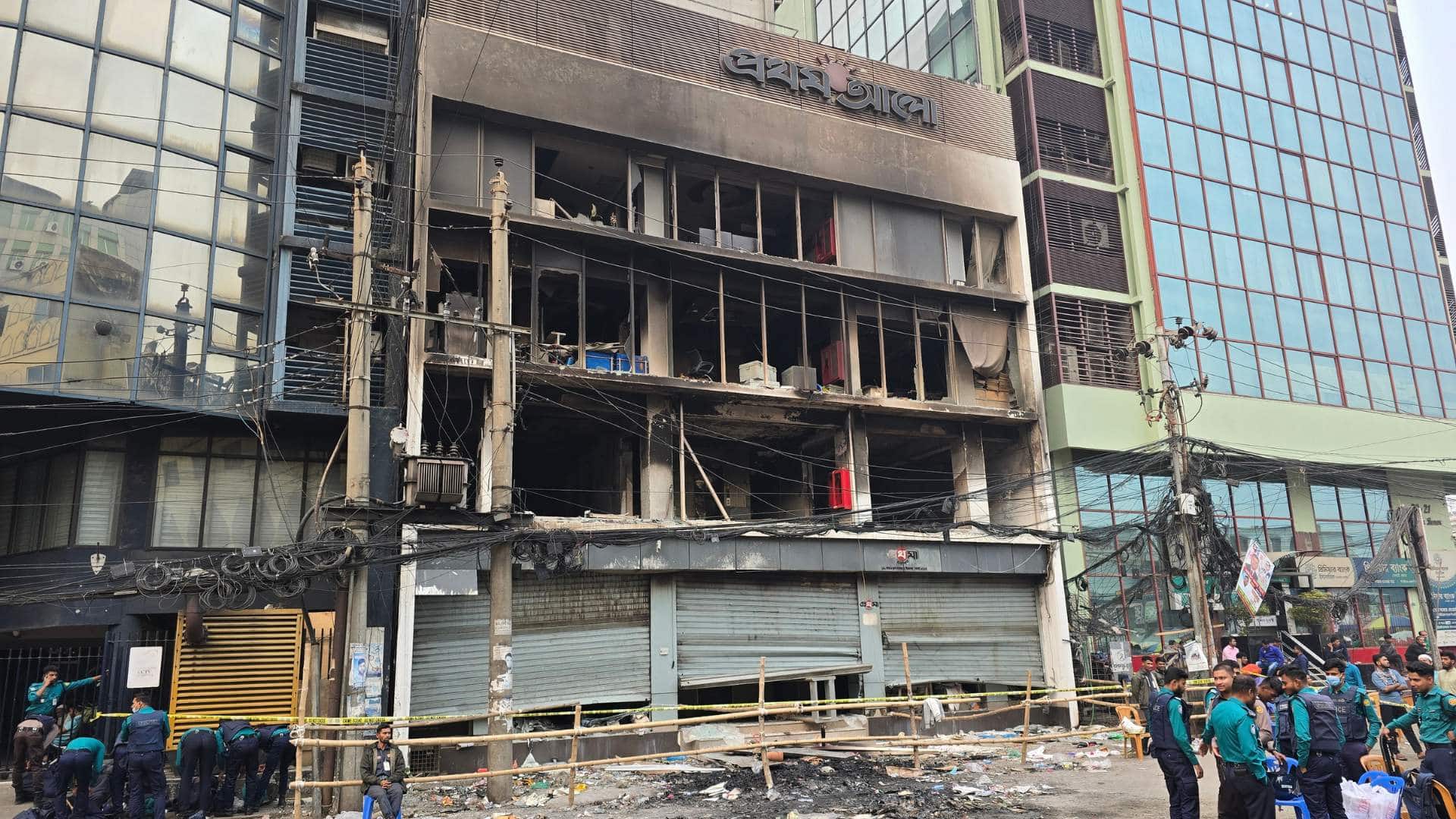
The burnt exterior of Prothom Alo’s office on 20 December 2025. (Photo by Sakib Howlader courtesy of Wikimedia)
This article was produced exclusively for News Decoder’s global news service. It is through articles like this that News Decoder strives to provide context to complex global events and issues and teach global awareness through the lens of journalism. Learn how you can incorporate our resources and services into your classroom or educational program.
In the predawn darkness of 19 December 2025, smoke rose above the newsroom district of Dhaka, the capital of Bangladesh, curling into the winter sky. Frightened journalists scrambled for exits. Inside the offices of Prothom Alo and The Daily Star, Bangladesh’s two most influential newspapers, desks lay overturned, computers smashed and broadcast equipment reduced to ash.
Protesters — many masked, some carrying iron rods — had stormed the buildings, setting parts of them on fire and trapping staff inside.
The Human Rights Support Society, a national, nonprofit human rights organization based in Dhaka, reports that 197 people were killed in mob attacks between January and December 2025.
“It felt like we were being hunted,” said a senior reporter at The Daily Star, who asked not to be named for safety reasons. “They weren’t just angry at the government. They were angry at us for telling the story.”
The attacks marked a dramatic escalation in Bangladesh’s widening political unrest, triggered by the death of Sharif Osman Hadi, a 32-year-old youth leader and outspoken critic of India.
A killing became a political fault line.
Hadi was shot in the head by unidentified assailants on 12 December as he left a mosque in Dhaka. Six days later, he died in a Singapore hospital.
His death ignited nationwide protests that quickly spiralled into violence, directed not only at the interim government, but at the media itself.
At the heart of the unrest lies a volatile mix of economic frustration, political transition and intensifying anti-India rhetoric, one that has turned journalists into symbolic enemies in a larger geopolitical struggle.
Hadi had risen to prominence during the 2024 student-led uprising that forced former Prime Minister Sheikh Hasina to flee to India after weeks of mass protests.
As a spokesperson for Inqilab Moncho (Platform for Revolution), Hadi positioned himself as a voice of a new political generation, accusing Hasina’s government of authoritarianism and alleging that New Delhi had shielded her regime for strategic interests.
Speculation spreads.
At the time of the attack, Hadi was campaigning for parliamentary elections scheduled for February 2026, elections meant to restore civilian rule after months of interim governance led by Nobel laureate Muhammad Yunus.
Almost immediately after Hadi’s shooting, speculation filled the vacuum left by unanswered questions.
Protesters accused the interim government of negligence, while social media amplified claims, without evidence, that the attackers had fled to India. “India killed Hadi” became a rallying cry in protest marches from Dhaka to Chattogram.
“This wasn’t just about justice for one man,” said Zaheer Ahmad, a political analyst in Dhaka. “Hadi’s death became a vessel for accumulated anger, against the state, against elites, and against India.”
That anger soon found a tangible target. Newsrooms perceived as sympathetic to the former Awami League government — or insufficiently hostile toward India — were singled out.
Media takes the blame.
On 18 December, mobs stormed Prothom Alo and The Daily Star, ransacking offices, looting more than 150 laptops and desktops and torching sections of the buildings. Journalists described choking smoke, emergency stairwells blocked by debris and colleagues helping one another escape through back doors.
“For decades, we reported from conflict zones,” said editor Meezan Khan. “We never imagined our own newsroom would become one.”
The violence spread beyond media houses. Cultural institutions such as Chhayanaut were vandalized.
Nurul Kabir, editor of New Age, was assaulted while trying to help trapped journalists. For the first time in Bangladesh’s history, the country’s two largest newspapers suspended both print and online operations simultaneously.
International press freedom groups reacted with alarm. The UN Special Rapporteur on Freedom of Expression called the attacks “deeply disturbing,” while free speech advocacy organization ARTICLE 19 warned that Bangladesh was entering “a phase of open hostility toward independent media.”
Journalists caught in communal crossfire
As protests intensified, journalists, particularly from minority communities, faced growing danger. On 18 December, Dipu Chandra Das, a Hindu journalist who also ran a small grocery shop in Mymensingh district, was lynched and set on fire by a mob.
Local police cited allegations of derogatory remarks, but colleagues and rights groups say the killing occurred amid politically charged unrest.
In separate incidents, a Hindu factory owner was shot dead in Jashore, and a Hindu woman was gang-raped and tortured in Khulna district. While fact-checkers caution against exaggeration and misinformation, minority communities report a sharp rise in fear since Hasina’s removal.
“Hindus are seen as extensions of India,” said, Mohammad Jameel, a rights activist in Dhaka. “That perception makes them targets when anti-India sentiment spikes.”
Bangladesh’s interim government has condemned the attacks, but critics say protection has been inadequate. Human Rights Watch reports hundreds of journalists detained or charged since August 2024, often under vague accusations of “instigating unrest.”
Economic anger beneath the slogans
Behind the political slogans lies deep economic anxiety. Bangladesh’s economy, once hailed as a South Asian success story, has slowed under inflation, unemployment and post-pandemic strain. Youth unemployment remains stubbornly high, while growth has dipped below pre-Covid levels.
The protests that toppled Hasina began over student job quotas but quickly evolved into broader demands for accountability and reform. Anti-India narratives, framed around water-sharing disputes, trade imbalances and alleged political interference, have offered protesters a clear external villain.
“India has become shorthand for everything people feel powerless about,” said an economist based in Dhaka. “It simplifies complex failures into a single enemy.”
Social media has played a decisive role in amplifying anger. Platforms like X have been flooded with videos, slogans and claims, many misleading or false, blaming India for Hadi’s death and exaggerating communal violence.
Fact-checking organizations have debunked viral claims of “genocide” and mis-captioned videos recycled from unrelated incidents.
Disinformation fuels the fire.
A recent EU DisinfoLab report documented long-running influence operations involving Indian-linked networks spreading anti-Bangladesh narratives, while local disinformation within Bangladesh has fueled communal mistrust. Caught in the middle are journalists, accused simultaneously of serving Indian interests and of endangering national stability.
“We’re attacked online as Indian agents, and offline as enemies of the people,” said, Abdul Qyoom a Dhaka-based reporter. “There is no safe space left.”
The turmoil has implications far beyond Bangladesh’s borders. India–Bangladesh relations, already strained by Hasina’s exile, have deteriorated further amid vandalism of Indian diplomatic properties and cultural symbols. Analysts warn that unchecked disinformation risks inflaming communal tensions in India as well, where reports of anti-Hindu violence, often exaggerated, are used to stoke Islamophobia.
Despite the hostility, India continues to supply Bangladesh with food grains, electricity and water. Yet public perception in Bangladesh remains deeply skeptical.
“Diplomacy cannot survive if public anger is this raw,” said a former Bangladeshi diplomat. “And press freedom is often the first casualty.”
Bangladesh now ranks near the bottom of global press freedom indices. Editors warn of rising self-censorship as reporters weigh professional duty against personal safety.
India-Bangladesh tensions rise.
With elections approaching and political tensions unresolved, journalists fear the worst may be yet to come.
“The press is being punished for reflecting reality,” said Usmaan Ahmad, another senior editor. “When truth becomes dangerous, democracy is already in trouble.”
Relations between India and Bangladesh have sharply deteriorated since the ouster of Sheikh Hasina, plunging from a “Golden Era” of cooperation to a phase marked by recrimination and distrust by January 2026. Tensions escalated after India provided refuge to Hasina following her resignation, a move seen by many in Bangladesh as supporting an “autocratic” leader.
The interim Bangladeshi government has formally sought her extradition to face trial for alleged crimes during the 2024 uprising, and India’s refusal has become a major bilateral irritant.
Violence against the Hindu minority in Bangladesh, including the lynching of Dipu Chandra Das, a 25-year-old Hindu garment factory worker in December 2025, has drawn sharp Indian condemnation.
In response, right-wing groups in India staged protests near the Bangladesh High Commission New Delhi and vandalized the visa center in Siliguri, further deepening mutual suspicion between the two countries.
Questions to consider:
1. Why do some people blame the news media when political actions make them angry?
2. Why did people in Bangladesh attack the offices of Prothom Alo and The Daily Star?
3. Who do you tend to blame when something angers you?

Tauseef Ahmad is a Delhi-based freelance journalist. He has worked with news organizations including The News International, Al-Jazeera, Article 14, Polis Project, Fair Planet and Mongabay. He tweets @wseef_t.

Sajid Raina is a Delhi-based freelance journalist and has worked with news organizations including The News International, Article 14, Diplomat, Fair Planet and Polis Project. He tweets @SajidRaina1.