
Pope Leo XIV, the first pontiff from the United States, has become a quiet foil to his most prominent compatriot, U.S. President Donald Trump.
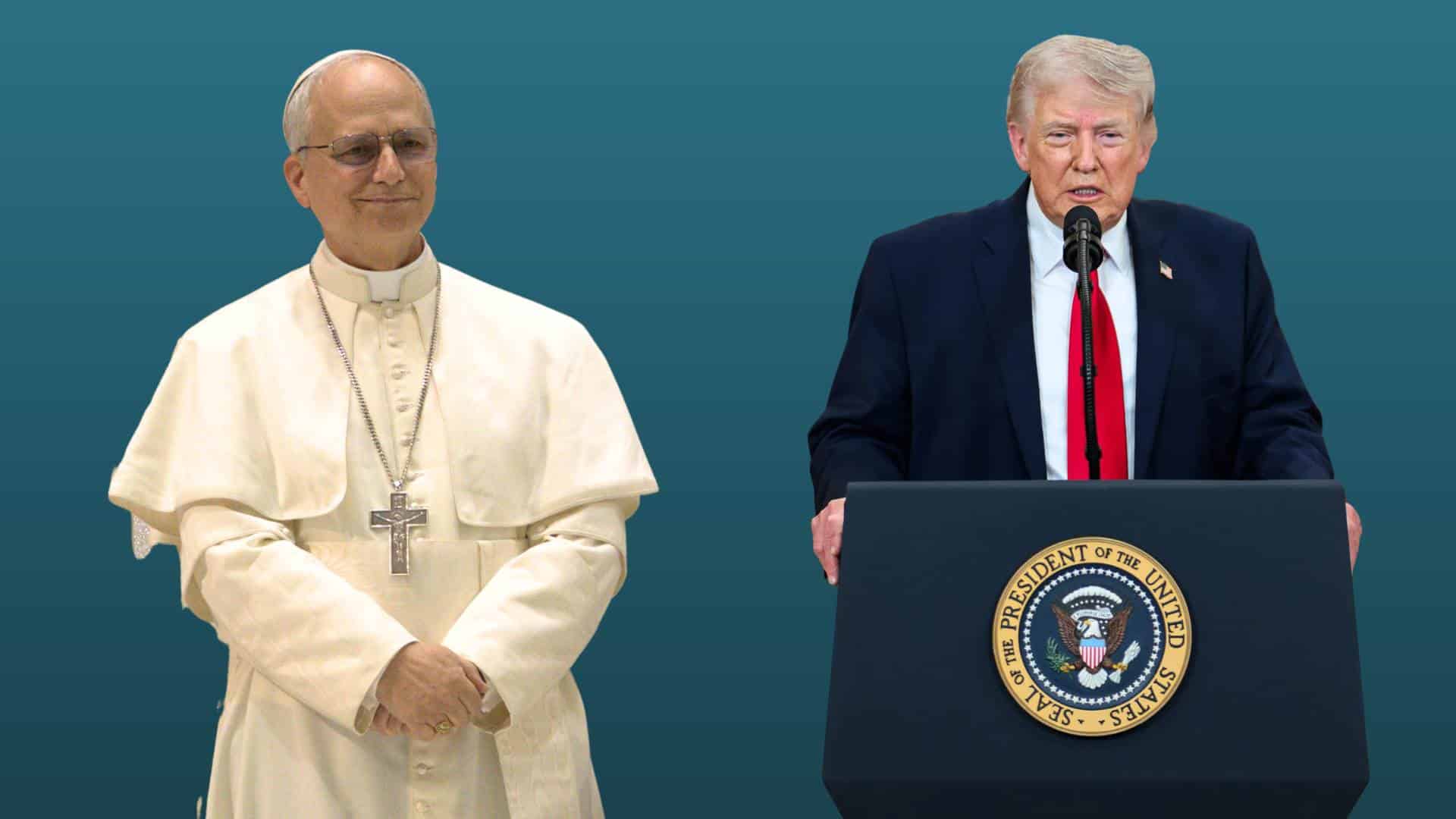
Donald Trump and Pope Leo XIV. (Illustration by News Decoder)
This article was produced exclusively for News Decoder’s global news service. It is through articles like this that News Decoder strives to provide context to complex global events and issues and teach global awareness through the lens of journalism. Learn how you can incorporate our resources and services into your classroom or educational program.
Context is one of the most important elements in a news story. Without context, there is no news. Pope Leo XIV, the first American to lead the Roman Catholic Church, turns out to be quite aware of the context in which journalists will report his words.
In his 11 months in the job, Leo has rarely named names or given off-the-cuff answers like his late predecessor Pope Francis used to do. He doesn’t need to. While he stays diplomatic, reporters read between the lines and give the context he purposely avoids.
After a slow start, his public role has evolved into that of an influential critic of another well-known American, President Donald Trump. In words and in deeds, he has made it clear he has a different view of the role and the future of their common homeland.
He has two advantages. With English the global language, millions hear Leo’s words directly rather than in a voice-over from Italian, Spanish or another language. When he refers to U.S. policy, nobody can brush him off saying he doesn’t understand the United States.
A sharp contrast
Many publications have run stories with headlines like, “Pope Leo XIV criticizes President Donald Trump’s foreign policy” or “Pope Leo XIV hits back at Defence Secretary Pete Hegseth.” Simply put, the stories contrast Trump officials arguing loudly for war and Leo quietly for peace.
But some important context is rarely added. A useful “nut graph” explaining the context would say something like this: “Pope Leo was only saying what Christians can read in their Scriptures or hear in their churches. Jesus preached peace and neighborly love, and told parables about caring for strangers.”
That inspiration doesn’t only reach Catholic ears. Many other Christians, in fact many people no matter what they believe, will respond to this message. It’s Morals 101, simple decency, at a time when there’s little of it in public life.
Overt and not-so-subtle messaging
Leo named Trump only once, during Holy Week this month when a reporter asked about Trump and the Iran war.
“I’m told that President Trump has recently stated that he would like to end the war,” Leo told reporters in English. “Hopefully, he’s looking for an off-ramp. Hopefully, he’s looking for a way to decrease the amount of violence.” Leo occasionally answers questions in fluent Italian or Spanish. This time, it seems, he wanted his words to be crystal clear to Americans.
His Easter Sunday “Urbi et Orbi” (To the City and the World) speech a few days later went back to nameless appeals.
“Let those who have weapons lay them down!” he said. “Let those who have the power to unleash wars choose peace! Not a peace imposed by force, but through dialogue. Not with the desire to dominate others, but to encounter them.”
Calls for war and peace
During a recent prayer service at the Pentagon, Defence Secretary Pete Hegseth pushed a militaristic view of Christianity, asking God to “snap the rod of the oppressor, frustrate the wicked plans and break the teeth of the ungodly. By the blast of your anger, let the evil perish.”
Four days later in his Palm Sunday homily, Leo responded: “Jesus is the King of Peace … he does not listen to the prayers of those who wage war, but rejects them.’”
He quoted the prophet Isaiah, saying: “Even though you make many prayers, I will not listen: your hands are full of blood.”
Things seem to be getting get down and dirty. In the past few days, U.S. news organizations have reported that the Pentagon called in the papal nuncio (the Vatican’s ambassador) last January to make clear that Washington expected the Vatican to toe the American line in the coming Middle East clash, or else.
After this incident, Pope Leo decided not to attend the 250th anniversary celebrations of U.S. independence in Washington which will take place in July.
He vowed instead to go to Lampedusa, the southernmost island of Italy, to greet migrants who succeed in reaching European soil from Africa. He didn’t mention Trump, but the context said it all.
Dueling media coverage
Since becoming pope, Leo has also encouraged U.S. bishops to criticize acts such as the talk of taking over Greenland or the killing of two demonstrators by immigration enforcement agents in Minneapolis in the state of Minnesota.
It has turned the U.S. Catholic Church from the divisive “either-or” view of politics of recent decades to the Church’s more inclusive “both-and” approach. Even the top Catholic chaplain for the U.S. military is now critical.
“It’s hard to cast this war as something that would be sponsored by the Lord,” Archbishop Timothy Broglio told CBS News at Easter.
Pope Leo has also picked more open-minded men to lead several U.S. cities, especially Ronald Hicks, a fellow Chicagoan who, like the pope, has missionary experience in Latin America, to replace the pro-Trump Timothy Dolan as archbishop of New York.
Leo’s U.S. supporters don’t follow him blindly, but they have a vote in the midterm elections this November, the results of which could put the opposing Democratic Party in control of the U.S. Congress.
The Iran war, the rising price of gasoline or the excesses of ICE agents in Minneapolis will probably weigh heavier on their decision than anything that Leo says.
But the pope will have spoken his mind on an issue that troubles him as a Christian and an American. Maybe more people than expected will be inspired to speak out too.
Questions to consider:
1. How does Pope Leo convey his opposition to war without naming names?
2. Why is it important whether Pope Leo speaks in Italian, Spanish or English?
3. Can you think of a time when you needed to express disagreement to someone in power but felt uncomfortable about doing so directly?

Tom Heneghan was a correspondent, bureau chief, regional news editor and global religion editor during his 40 years at Reuters, with postings in Vienna, Geneva, Islamabad, Bangkok, Hong Kong, Bonn and Paris. He covered the Soviet-Afghan war, two papal elections and Germany’s reunification, which he analyzed in his book “Unchained Eagle: Germany After The Wall”. Based in Paris, he now writes regularly for The Tablet in London and Religion News Service in Washington.