
Some think Big Tech is to blame for our inability to get off the social media that has left so many of us depressed. Why is it so hard to turn off the phone?
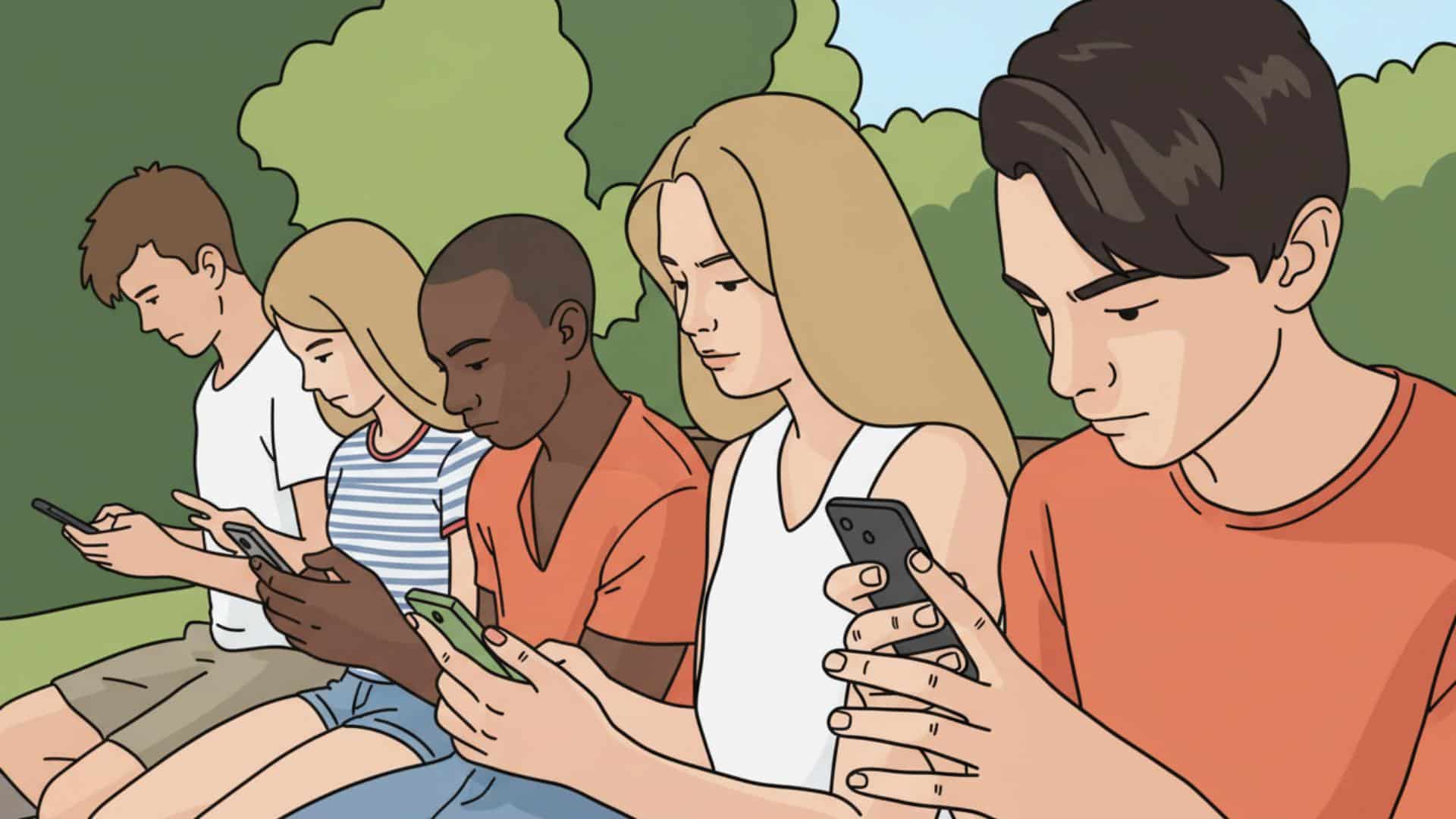
Teenagers on their phones. (Illustration by News Decoder.)
Editor’s note: This week Meta founder and CEO Mark Zuckerberg is testifying in Los Angeles in a trial over allegations that Meta’s social media platforms, along with platforms and applications of the tech giants Google, ByteDance and Snap, have been designed to get children addicted to social media and as a result have created a mental health crisis.
This is the first of what is expected to be thousands of similar lawsuits. At News Decoder, we have been exploring both the good and bad of social media and the many ways young people use it and are affected by it. To put some of the arguments in the Los Angeles trial into perspective we decided to republish a story by Indiana University student Haley Davis, originally published in January 2025, that explores social media addictions and doomscrolling.
We launched Decoder Replay to help readers better understand current world events by seeing how our correspondents decoded similar events in the past.
After hours of mindlessly scrolling on Instagram Reels and clicking through Snapchats, I noticed a feeling of tightening in my temples and a cloud of mental fog.
My eyes had been glued to my phone screen from the hours of 5–7 PM and they suddenly felt strained.
I am not alone in experiencing these effects after hours of scrolling on my phone. The Internet has even given this feeling a name. The term “brain rot,” or the feeling of cognitive, emotional and mental decline that can occur after excessive phone usage, has been used since the early 2000s and is resurfacing on social media platforms like TikTok.
What actually happens when you spend too much time on your phone? Does excessive phone usage really affect our brain?
“It certainly seems to be the case that in some individuals depending on how much and how often they use their phone and social media, there is a detrimental effect,” said Natasha Chaku, assistant professor of psychological and brain sciences at Indiana University.
This seems to affect mental health more than cognition, she said. Since the introduction of phones, our attention spans have definitely decreased. Furthermore, research from a study done at the University of California Los Angeles (UCLA) has shown that specifically in young children, when more time is spent on a phone instead of engaging in an intellectual activity such as reading, there has been an association with poorer development in language.
Aches, pains and eye strains
The UCLA study found that in adults, excessive phone usage could impact sleep quality, which is associated with a higher risk for age-related cognitive issues and Alzheimer’s disease.
While this evidence suggests that there may not be a direct link to major cognitive changes after hours of scrolling on social media, the experience of the feelings of “brain rot” has been felt by others.
Spending a large amount of time on his phone leaves Indiana University student Ethan Brown feeling that he has wasted his time and been unproductive. “I definitely feel some eye strain and sometimes have a headache when I have too much screen time,” Brown said.
In contrast, when I pick up a book or engage in another stimulating activity instead of scrolling on my phone, I notice that my attention span becomes more focused, my vocabulary feels sharper and my head feels clearer. These moments leave me feeling more accomplished with my time and free of the mental fog I might experience while scrolling on social media.
If someone gets stuck into an addictive cycle of social media scrolling what does this do to our brains long term? Chaku said that might depend on the person and circumstances.
“I think it is complicated because associations might be true for one group of people and not for others,” Chaku said. “It also might be true at different times of your life and not others, or it might be true for certain regions of your brain or not others.”
Young people, addicted.
The effects will likely be stronger the younger you are.
“Young people have really plastic and sensitive brains which means their brain is attuning itself to its environment,” Chaku said. “So the effects that we see in adults will likely be exacerbated in young people and adolescents because they are still learning and their brain is still developing.”
Despite the physical and mental effects of too much phone time, not much evidence points to a direct link to cognitive changes in the brain from extended phone usage.
However, reducing screen time and being mindful of the content we consume can help limit the physical and mental discomfort that comes with spending too much time on digital devices.
Plus, if you put your phone to sleep and look up and around, you might see something much more interesting. There is a whole world out there waiting for your attention.
QUESTIONS TO CONSIDER:
1. What is meant by “doomscrolling”?
2. What affect does hours of phone scrolling have on your brain?
3. What would you do if you had no digital device for a week?

Haley Davis is a student at Indiana University studying media advertising. In her free time she enjoys reading, yoga, Pilates and going on walks with her dog, Mazie.
I would walk a lot more, If I had not a cellphone