
In a world where things move so fast, people travel from over the world to appreciate the timelessness of books written by human hand, on paper.

Translations of books by James Joyce on display at the Museum of Literature Ireland. (Illustration by News Decoder)
This article was produced exclusively for News Decoder’s global news service. It is through articles like this that News Decoder strives to provide context to complex global events and issues and teach global awareness through the lens of journalism. Learn how you can incorporate our resources and services into your classroom or educational program.
The most surprising thing about the MoLI in Dublin was the number of people in it.
We went to the Museum of Literature Ireland on a grey Sunday morning, expecting to be the only ones there. I mean, who besides two book nerds would want to spend a day off in a museum about old books?
I’m a Joycean, one of those people at the extreme end of the nerd scale, obsessed with the Irish writer James Joyce, whose book “Ulysses” has long been considered one of the most important novels ever published.
For me, the most exciting part of the museum wasn’t the very first copy of “Ulysses” ever printed. It was the three young tourists excitedly taking photos of each other beside the glass case that housed it.
There were some 80 people in the museum when we got there, of all ages, and by eavesdropping on conversations it was clear that a good number of people weren’t Irish or even English speaking.
Tourists take photos next to the first printing of “Ulysses”. (Photo by Marcy Burstiner)

First edition of “Dracula” by Bram Stoker. (Photo by Marcy Burstiner)
A worldwide wonder over words
Once through the exhibits, I began to understand the attraction of a museum of Irish literature for people from other countries.
On one large wall hung covers from various Joyce books — “The Portrait of the Artist as a Young Man”, “Ulysses”, “Dubliners” — in dozens of languages, everything from Korean to Turkish to Portuguese.
I struggled through “Ulysses” and English is my native tongue. I couldn’t imagine what it would be like to read a Japanese translation.
How does a work created by one person find devotees in every country and throughout every decade?
One answer came in another display, this time of pages of Joyce’s notebooks where viewers could see not only his handwritten drafts of his books, but all the crossings-outs in red marker. It seems that to craft a work of genius is an ugly process.
The museum wasn’t all about Joyce. You could take a selfie besides the first edition of Bram Stoker’s “Dracula” as well. The museum explored the breadth of Irish literature from the past — Oscar Wilde, George Bernard Shaw and Samuel Beckett (his typewriter is there).
But the overall message of the Museum of Literature Ireland wasn’t that such works are in the past. It explored the works of contemporary authors like Maeve Binchy and John Banville as well.

Edits by James Joyce to a page of a draft novel. (Photo by Marcy Burstiner)

First lines of a novel crafted by visitors to the MoLI. (Photo by Marcy Burstiner)
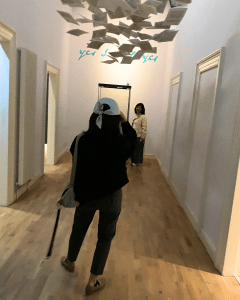
This was no dusty library. In one room towards the end was a long table covered with pencils and blank square of paper. It encouraged visitors to craft a first sentence of their own story. The wall beside the table was covered with the first lines that people had crafted.
Perhaps a hundred years from now, tourists will take selfies beside the first edition of a book that begins with the words on one of those scraps of paper, after it has been translated into a hundred languages.
What would be the first line of your story?
Questions to consider:
1. Can you think of one book you read that stuck with you?
2. Why do you think there are still many people who read books in paper form?
3. If you were to write the story of your life how would you start it?

Marcy Burstiner is the educational news director for News Decoder. She is a graduate of the Columbia Journalism School and professor emeritus of journalism and mass communication at the California Polytechnic University, Humboldt in California. She is the author of the book "Investigative Reporting: From premise to publication."