
Society places value on being social. When we choose to bow out, people wonder what’s wrong. But sometimes healthy “me time” means: Just me.
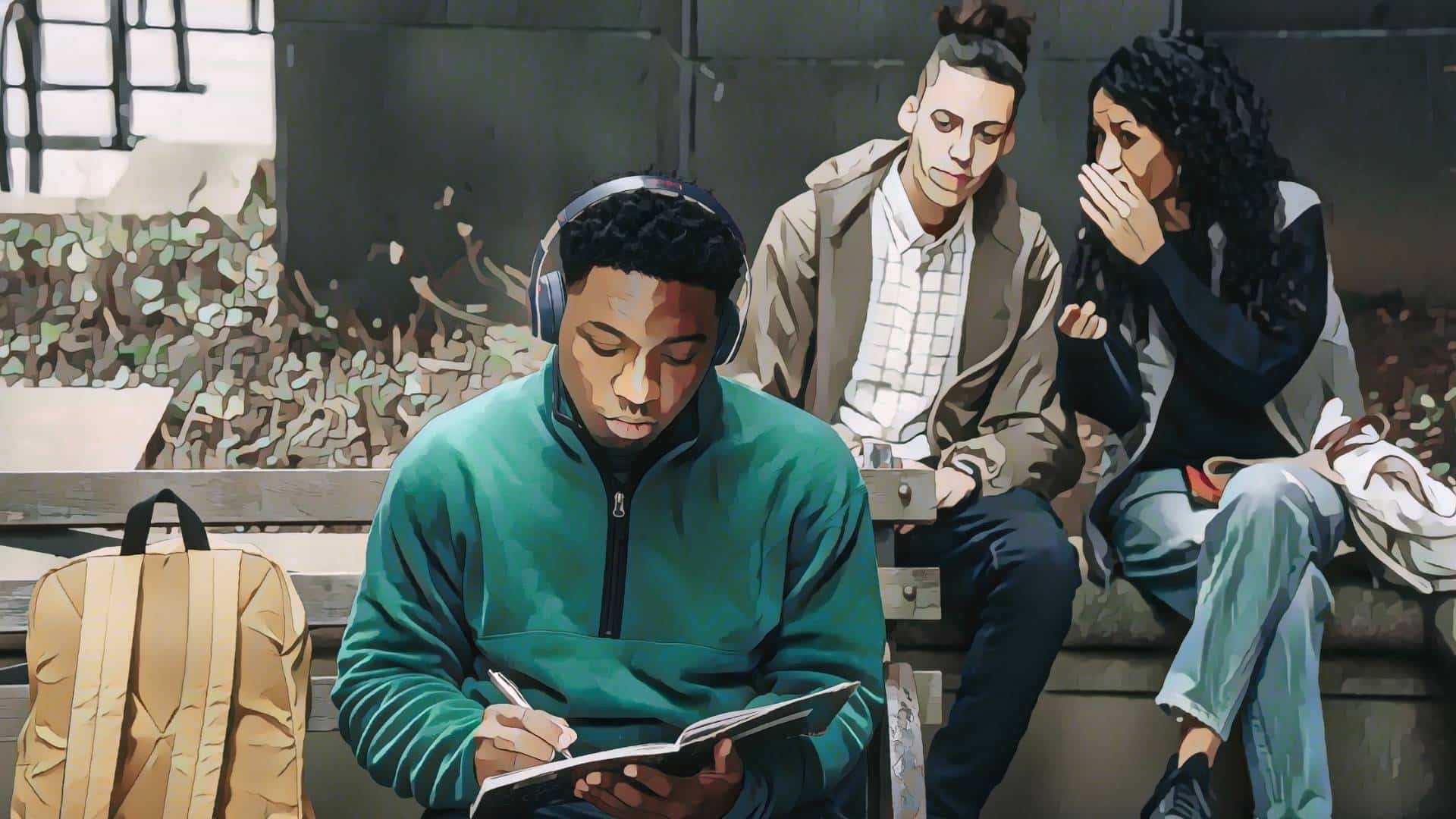
Two teens make fun of one who sits alone. (Illustration by News Decoder)
This article, by student, Mahara Mmangisa, was produced out of News Decoder’s school partnership program. Mahara is a student at African Leadership Academy in South Africa, a News Decoder partner institution. Learn more about how News Decoder can work with your school.
I’ve never had trouble making friends or interacting with people. Ironically, this led to me being misunderstood quite a lot of the time.
There’s a common assumption that extroverts always want to be surrounded by people. For me, this was never entirely true. As I grew up, I often found myself feeling drained after certain gatherings and events, but I could never pinpoint why. The confusion was real, wasn’t I supposed to thrive in social settings?
Everything changed when I was introduced to the concept of boundaries. I realized it wasn’t that I didn’t want to be around people anymore. Rather, I had been stretching beyond my limits to satisfy those around me, driven by a deep-seated fear of ending up alone.
First, I had to make peace with being alone. This was not easy.
In my old school, clique culture dominated, and I was part of one. If I sat alone in the dining hall during a meal, I would suddenly be labeled as “depressed” or a zoba (which means fool).
Learning to be alone
The social pressure was suffocating. There was an unspoken rule: visibility equals validity. If you weren’t seen with your group, something must be wrong with you.
But I pushed through. I began excusing myself from some weekend outings to recharge. The first time I did this, I felt guilty, almost anxious. I kept checking my phone, scrolling through stories of my friends at events I’d declined. With my fear of missing out (FOMO) the pressure felt very real and relentless.
Yet something unexpected happened during those moments of solitude. I started sitting alone during meals, initially with my headphones in as a shield against judgment. I used that time for serious reflection about my life and where I wanted it to go. I journaled. I allowed myself to simply be without performing for anyone.
What initially felt like social suicide gradually became an act of self-preservation. I discovered that being alone didn’t mean being lonely. In fact, those quiet moments became the foundation for understanding who I truly was beneath the social performance. I learned my own rhythms, when I had energy to give and when my tank was running empty.
This self-awareness became invaluable.
Setting boundaries
Second, I had to establish clear boundaries. This meant analyzing what made me uncomfortable, identifying who and what drained my energy, and taking the necessary steps to protect my peace. As harsh as it may sound, it was essential.
The process started with honest self-assessment. I began noticing patterns: certain friends always left me feeling exhausted, not because they were bad people, but because our interactions were one-sided. I was the listener, the problem-solver, the emotional support, but rarely the one being supported. Some social settings left me energized while others left me depleted. I had to acknowledge these truths without guilt.
I created practical boundaries: I learned to say “maybe” instead of an automatic “yes,” giving myself space to check in with my actual desires; I limited my time at gatherings, arriving late or leaving early when I needed to; and I stopped explaining or justifying my need for space.
“No” became a complete sentence.
I remember when a friend once showed up to pick me for a party, but I wasn’t really in the mood to be out and about. The old me would have jumped at that invitation regardless of how I was feeling, worried about disappointing them or missing something important. But I caught myself saying, “Nah, I’m good, bro.”
Avoiding energy vampires
The silence that followed was deafening. My friend looked confused, almost offended. But I held firm. I explained that I needed to recharge, that it wasn’t personal. To my surprise, they understood, eventually. Some friends adapted; others drifted away. Both outcomes taught me valuable lessons about authentic connection.
This was particularly difficult because of my FOMO. I’ll admit, I didn’t always succeed. At times, I still fell into the trap of saying yes when I should have said no, then regretting it as I forced myself through another draining evening or day. But each time I honored my boundaries, it became a little easier. I was training myself to prioritize my well-being over social approval.
Finally, I learned to identify and avoid “energy vampires.”
In an article published on Medium, Emily Sheen discusses how extroverts tend to self-sabotage by avoiding alone time, and she highlights the benefits of solitude. Reading it felt as though she was speaking directly to me. She articulated something I’d been experiencing but couldn’t name: extroverts can burn out not from the socializing itself, but from socializing without boundaries.
Energy vampires are those colleagues, friends or family members who drain you dry, leaving you depleted rather than fulfilled. They’re not necessarily malicious; many don’t even realize the effect they have. But the impact is real.
Categorizing friendships
I identified several types in my own life:
The Crisis Friend: Always in emergency mode, always needing immediate support, but never available when you need them. Every conversation is about their latest drama, and you leave feeling emotionally wrung out.
The Guilt-Tripper: Makes you feel bad for having boundaries. “You never hang out anymore.” “You’ve changed.” “Remember when we used to do everything together?” They use nostalgia and obligation as manipulation tools.
The One-Upper: Can’t let you have a moment. Share good news? They’ve got better news. Share a struggle? They’ve struggled worse. Every interaction becomes a competition you never signed up for.
The Chronic Complainer: Refuses solutions, only wants to vent repeatedly, about the same issues. You offer advice; they explain why it won’t work. You offer support; they continue wallowing. It’s an endless cycle that leaves you frustrated and drained.
Fine tuning friendship
Once I identified these patterns, I had choices to make. With some people, I reduced contact gradually: fewer hangouts, shorter conversations, strategic unavailability. With others, I had direct conversations: “I care about you, but I need our friendship to be more balanced.” Some relationships improved; others ended. Both results were necessary.
I also learned to protect my energy during unavoidable interactions. I set time limits before meeting certain people. I practiced mental boundaries, reminding myself that I’m not responsible for fixing everyone’s problems. I stopped taking on other people’s emotional burdens as my own.
The most liberating realization? Not every relationship deserves unlimited access to your energy. Protecting your peace isn’t selfish, it’s self-respect. And the right people will not only understand this but will appreciate you more for it.
The journey toward understanding my boundaries has taught me that being an extrovert doesn’t mean being endlessly available.
It means knowing when to engage and when to retreat, when to say yes and when to protect your energy. Most importantly, it means recognizing that time alone isn’t loneliness, it’s self-care.
Questions to consider:
1. What does the author mean when he describes himself as an “extrovert”?
2. What does it mean to set boundaries for yourself?
3. When was the last time you felt pressured to do something with friends that you didn’t want to do?

Mahara Mmangisa is in the second year at the African Leadership Academy and has a deep passion for entrepreneurship, music and community well-being. He thrives on creating opportunities, bringing people together and turning ideas into action. Driven, detail-oriented and energetic, Mahara aspires to make a meaningful impact through innovation, leadership and service.
Interesting how as an introvert, I somehow understand where you’re coming from.
Not gonna lie, at first, this article comforted me a bit since the measures to the problem you had are what I did on a daily basis; then I realized I’m the complete opposite of the targeted audience.
Nevertheless I get that the goal is to achieve a social balance.
Very impressive, Mahara. I really enjoyed reading your article and found myself relating to so much of what you shared. Many of us struggle with setting boundaries, and before we realise it, we are exhausted from constantly showing up for others while forgetting to care for ourselves.
Over time, I’ve come to understand that we cannot pour from an empty bucket. When we learn to prioritise our wellbeing and set healthy boundaries, we actually become better equipped to support those around us. Thank you for sharing such a thoughtful and relatable reflection.
My favourite statement in the article and I quote “means knowing when to engage and when to retreat, when to say yes and when to protect your energy. Most importantly, it means recognizing that time alone isn’t loneliness, it’s self-care.”
Thank you for this