
Young people across the globe are taking to the streets. In Morocco one demand is clear: Give us an education that helps us navigate the world we live in.
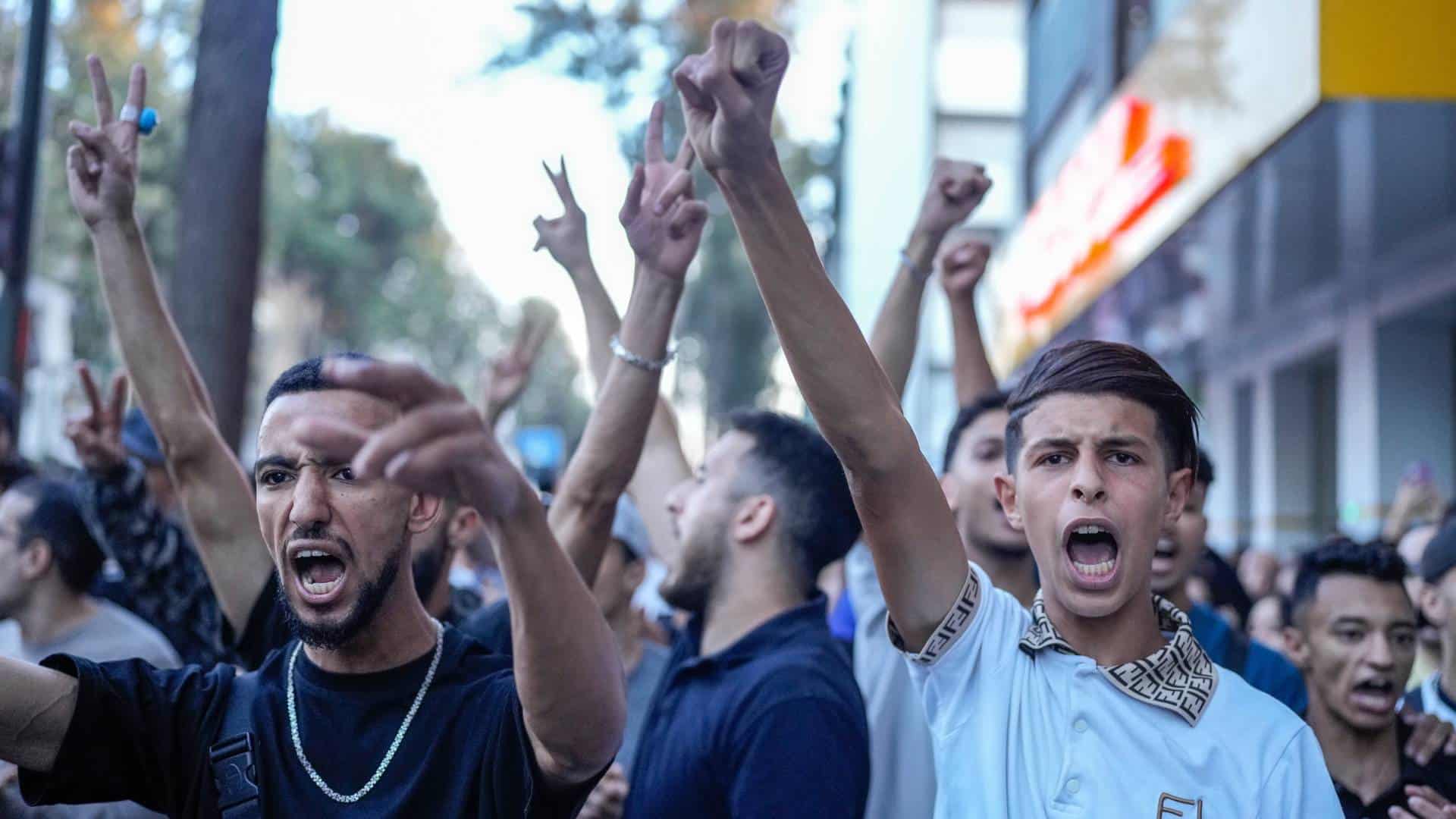
People take part in a youth-led protest against corruption and calling for healthcare and education reform, Rabat, Morocco, 2 October 2025. (AP Photo/Mosa’ab Elshamy)
This article by student Ahmed Elias Koudir was produced out of News Decoder’s school partnership program. Ahmed is a student at African Leadership Academy in South Africa, a News Decoder partner institution. Learn more about how News Decoder can work with your school.
In late September 2025, young people began gathering in the streets of Rabat, Oujda, Casablanca, Agadir and other Moroccan cities. Most were students or recent graduates. Many had never protested before. They held signs asking for better education, better healthcare and an end to corruption.
Police sirens replaced lectures. Classrooms emptied.
Online, the protests came to be known as Gen Z 212. Videos spread quickly on social media and through Discord servers. Young people watched clips from Nepal, Madagascar and Peru, then shared footage from their own streets. The images looked familiar. Crowds. Shouting. Smoke. Phones held high.
Moroccan researcher Marouane El Bahraoui said anger moved faster than ideas. Social media pushed emotion first. Frustration. Outrage. The feeling that something had to happen, even if no one agreed on what came next.
In Morocco, corruption was one of the loudest demands. Young people talked about public money, political elites and lack of accountability. Similar anger appeared elsewhere. In Nepal, protesters targeted the children of politicians, often called “nepo kids,” whose luxury posts stood in sharp contrast to unemployment and inflation.
In Madagascar, protests grew after years of anger toward a president who came to power following a military coup. In Peru, protesters set fire to parliament buildings, fueled partly by images circulating online.
Each country had its own trigger. In Morocco, one issue kept returning: Education.
Students marched for their future.
Many protesters were still in school or had just finished. They were not marching for a distant future. They were reacting to a system they were living inside every day.
One of them was Amin Boussada. Amin was 19 years old. He studied at Mohammed First University in Oujda. On 30 September 2025, he joined a protest near his campus. During clashes between protesters and security forces, a police vehicle struck him. Videos of the moment quickly spread online. Amin was taken to CHU Mohammed VI hospital in critical condition. His injuries were severe.
His case traveled fast. In Casablanca, students marched carrying his photo. Some wrote his name on cardboard signs. For many young people, Amin’s injury made the cost of frustration visible.
He had followed the path that was promised. He studied. He showed up. When that path stopped making sense, he stepped into the street.
The protests continued for weeks. Arrests increased. Demonstrations grew more tense. Several protesters were killed in different cities. Human rights organizations raised concerns about excessive force. The reasons young people protested did not disappear.
Diplomas plentiful, jobs not so much
Youth unemployment stood at around 36%. Many young Moroccans held diplomas but jobs remained scarce. Families had invested years of savings into education, believing it would lead to stability. Instead, many graduates waited at home. Others worked informal jobs unrelated to what they studied.
Inside schools, education remained heavily focused on exams. Success meant memorizing content and reproducing it on paper. Morocco’s system still follows structures shaped during and after the colonial period, especially the French model.
Language sits at the center of this problem. Mathematics and science are often taught in French, a language many students do not speak at home. Other subjects are taught in formal Arabic, which also differs from daily speech.
Many students grow up speaking Darija or Amazigh, then move between languages depending on the subject, the exam, or the level of school. Learning begins in one language and ends in another.
El Bahraoui described this as a distance problem. Knowledge feels imported. Students spend years translating instead of understanding. They learn how to answer exam questions but struggle to connect lessons to life outside school. School feels foreign.
A disconnect between education and life
Civic education is another gap. During the protests, young people spoke openly about corruption and accountability. Yet many lacked a clear understanding of how political institutions actually work. Parliament. Executive power. Courts.
El Bahraoui said this matters. When political education is missing, anger replaces strategy. Movements struggle to last. Leadership remains unclear. Responsibility becomes blurred.
That showed during the protests. Most criticism focused on Prime Minister Aziz Akhannouch and his government. The role of the monarchy remained largely untouched. In Morocco’s political system, that silence carries weight. Avoiding certain questions limits how far protest movements can go, even when frustration is widespread.
Education systems also struggle to develop skills that can’t be measured by exams. Extracurricular activities remain limited in many public schools. Clubs, debate teams, student organizations and entrepreneurship programs are rare. Students often spend long days in class, then return home exhausted. School feels like work.
Exploration comes later, if it comes at all.
Other models for education exist.
My own experience reflects this contrast. In Morocco, mathematics and physics meant applying formulas correctly. At African Leadership Academy in South Africa, the same subjects were taught through problem solving. Understanding mattered more than memorization.
Questions addressed how concepts applied to real situations. The difference was clear.
El Bahraoui said exams alone fail to measure intelligence. They reward repetition more than thinking. Systems that rely heavily on grades overlook creativity, leadership and initiative. These gaps matter when jobs are limited and traditional paths disappear.
Inequality deepens everything. Urban schools have more resources than rural ones. Students from villages often fall behind when they move to cities. Private tutoring has become common, giving an advantage to families who can afford it. Teachers themselves face unstable conditions, pushing many to rely on pay from private lessons to survive.
Funding reflects priorities. While Morocco announced a 16% increase in education and health spending in the 2026 budget, comparisons with military and infrastructure budgets continue to raise questions. Where money goes shapes what education becomes.
The link between education and health
Healthcare failures made that link clearer. In Agadir, eight women died during childbirth in a public hospital. Medical students had already been protesting training conditions and lack of resources. For many young people, education and healthcare appeared tied together. Years of study did not guarantee protection, dignity or trust in public systems.
By mid-October 2025, King Mohammed VI addressed Parliament and called for reforms. The protests slowed. Streets grew quieter.
El Bahraoui said this pattern is familiar. Pressure builds. Limited reforms follow. Deeper questions remain. Amin Boussada continued his recovery away from cameras. His life changed in ways he did not choose. Public attention moved on. Education did not collapse in September 2025, but its limits became visible.
Across Africa, many education systems were built to serve colonial administrations. Their structure still shapes classrooms today. Young people feel this history even when they cannot name it.
The Gen Z protests in Morocco were about corruption, healthcare and jobs. Education connected all of them. When education stops offering direction and opportunity, frustration looks for another place to go.
Sometimes, it finds the street.
Questions to consider:
1. What do young people in Morocco think is missing from their education?
2. What kind of connection is there between a university degree and employment?
3. Is education a right or a privilege? Can you defend your choice?
Ahmed Elias Koudir is a Moroccan student at the African Leadership Academy in South Africa. He writes about education, youth frustration and everyday life in Morocco. His work is shaped by personal experience and conversations with other young people trying to understand what school is really preparing them for.
This is well-written Ahmed, well done! Proud of the person you are growing into!
1. What do young people in Morocco think is missing from their education?
The practicity of the knowledge taught.
2. What kind of connection is there between a university degree and employment?
They must be next to each other in the path of any student
3. Is education a right or a privilege? Can you defend your choice?
I think is a right, because it is the only way to develop oneself. And the mission of all us human is to develop oneself, not only living, otherwise the current society would not exist as we know It nowadays.