
We are faced with a world full of disaster and suffering but feel powerless. The result? We stop caring.
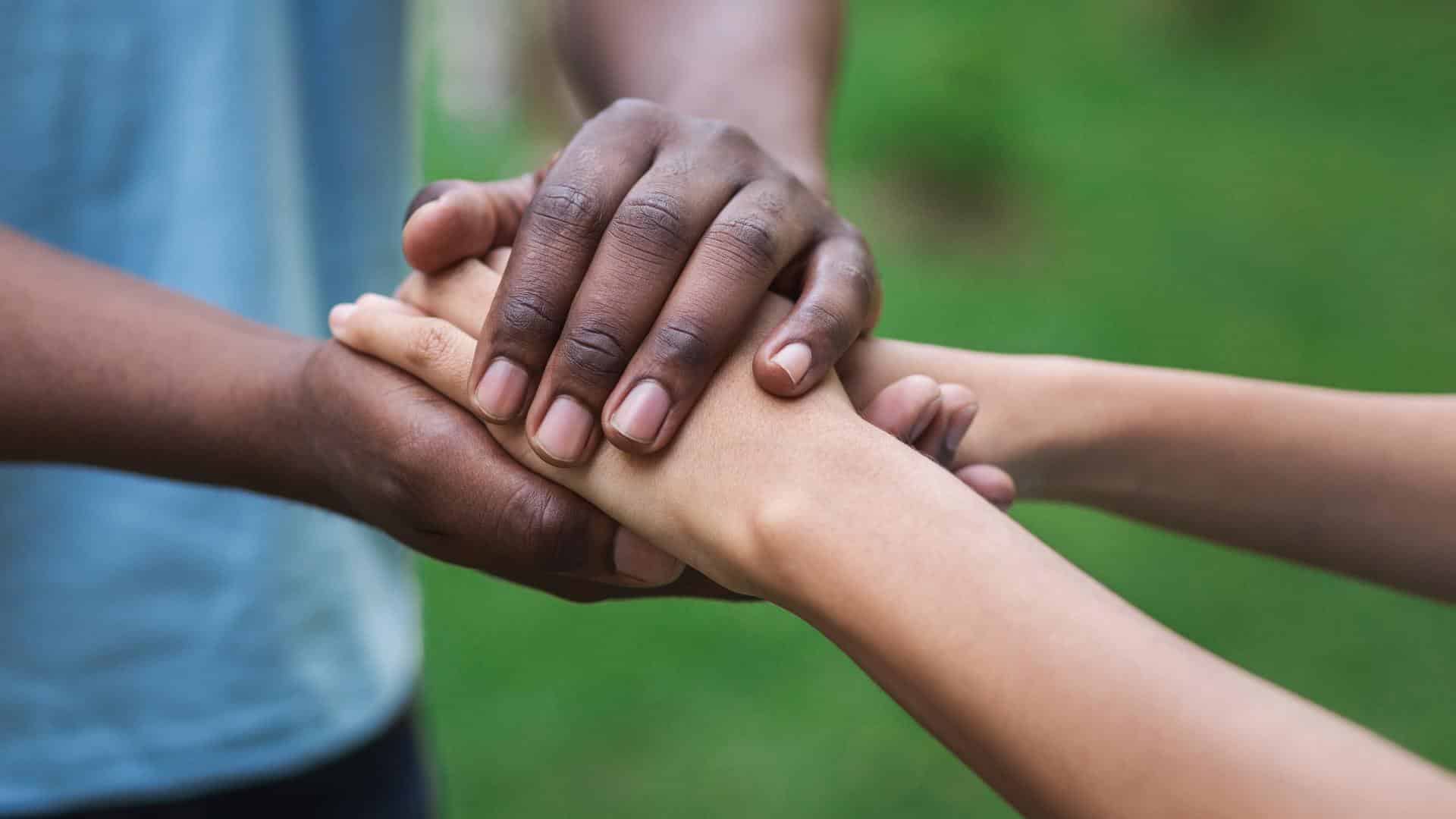
Hands grasped in empathy. (Photo by Prostock-studio)
This article by student Hamza Mohamed Ramadan Zahran was produced out of News Decoder’s school partnership program. Hamza is a student at African Leadership Academy in South Africa, a News Decoder partner institution. Learn more about how News Decoder can work with your school.
The first time I saw empathy disappear, it was not on a phone screen. It was at a wooden table in my village.
The land had fed my family for generations. It carried our history, our pride, our survival. But one season, a disagreement began over who should control it. At first, it sounded like responsibility. Then it became authority. Then it became ego.
I remember sitting quietly while voices around me grew sharper. No one was screaming yet. That was the painful part. It was not loud hatred. It was slow distance. The tea was still served. The chairs were still full. But something inside the room changed. People stopped listening. They waited only to respond.
I watched love shrink.
And I learned something that day: empathy does not disappear in one dramatic moment. It fades in small silences.
No statistics on silence
Years later, when I scroll past images of war, hunger and disaster, I feel that same silence. The world is louder than ever yet somehow more distant. We see everything. We feel less.
We live in a time where suffering reaches us instantly. A crisis happens thousands of miles away, and within seconds it appears in our hands. At first, we feel something. But after the tenth video, the twentieth headline, the hundredth tragedy, something inside us grows tired. Researchers have observed that empathy is declining, particularly among young people raised in constant digital exposure.
But I do not need statistics to understand this. I have felt it in myself the moment when scrolling becomes easier than stopping.
Psychologists now refer to it as “compassion fatigue.” I know it well as “emotional exhaustion.” When I first arrived at African Leadership Academy, I also had this burden with me. People ask, “How are you?” and they wait.
Not the automatic “I’m fine, thank you.” Not the rehearsed smile. They pause. They look at you. Sometimes they sit down.
It sounds simple. But it changed me.
Empty gestures without intention
I realized that in many places, “How are you?” is just a social password. We say it without intention. We answer it without truth. We smile without presence. One afternoon in Soweto, South Africa, I asked a man how to greet someone in Zulu. He said, “Unjani?” — How are you? I repeated it back to him.
When he realized I tried to speak his language, his expression softened. It was small — just a shift in his eyes. But I saw something real. He felt seen.
At that moment, I understood: empathy begins when someone feels noticed. Not evaluated. Not used. Not benefited from. Not politely tolerated. Seen.
Later, at the Mandela Impact Forum in Cape Town, I noticed something else. So many conversations were about opportunity. Networks. Advantage. Influence. And I kept thinking what if we built relationships not because we gain something, but because we care?
Too often, friendship becomes transactional. If I benefit from you, I stay. If I do not, I leave. But love does not calculate. Empathy does not negotiate.
We can carry hope with us.
I learned that lesson most deeply when I brought “Building in a Box” to my village, an ALA leadership and social innovation camp I led to awaken curiosity in rural youth in Egypt. With science kits, workshops and the spirit of collaboration, we transformed ordinary afternoons into laboratories of imagination. Students learned to plan projects, build prototypes and manage resources; but more than that, they learned to believe in themselves.
I will never forget the moment a girl’s eyes widened as her first circuit flickered to life. Her joy rippled through the room and for an instant, it was the first time such an initiative had ever reached our rural community. I was not just a program director, I was carrying hope back home.
When we opened that program, children ran forward with curiosity. Parents stood quietly, almost unsure if it was real. Teachers touched the materials gently, like something fragile and precious. Community leaders shook my hand not because it benefited them, but because they felt included in making the impact and felt empathy for everyone.
That day, the land was not the center of conflict, but rather the center of unity. And I saw something I had not seen during the family dispute years before. I saw love move through a crowd.
Not dramatic love. Not loud love. Quiet love. The kind that says, “We believe in you.”
Invest in potential
After that day, my phone filled with messages from villagers. Some thanked me. Some asked if we would continue next year. Some simply said they felt proud.
However, it was through my time at ALA that I learned something significant: empathy isn’t simply about encountering another’s suffering, but also investing into another’s potential. Numerous global discussions are addressing a decline in empathy; the phenomenon of digital fatigue; and emotional exhaustion.
A 2025 report from the World Health Organization found that many ambitious teenagers today are experiencing an overwhelming need for change when faced with a world full of disasters yet are experiencing feelings of powerlessness to make any change at all. But statistics never moved me as much as that table in my village. Or that word in Soweto. Or those children opening the box.
Because empathy is not a theory to me. It is the difference between silence and listening. Between control and collaboration. Between pride and humility.
I have seen what happens when empathy fades. Families divide. Conversations harden. Smiles become polite masks.
Bringing empathy back
I have seen what happens when empathy returns. Communities breathe. Young people rise. Hope spreads quietly.
Now when I ask someone, “How are you?” I try to mean it. Not because it benefits me. Not because it sounds kind. But because caring is a responsibility.
Sometimes empathy is not solving a global crisis. Sometimes it is sitting longer than comfortably. Sometimes it is choosing not to win an argument. Sometimes it is speaking someone’s language for one word.
And sometimes it is bringing a simple box back to a village and watching people remember what it feels like to believe in each other.
The world does not only need policies and strategies. It needs presence. It needs sincerity. It needs the courage to love without calculation.
Mindset can shift.
So I leave you with this:
Empathy fades quietly. But love, when practiced intentionally, returns just as quietly. And we as young people must understand something powerful: we are not powerless.
We are still students. We are still learning. But that does not mean we are waiting. The mindset of a generation can shift because of us. Our classrooms are impacted by the way we operate today; our workplaces of tomorrow will be shaped by the kindness we extend today. Too frequently do we determine the value of our world by the degree of productivity. Companies ask, “What do you bring to the table?” meaning profit, strategy, promotion salary increase.
But what if we also asked: Who do you bring to the table?
Are you someone who makes customers feel respected? Are you someone whose kindness builds trust? Are you someone whose presence makes others feel safe? Success should not only be about numbers. It should also be about humanity. We lose nothing by being kind. We lose nothing by noticing people.
Why don’t we smile at the chef in our school and say, “It is my honor to eat from your hand today. Thank you. Without you we would not eat”?
When we see the quiet nurse in the corner of the school, how many of us take time out to thank her for being available for the emergencies that go unnoticed? When the lesson concludes, how many times do we look into our teacher’s eyes and say “Thank you for your hard work”?
Communicating from the heart
In Arabic, we often say “shukran min al-qalb” thank you from the heart. When communication comes from the heart, it touches the heart. Imagine how our schools would feel if appreciation had become customary.
Imagine how different workplaces would feel if leadership meant care. Imagine how different streets would feel if greeting someone was not automatic, but intentional. As young people, we still carry pure energy. Our smiles are not yet fully shaped by competition. Our hearts are not yet fully hardened by ambition. That is our strength.
We have the power to make people feel seen. We have the power to soften rooms. We have the power to create environments where love is not weakness, but identity.
At the conclusion of the day, it is unlikely that people will recall your title prior to your feelings for them. People do not remember what you did, they only remember how you made them feel.
Empathy fades in obscurity, but also develops in obscurity of classrooms, villages, places of work and streets every time we choose to be genuine versus put on a show. Therefore, I shall ask myself and perhaps you as well:
When was the last time we listened instead of waiting to respond?
When was the last time we asked “How are you?” and pursued a meaningful answer? If we removed benefit from our relationships, would we still choose to care?
Questions to consider:
1. What do we mean by empathy?
2. What is one way you can show that you empathise with someone else’s suffering?
3. Have you ever felt hurt or pain and felt that no one around you cared?

Hamza Mohamed Ramadan Zahran is a student from rural Egypt, shaped by a life of movement across classes and communities. At the African Leadership Academy, he sees how struggle, care and dignity define humanity. Hamza’s writing grows from these crossings, seeking meaning in ordinary lives and the quiet power of empathy.
Interesting perspective on how we can become desensitized to suffering. Makes me wonder how that affects our relationships in the long run.
Thank you so much for your thoughtful comment I really appreciate you sharing that perspective. I completely agree with you. When we become desensitized to suffering, even unintentionally, it can slowly affect how we connect with others and respond to their emotions. Over time, that distance can shape our relationships in ways we might not immediately notice. It’s such an important reminder for us to stay aware, compassionate, and present with the people around us
The article moved my heart. I almost cried when I was reading this