
With corruption scandals rife in Spain, the spread of false rumors is eroding people’s trust in their government. Can anything be done to restore la confianza?
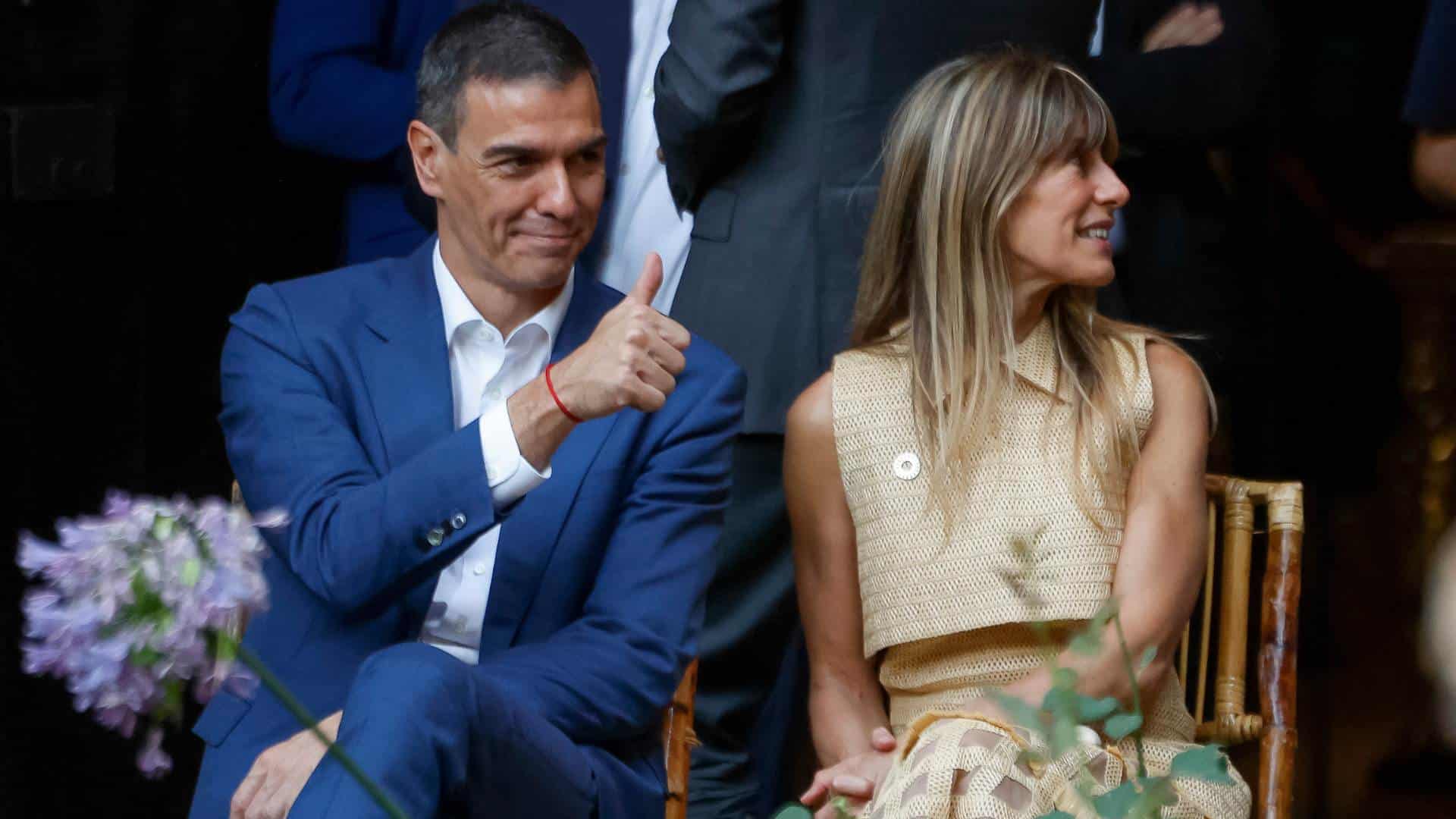
Spain’s Prime Minister Pedro Sànchez gestures next to his wife, Begoña Gomez in Seville, Spain, 30 June 2025. Some social media campaigns have attacked the couple with wildly false disinformation. (Photo by Juanjo Martin/pool photo via the Associated Press)
This article was produced exclusively for News Decoder’s global news service. It is through articles like this that News Decoder strives to provide context to complex global events and issues and teach global awareness through the lens of journalism. Learn how you can incorporate our resources and services into your classroom or educational program.
Begoña Gómez, the wife of Spanish Prime Minister Pedro Sánchez, was born a man by the name of Begoño. Some 500 kilos of gold were once found in her house on the Canary Islands. She is now being blackmailed with material stolen from her mobile phone while she was on a trip to Morocco. Oh, and she headed a drug-trafficking cartel.
If you believe even some of these stories as a Spaniard, you’d think your country had gone insane. You’d think you were being ruled by a class of deceiving drug traffickers. Lies, or rather disinformation, are nothing new in Spain, but in recent years they have been forming increasingly coherent narratives of an alternative reality.
They are often a fantasy that sometimes does brush up against reality: last June, several higher-ranking members of the governing party Partido Socialista Obrero Español (PSOE), or Spanish Socialist Workers’ Party, were forced to step down due to a corruption case. Private messages emerged in which they talked about large sums of money and escort services.
The case was particularly painful for Prime Minister Pedro Sánchez, who came into power fighting corruption.
In 2018, as leader of the opposition, he called a vote of no confidence involving then Prime Minister Mariano Rajoy. That government fell, and since then Sánchez has led consecutive governments, on a promise to finally eradicate the systemic corruption that plagues Spain.
“This [latest corruption case] is confirming the narrative that all politicians lie, all politicians steal, all politicians are there for their personal gain,” said Alba Tobella, director of Catalan fact-checking platform Verificat. “Every case of corruption serves to further reinforce this idea.”
A flood of falsehoods
Through their website and social media, Verificat checks the accuracy of news spread over the internet. They noticed that from the moment Sánchez came into power, institutions on the right have tried hard to discredit him.
“Anything that can be used to delegitimize Pedro Sánchez will be used against him,” Tobella said. “Any failure in Spain is directly linked to Pedro Sánchez.”
These disinformation campaigns were particularly evident during the 2017 referendum for independence of Catalonia, when falsehoods from both sides were widespread. That period was one of the reasons Verificat was founded.
Another surge of false information swept through the country in 2024, following the flooding disaster in the Valencia area in which at least 229 people died. At the time, misinformation spread among the local population quickly, because people felt the government had failed to protect them.
What is new though, Tobella said, is that hoaxes are becoming increasingly complex and nuanced. She notes a normalization of these alternative realities, which some people are completely immersed in.
“It’s like a complete disconnection of the audience from the truth, as well as a lack of interest in seeking the facts,” she said.
The spreaders of fabricated “facts”
Much of the disinformation reaches people through social media and WhatsApp messages, as is shown on the websites of fact checkers like Verificat. Some websites and media outlets also contain this kind of fake news, and it is sometimes spread by politicians such as Santiago Abascal, leader of radical-right party Vox.
Now, following the latest corruption cases involving the PSOE, misinformation has again found fertile ground. Even though Sánchez has acted and those involved in the corruption have stepped down, a general feeling of being unprotected persists among the Spanish population. In a Eurobarometer survey this summer, a whopping 90% of Spaniards said they considered corruption to be “widespread” — one of the worst scores in the EU.
Sebastiaan Faber, a professor of Hispanic Studies at Oberlin College in the United States, sees parallels with what is happening in the United States and elsewhere in the world.
“What is going on is a very conscious undermining of trust,” Faber said. “Creating doubt about science, about the judicial system, public health institutions. The goal is to push people away from traditional institutions so that maintaining them will be seen as less important.”
Faber, who wrote several books about Spain, the Spanish Civil War and the long dictatorship under Francisco Franco that ended in 1975, notes clear links between the way misinformation is used as a political tool in Spain and the United States.
“They, for instance, try to keep sending the message that any left-leaning government is illegitimate,” Faber said. “That goes back to ’36. The Franco regime was based on the idea that the elected government had forged the election results and that they were financed by Russia, with anti-Spanish ideas. It’s always a repetition of portraying the left as immoral.”
Actual corruption and phony accusations
Faber sees a clear connection between these Francoist tactics and Trumpism. Figures surrounding Trump during his rise, such as his former political advisor Steve Bannon, represent a group of people that actively try to deconstruct democracy.
Bannon once famously stated: “Flood the zone with shit.” He was referring to the creation of a deluge of half-truths and lies so consistent that people lose track of reality. Social media are an effective way to do so.
These tactics of disinformation campaigns crossed the ocean twice, Faber said. It could be seen under Franco, who constantly spread lies about the legitimate Segunda Republica government of Spain.
That made its way up to the United States. There, similar lies and disinformation campaigns culminated in Trump loyalists storming the Capitol in an attempt to stop Congress from certifying Joe Biden’s 2020 presidential election victory. These same tactics, a deluge of disinformation, are now being copied again in Europe to delegitimize people in power, such as Pedro Sánchez.
Faber doubts that the public is ready to believe all the disinformation about Sànchez even with the proven case of corruption in the Prime Minister’s own political party. “I would say that the receptiveness for fake news is very much defined by your political preferences and the information bubbles [you] are in,” he said.
Alienating voters
The corruption case might leave those on the right feeling further alienated from the left-wing government however, and they might start to believe additional falsehoods about the government and Sánchez.
And on the left, a general sense of hopelessness has now taken hold, as becomes clear when speaking with Spaniards about the case since the story of the corruption case broke.
Tobella said that what’s important here, is that people understand that it’s never only ‘the other side’ that behaves badly. For example, from a Catalonian perspective, where sentiments can at times be very anti-Spanish, there’s a long-standing myth that Catalonian politicians are less corrupt than those politicians in the national government in Madrid.
At the time of the interview with Tobella, the corruption case involving Catalonian leader Jordi Pujol had just begun. Pujol was in power for 24 years, and now faces charges of money laundering and criminal association.
“These accusations are extremely serious,” Tobella said. “If it is said that there is no corruption in Catalonia, I think that that is maybe the oldest myth going around. It is clear that there are also very serious cases here.”
So what can be done to counter the weakening of democracy through disinformation, especially when an alternative narrative does intersect with reality, as happens with these corruption cases? Debunk the lies, sift through hoaxes and show where claims rely on questionable evidence. In short, flood the zone with truth.
“Well, what we already do, right?” Tobella said.
Questions to consider:
1. What is new about the latest round of disinformation in Spain?
2. Why might disinformation campaigns have limited power when it comes to changing the minds of political supporters?
3. Do you generally trust the politicians representing you in government? What affects how you feel about them?
Jurriaan van Eerten is a Dutch writer and reporter. After having worked for years in Latin America and the United States, now he is based in Madrid, Spain, where he is writing his second novel. He works together with his wife, photographer Eline van Nes.