
Candidates make a lot of political promises. Why can’t they keep the vow to leave office when their term is up?
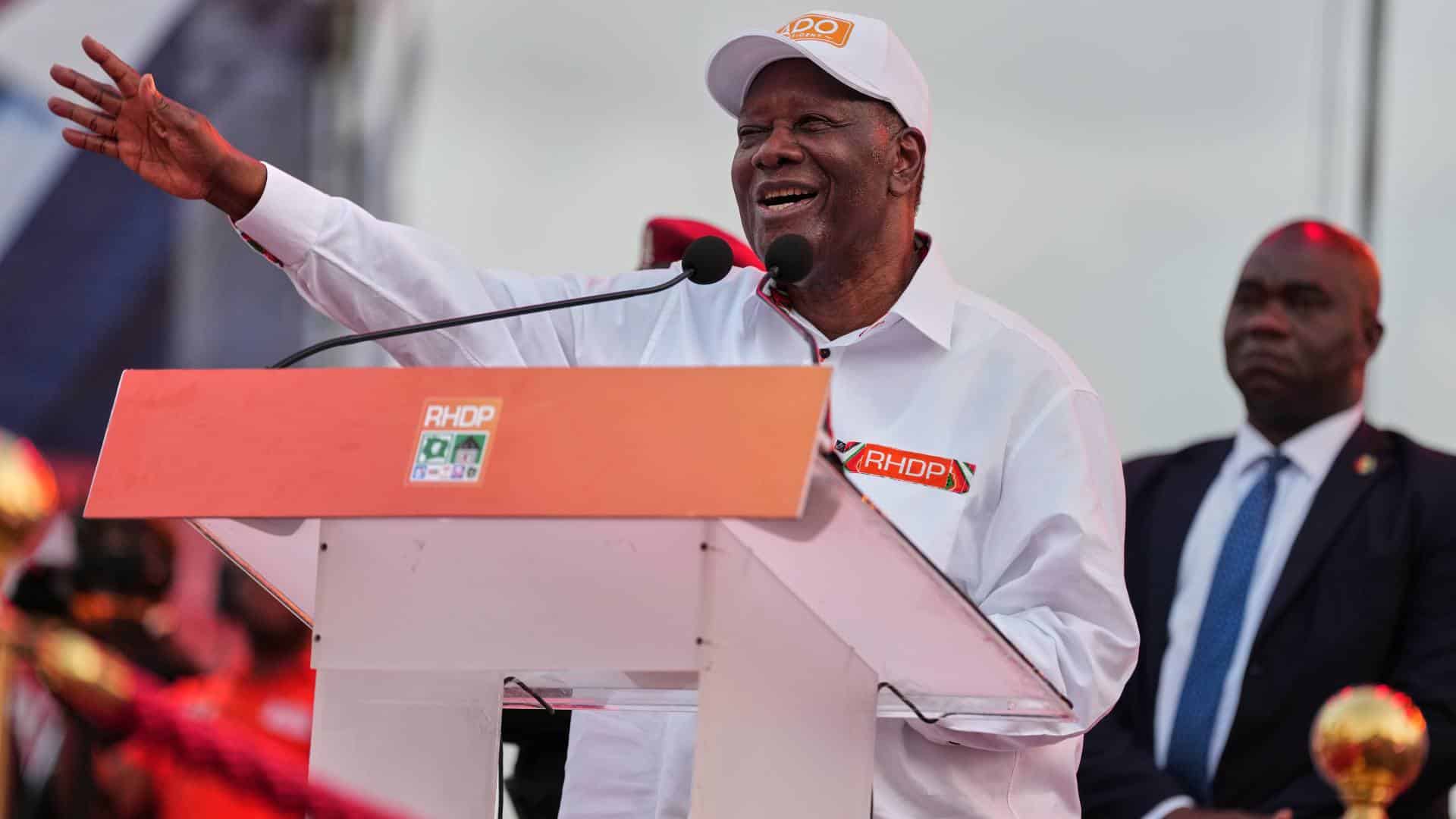
Côte d’Ivoire President Alassane Ouattara speaks during his final campaign rally in Abidjan, 23 October 2025. (AP Photo/Misper Apawu)
This article was produced out of News Decoder’s school partnership program. The author is a student at African Leadership Academy in South Africa, a News Decoder partner institution. Learn more about how News Decoder can work with your school.
“Don’t you ever dare say this name in public.”
My mother spoke these words, taking me aside to ground me. As a 6-year-old talkative kid, it did not occur to me to read the atmosphere in the room. The youngest of all the children present, I clung to my mom, scared of being bullied.
She reluctantly let me sit at the adult table. They were talking about the new political landscape in Côte d’Ivoire, and my candid self thought it would be a good idea to meddle.
“B.. but, I thought the president was Laurent Gbagbo,” I said with a shaky voice.
From their scowling faces and the look my mother gave me, the message was clear; I had made a terrible mistake.
“She was very young when that happened,” said my mother, desperately trying to brush off the awkwardness. She was right. I was too young to understand what “that” really meant.
We idolize people from afar.
Between 2010 and 2011, Côte d’Ivoire — a country of 30 million on West Africa’s coast -– had descended into civil war after a disputed election preceded by a decade of political tension. Neither Laurent Gbagbo nor Alassane Ouattara, the two candidates in contention, wanted to concede.
Bloodshed followed. According to Human Rights Watch, it led to more than 3,000 deaths and 150 women raped. I didn’t know then that people were killing each other over loyalty to men they had never met.
What else would you expect from a child who had survived a civil war? How could she possibly remember the definitive outcome of that election when she only had memories of hunger, gunshots and cadavers?
In any case, the lecture my mom gave me after the guests had left made one thing very clear in my child’s mind: “Politics is taboo, and I should never talk about it nor get involved in it.”
Fast-forward two years. In 2015 I was now old enough to understand my surroundings better. In less than two months, an election was about to take place in my country, with the international community watching closely; the wounds of the previous election had not healed.
Recognizing propaganda
I could not help but notice the ominous placards and T-shirts, “ADO is the solution,” with a face that had become familiar to me: Alassane Dramane Ouattara known as ADO, the widely agreed-upon winner of the 2010 elections and candidate for re-election.
What stuck with me was the laudatory vocabulary people used to describe him: “He is fixing the economy,” “He united us,” “He brought peace to this country.”
I started to see the pattern everywhere. My classmates didn’t debate policy; they recited talking points their parents had given them. The neighborhood shops played campaign songs on loop until the words burrowed into your brain. Even the journals seemed different now, with new headlines on “national reconciliation” that painted recent history in very specific colors.
Something was happening to the air itself, the way everyone spoke, the things we were allowed to say out loud versus the things we whispered.
I didn’t have the word for it yet, but I was learning to recognize its texture. Political scientists have a term for this: propaganda. American political scientist Harold Lasswell described it as the multiplication of stimuli designed to evoke desired responses while nullifying those that might inspire resistance.
History repeats.
The election ended with Ouattara’s predictable victory, a result the opposition parties (or at least what was left of them) consoled themselves by viewing as temporary. It will be his last term anyway, they reasoned.
Throughout his second term, Ouattara delivered. GDP doubled, poverty halved and infrastructure projects transformed cities. People saw these achievements, used them and benefited from them. And this made the idolization unshakeable.
Then came the third term in 2020. The constitution was clear: two terms maximum. Ouattara himself had promised he wouldn’t run again.
But then the promises changed. First, there were legal arguments. The new constitution of 2016 “reset the count”, they said, so technically this would only be his first term under the new rules. Then came the familiar rhetoric: The country still needed him; he was the only one who could maintain stability, and his opponents would drag us back to war.
The same vocabulary was recycled. “ADO is the solution” became “ADO is the ONLY solution.” This is called “constitutional capture”; when leaders use somewhat legal mechanisms to undermine democratic limits.
Cycles of violence
Political scientists Nic Cheeseman and Brian Klaas, who wrote the book “How to Rig an Election” analyzed electoral manipulation in Africa and found a repeated pattern: leaders don’t usually abolish constitutions; they reinterpret them. They don’t cancel elections; they make sure there’s no real opposition to vote for.
This time, I watched something shift: people in the street protesting for a change of power. And the response was swift and so brutal that we had to be dismissed from school for two weeks, as violence started spreading.
The official story on television spoke of “restoring order” and “protecting democracy.” But the bodies told a different story. Official numbers talk about 83 deaths and 633 injuries.
What shocked me was how partisans from both sides justified this violence. On one side stood the “pro-ADO,” who believed the country could not function without Ouattara. On the other hand, the “anti-ADO” — a coalition of opposition parties, led largely by Gbagbo loyalists, who wrapped themselves in the language of democracy.
But scratch the surface, and their lofty calls for democratic restoration revealed a simpler, more self-serving aim: getting their own leader back in power. The opposition’s effort was in vain.
Power prevails
Ouattara secured his third term, and the country moved forward under his continued rule and with the international community’s conspicuous silence.
Infrastructure projects continued, the economy still grew but cracks began to show. The cost of living rose. National debt mounted. Corruption scandals erupted. Discontent spread, this time even among those who had historically supported him. Still, people held on to one hope: “This will be his last term.”
Constitutional limits had been stretched once; surely they wouldn’t break again.
Yet came the fourth term in 2025. I am now 19 years old. For my entire conscious life, there has been only one face, one name, one leader. When a leader is convinced he is the Messiah, he will do anything to stay in power. And when people have been met with violence for resisting, they learn inaction.
This is what successful idolization produces: an entire generation for whom one man’s permanent rule feels normal and unchangeable. The only thing that is clear to me now is that the idolization of leaders, whether yours or theirs, is the soil in which authoritarianism and violence grow.
Questions to consider:
1. Why is it important for elected leaders to have a limited number of terms in office?
2. How might politician ensure they will stay in office without canceling an election?
3. If a political leader were doing a good job and helping the people of a state or country do you think they should stay in office indefinitely? Why?
The author is a high school student at African Leadership Academy who enjoys exploring identity, culture and technology through writing, using storytelling to better understand the world and their place in it.