
Many teachers find that students can’t learn if they are hungry or cold. But that often means providing food and clothing out of their own pockets.
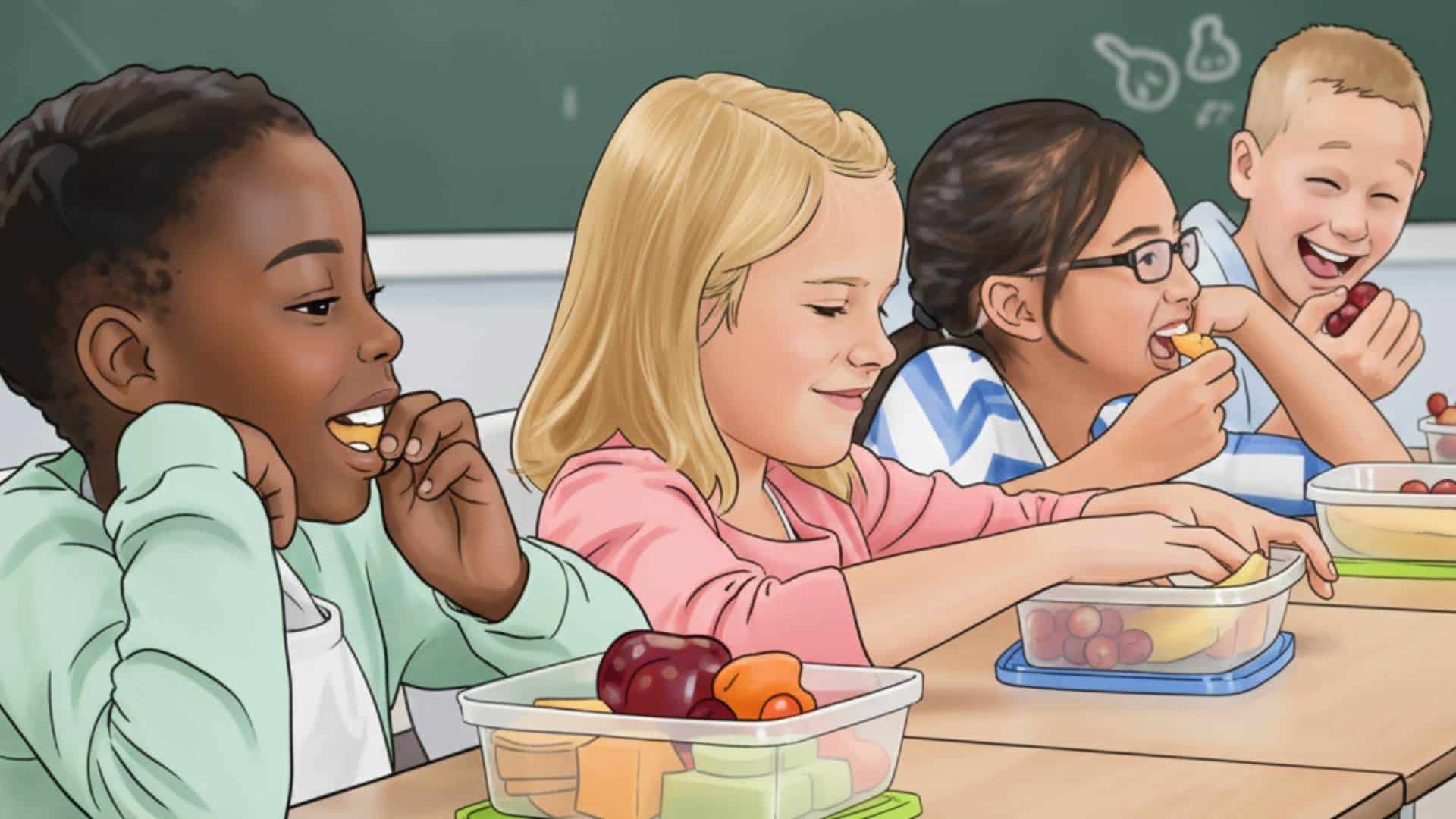
Children eat snacks in a classroom. (Illustration by News Decoder)
Ashley teaches Spanish at a public high school in the U.S. state of New Jersey that has a large percentage of students from low-income backgrounds. She has gone food shopping for families and has babysat for weeks while a parent had surgery. She has attended countless graduations, birthday parties and baby showers. She has spent thousands of dollars of her own money on students.
Because school teachers can face negative repercussions for speaking out, I agreed not to use her last name or the last names of any of the other teachers in this article.
Ashley is one of many teachers across the United States who perform duties beyond their job description, training and pay. They see it as a result of parents who must work multiple jobs due to greater financial hardship.
“Anything can happen in this economy,” Ashley said. “A family can be one pay check away from being unhoused.”
In the U.S. state of Colorado, Shannen teaches at a charter school — a taxpayer-funded, public school that operates under its own “charter,” giving it a degree of independence within local school systems. In November 2025, she voted to approve two propositions to boost Colorado’s universal free school meals program and food stamps program, known as SNAP, which subsidizes nutritious food for low-income families. In 2023, about 35% of SNAP recipients were children.
“I think it’s a good thing to have in schools,” Shannen said. “We see a lot of kids with food insecurity, but who don’t want to say that, so it’s nice that it’s just available [for everyone]. We provide breakfast, snack and lunch.”
Should schools feed everyone?
According to a 2025 report from UNESCO, decades of international evidence support the benefits of universal school meals, including behavioral and academic improvement for students of all income levels, and less stigma compared to income-based eligibility.
Yet Shannen and other teachers wonder if initiatives like this are sustainable — or just blurring the lines between school and home, and parenting and teaching.
“I wish it weren’t so dependent on schools because then what happens on the weekends and in the summers?” Shannen said. “I don’t know if it should necessarily be the school’s role, but it ends up being the school because it’s the easiest. Teachers and administrators are asked to take on far more than just educating.”
Ashley said that school is where many of her students get their needs met, and much of that support comes from teachers. “If I don’t supply medicines, they’re not getting them,” she said. She also buys bandages, rubbing alcohol, tissues, hand sanitizer, paper plates, napkins, utensils and wipes. “If I’m not replacing them, it’s not getting done,” she said. Ashley’s students can also wash their clothes using the school’s laundry machines.
Students attending school without the resources they need is not unique to the United States. According to a 2024 report by the National Foundation for Educational Research in the United Kingdom, economically disadvantaged students there continue to arrive at school hungry and without necessary supplies and clothes like winter jackets. Nearly 20% of teachers in the UK are also reporting spending their own money to meet the welfare needs of their students.
Equity versus equality
Shannen said that it is important to understand the difference between equity and equality as a teacher. “If one of my kids said they didn’t have shoes, I would … make sure they got their shoes,” Shannen said. “For certain students [in need], I think schools should provide as much as possible to make sure they have the same opportunities. Sometimes equity is making sure certain kids are getting more so that in the long run it’s more equal.”
Giving all this extra support can take a toll. Jill, a public high school teacher in New Jersey, takes on multiple roles but gets no additional support. That has affected her well-being and ability to do her job.
“I have to be a social worker, psychologist, counselor, nurse, provider, all of it,” Jill said. “I came home crying the other day because a student has a severe drug problem at home, and also came out to me because he couldn’t come out to his parents. As this is happening, I have a whole class of 30 other kids who need my attention.”
Jill said she could benefit from working with an aide in the classroom. Reporting by the National Education Association showed that today’s students have increasingly complex needs that would benefit from smaller class sizes.
Ashley agrees that more professionals are needed at school. “We have six guidance counselors, a substance use counselor and a trauma counselor,” Ashley said. “We have a team of educational experts, social workers, psychologists and nurses. We probably have 25 different healthcare professionals. And that’s still not enough.”
Who should pay for the essential needs of students?
All of the teachers I interviewed also say their pay needs to reflect their workload. Salary is not keeping up with inflation and the economic challenges those in the United States are facing. Without the help of her partner’s income, Jill would not be able to afford the $3,000 monthly rent on their apartment. She has a master’s degree and her salary is $68,000 after 10 years of teaching.
Carson is a former teacher at a private high school in Sacramento, California. He believes unions can advocate for burnt-out teachers.
“Teachers’ unions usually help with salary, but they should help with managing expectations, like grading,” Carson said. “It wasn’t the teaching that burnt me out. It was … all the other stuff.”
Education International is a global education union that believes the rights of teachers and students are intertwined — the right to dignity at work and the right to receive a quality education.
Organizations in the United States that are members of Education International are the National Education Association and the American Federation of Teachers.
“Teaching is a calling,” Carson said. “And that’s why I think teachers’ unions are important,” Carson added. “Teachers are naturally going to give and give. They need somebody looking out for them.”
Questions to consider:
1. Why are many schools becoming places that provide food and social services in addition to education?
2. Why do some teachers feel compelled to pay for things like food and clothing for their students?
3. In what ways are schools good places for the distribution of food and other public assistance to needy people?

Angelica Recierdo is a health writer, poet and former nurse from the United States. She is a fellow in Journalism and Health Impact at the University of Toronto, Dalla Lana School of Public Health.