
Many people picture Africa as desert, safaris and trash-filled cities. Of 54 nations and vibrant urban scenes? Not so much. Why do we think we know places we’ve never visited?
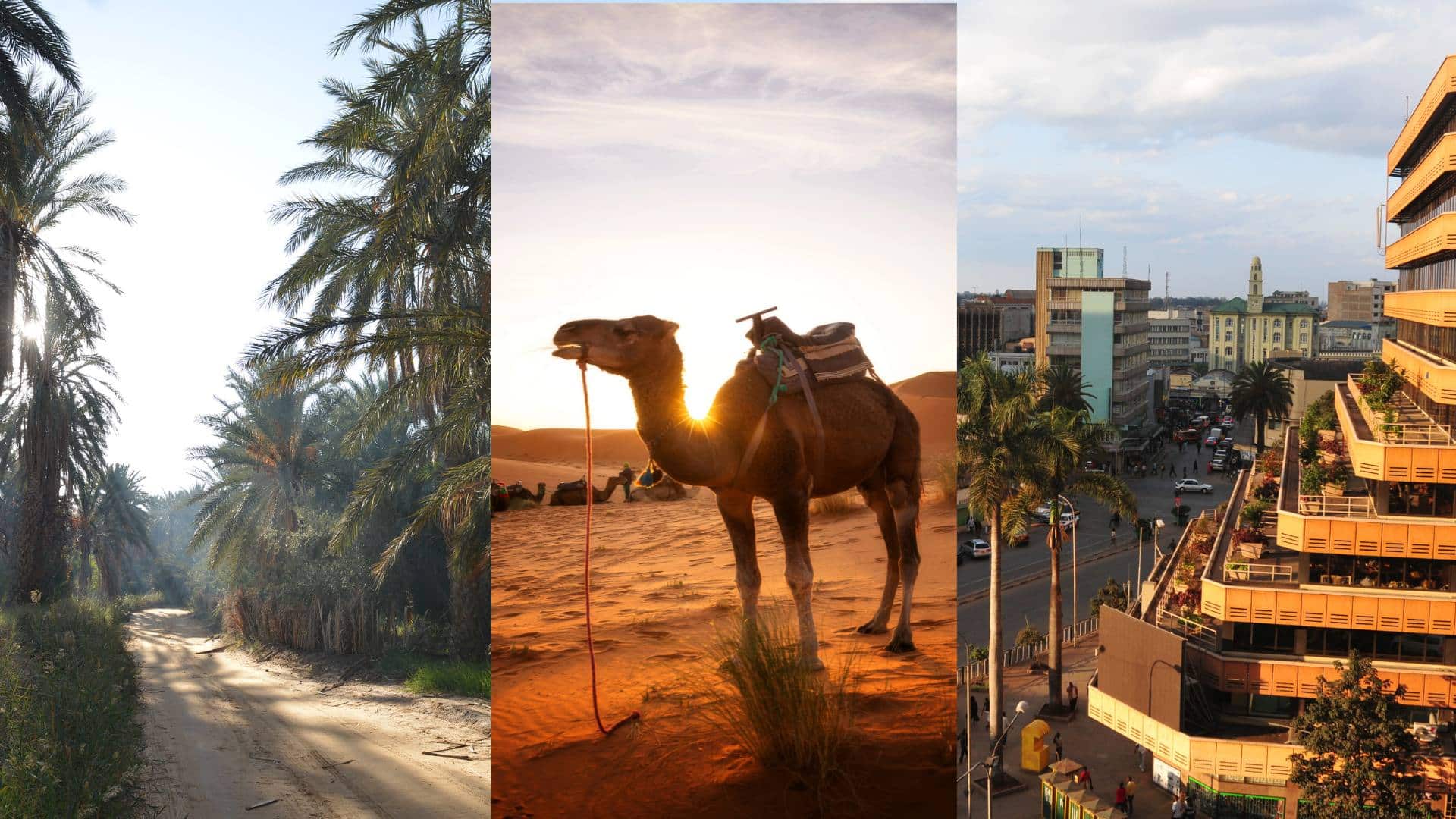
Left to right: A Tunisian oasis (Kaji from Kajicom); A camel in the Sahara (Nato Manzolli from Getty Images); and Downtown Nairobi, Kenya (mtcurado from Getty Images Signature)
This article was produced out of News Decoder’s school partnership program. Mohamed Adem Somai is a student at African Leadership Academy in South Africa, a News Decoder partner institution. Learn more about how News Decoder can work with your school.
One of the strangest things about the modern world is how sure we are about places we’ve never been. We talk about countries we’ve never seen as if we understand them perfectly. We imagine how people live, what they fear, what they care about and whether their lives are “modern” or “traditional.”
That certainty comes from the repetition of stories that we hear so often that they begin to feel like facts rather than interpretations.
I carried that same certainty before I left my own country. I believed I knew the world. I didn’t realize that most of what I thought I knew was shaped by selective, incomplete stories learned long before I had the chance to question them.
I first noticed this when someone described my country without ever having been there. It happened in South Africa, during a casual conversation with my boarding school roommate. When I said I was Tunisian, he nodded and said, “So… desert?”
I laughed. Then I realized he was serious.
Small ideas about a big world
He pictured Tunisia as endless sand, camels and oases. When I told him much of the country is green, forested and rainy in winter, he didn’t believe me. We pulled out a map and went through all 24 districts. Only five are in the Sahara.
What stayed with me wasn’t his mistake, but how natural his assumption felt. He wasn’t ignorant. He was thoughtful and genuinely interested in the world. What he lacked was alternative stories.
That moment made me realize something important: much of what we know about the world comes from stories long before we experience it ourselves.
In fact, most people encounter the world first in classrooms, books, movies or headlines. Maps divide it into neat regions. History condenses centuries into a few pages. News repeats familiar images: conflict, poverty, spectacle.
But why those images?
Stories travel.
Certain kinds of stories travel farther and faster than others. Crisis is more dramatic than routine. Poverty is more striking than normality. Over time, these fragments organize the world in our minds. They begin to rank it. Some places become associated with danger or dysfunction. Others with glamour and success.
As Chimamanda Ngozi Adichie explained in her TED Talk, The Danger of a Single Story, “the problem with stereotypes is not that they are untrue, but that they are incomplete. They make one story become the only story.”
When that single story is repeated often enough, it becomes like reality.
Africa is a clear example of how this works. It is often taught as a single subject rather than as a continent of 54 countries. Wildlife documentaries replace city life.
Poverty is presented as a defining feature rather than the result of histories of violence and colonialism imposed by what is often called the “modern” world.
Colonialism of ideas
I once read passages from a travel guide to East Africa describing Mombasa, Kenya, as a place of “birds swooping low over great piles of smoking trash,” with buildings “so scorched by the sun that their burnt skin peels away just like ours,” and a city that is “grimy and sleazy with deep ethnic tensions and security concerns.”
This was in a guide meant to encourage tourism.
Curious, I asked several Kenyan classmates from different cities how they would describe Mombasa. None mentioned smoking trash or ethnic tension as defining features. None described it as “grimy” or “sleazy.” They spoke about beaches, culture, food, music, traffic, work and daily routines.
What becomes clear from this contrast is that the difference is intentional. A travel guide to Paris rarely opens with the smell of garbage in summer. A guide to New York does not begin with subway rats or homelessness. Those realities exist. But they are not presented as the defining essence of those cities.
This pattern, however, works in different directions.
The world through a movie camera
Take Mexico. For many people who have never been there, Mexico exists through a cinematic filter: yellowed light, dusty streets, danger lurking everywhere.
That image didn’t come from one film but from decades of repetition. It becomes so familiar that we stop questioning it. There is irony in this. Parts of what is now California were once Mexico. Yet modern California is never filmed through that same yellow filter.
Los Angeles is known globally as a glamorous city of celebrities and palm trees. But that story leaves out the city’s deep inequality, racial diversity and the 16% of people living below the poverty line.
The difference is not geographical. It is the narrative framework that convinces us these cities belong to different worlds.
Beyond film, popular culture reinforces this pattern. Action movies turn parts of West Asia (a term my spell-check keeps trying to replace with “Middle East,” because Europe has to be the center of everything) and Latin America into permanent danger zones.
Video games warp our ideas.
Video games transform entire regions into empty battlefields, removing civilians, history and ordinary routines. Even when fictional, repetition shapes imagination.
Research in media and communication studies shows that repeated exposure to simplified portrayals influences how people interpret new information. When a place is already imagined as unstable or backward, new events are more likely to confirm that belief rather than complicate it.
The problem isn’t a lack of information. We live in an age of constant information. Rather, the problem is how unquestioned stories create quiet certainty. They tell us who belongs where, which places matter and how far “us” is from “them.” They rank the world without announcing it, and make hierarchy feel natural.
Recognizing this doesn’t mean ignoring differences. History, inequality and culture are real. But no place or identity can be captured in a single frame.
Understanding begins with noticing the limits of the stories we inherit. It requires intellectual humility and the willingness to admit that what feels like knowledge may only be a myth. In a world shaped by distance, migration and constant representation, that awareness matters.
If we do not question the stories we inherit, we risk mistaking familiarity for truth.
The storyteller matters.
That’s why we need to ask uncomfortable questions: Who is telling this story? What’s missing? Why have I seen this version so often? And what have I accepted without ever examining?
After that conversation with my roommate, I started doing something different. When I met someone from a country I thought I understood, I asked them how they would describe it. I began reading local writers instead of relying only on international headlines. I tried to notice which voices were amplified and which were absent. It didn’t erase stereotypes overnight. But it made me aware of how narrow my own lens could be.
Stories will always reach us before people do. That won’t change. What can change is how we carry them, whether we treat them as final judgments or as starting points for curiosity. Understanding begins with recognizing the edges of what we think we know.
So the next time you feel certain about a place you’ve never visited, pause for a moment. Ask yourself: Is this knowledge? Or is it simply a story I never thought to question?
Questions to consider:
1. Why might a person feel confident they are knowledgeable about a place they’ve never been to?
2. Why do some stories travel faster and farther than others?
3. Can you think of misconceptions people might have about the place you are from?
Mohamed Adem Somai is a student from Tunisia with a strong interest in storytelling, culture and how global narratives shape perception. He writes about identity, representation and the ways people understand places beyond their own experience, drawing on personal reflection and cross-cultural observation.