
Can national sovereignty be dismissed when a superpower claims a sphere of influence? Can U.S. economic interests in Venezuela be considered national security?
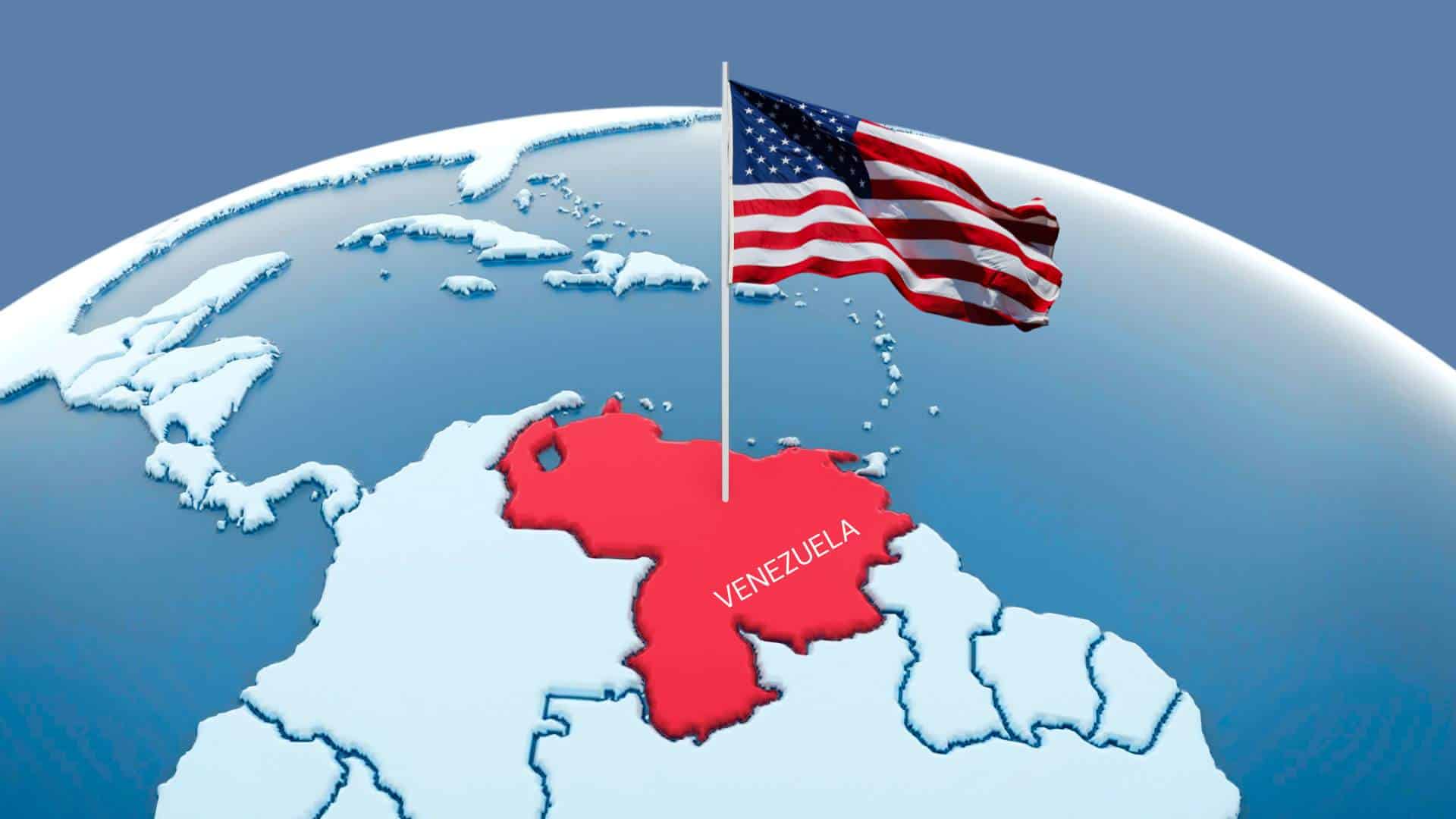
A map shows the U.S. flag planted on Venezuela. (Illustration by News Decoder)
This article was produced exclusively for News Decoder’s global news service. It is through articles like this that News Decoder strives to provide context to complex global events and issues and teach global awareness through the lens of journalism. Learn how you can incorporate our resources and services into your classroom or educational program.
The recent United States military incursion into Venezuela and abduction and subsequent arrest of its President Nicolás Maduro and his wife in New York is a major geopolitical event. Like all major geopolitical events, it has several components — historical, legal, political and moral.
And like all major geopolitical events, it has very different points of view. There is no grandiose “Truth” about what happened. There are many truths and points of view.
What can be said is that on 3 January 2026, the United States military carried out strikes on Venezuela and captured its president, Nicolás Maduro, and his wife Cilia Flores. The two were then flown to the United States where they were arrested and charged with issues related to narcoterrorism.
The United States’ intervention in a Latin American country has historical precedents as well as current foreign policy implications.
Under President James Monroe, the United States declared in 1823 that it was opposed to any outside colonialism in the Western Hemisphere. Now known as the Monroe Doctrine, it established what political scientists refer to as a “sphere of influence”; No foreign country could establish control of a country in the United States-dominated Western Hemisphere.
(This was indeed one of the central issues in the 13-day October 1962 Cuban Missile Crisis when the United States established a blockade outside Cuba to stop the installation of Soviet missiles on the island.)
The Trump Corollary
In the latest U.S. official security strategy document — National Security Strategy 2025 — the Monroe Doctrine was presented in what has been labelled “The Trump Corollary.” In it, the government said that defending territory and the Western Hemisphere were central tasks of U.S. foreign policy and national interest. The document clearly stated that activities by extra-hemispheric powers would be considered serious threats to U.S. security.
As such, the “Trump Corollary” of the Monroe Doctrine is the justification of the military action in Venezuela based on stopping Russian and Chinese influence in Venezuela. In addition, it can be seen as the justification for the U.S. to acquire Greenland, resume control of the Panama Canal and stop narcotics and illegal migrants coming into the United States from anywhere in the Western Hemisphere.
But the Corollary and Doctrine are mere national strategic statements. Are they legally justified? The U.S. military operation in Venezuela has been highly criticized by international lawyers as well as United Nations officials. The United Nations Charter, of which the United States is a signatory, clearly forbids the use of force by one country against another country except in the case of self-defense and imminent threat.
In an interview with New Yorker magazine reporter Isaac Chotiner on 3 January, Yale Law School Professor Oona Hathaway noted that when the UN Charter was written 80 years ago, it included a critical prohibition on the use of force by states. “States are not allowed to decide on their own that they want to use force against other states,” she told Chotiner. “It was meant to reinforce this relatively new idea at the time that states couldn’t just go to war whenever they wanted to.”
Hathaway said that in the pre-UN Charter world, you could use force if you felt like drug trafficking was hurting you and come up with legal justification that that was the case. “But the whole point of the UN Charter was basically to say, ‘We’re not going to go to war for those reasons anymore’,” she said.
The legality of an ouster
Besides the international legal issue, there is also a domestic legal question about the Venezuelan military action. The 1973 War Powers Act was enacted to limit the power of the U.S. president to use military forces with the approval of the Congress.
It was enacted following the Vietnam War during which the president engaged troops without Congressional approval or a formal declaration of war. The Act clearly requires the president to notify Congress before committing armed forces to military action.
Trump did not consult with members of Congress before and during the military action in Venezuela. The political implications of the Venezuelan strikes and abduction also have international as well as domestic implications. Internationally, there is a dangerous precedent being set.
If the United States asserts its sphere of influence in the Western Hemisphere, what is to stop the Russian Federation from claiming a similar sphere of influence in the Baltic countries of Latvia, Lithuania and Estonia as well as Ukraine?
Similarly, what about Chinese influence in the Indo-Pacific region and especially Taiwan? If the United States claims domination in one geographic region, why can’t other powers like Russia and China do the same?
The Westphalian system
Within the United States, there have also been serious reservations about President Trump’s actions. That was to be expected from the opposing Democratic Party. But, several members of Trump’s Republican Party as well as loyal members of his Make America Great Again (MAGA) movement argue that Trump was elected on the slogan “Make America Great Again.” One of the pillars of that movement is a focus on internal problems instead of foreign interventions.
Republican U.S. Representative Marjorie Taylor Greene used to be one of Trump’s staunchest supporters. On 3 January she told interviewer Kristen Walker on the NBC show “Meet the Press” that America First should mean what Trump promised on the campaign trail in 2024.
“So my understanding of America First is strictly for the American people, not for the big donors that donate to big politicians, not for the special interests that constantly roam the halls in Washington and not foreign countries that demand their priorities put first over Americans,” Greene said.
Other criticisms have centered on President Trump’s focus on restoring business in Venezuela for the U.S. oil industry, which has the world’s largest oil reserves. Republican U.S. Representative Thomas Massie warned that “lives of U.S. soldiers are being risked to make those oil companies (not Americans) more profitable.”
Finally, there are moral arguments against the use of force in Venezuela as well as Trump’s threats of the use of force in Colombia, Cuba and elsewhere. There is no question that Venezuelans had suffered under the rule of Maduro; statistics show the rapid decline in the economy as well as a significant democratic deficit.
Fundamental to today’s notion of international order is what’s known as the Westphalian system of the integrity of state sovereignty. The world has seen an order since the end of World War II and the establishment of the United Nations. That order was based on respect for the rule of law. There are other means for states to act against other states, such as sanctions, below military intervention. One country invading another goes against the basis of the Westphalian system.
The Venezuelan strikes and abduction have set a dangerous precedent.
Questions to consider:
1. What is meant by the “Monroe Doctrine”?
2. When is one country considered part of a “sphere of influence” of another country?
3. How do you define “national security”?
Daniel Warner earned a PhD in Political Science from the Graduate Institute of International Studies in Geneva, where he was Deputy to the Director for many years as well as founder and director of several programs focusing on international organizations. He has lectured and taught internationally and is a frequent contributor to international media. He has served as an advisor to the UNHCR, ILO and NATO, and has been a consultant to the Ministries of Foreign Affairs and Defense of Switzerland as well as in the private sector.
1. What is meant by the “Monroe Doctrine”?
It is an assertion used to defend the sovereignity of one nation. O believed that applied for any country, but I realise that it wasnt like that.
2. When is one country considered part of a “sphere of influence” of another country?
When this Foreign country has resources that the former country is interested about.
3. How do you define “national security”?
It is a state where there are a set of rules aiming to prevent a rising of conflict inside a country, trigerred by external or infernal agents.