Amina McCauley experienced climate change in the ancient forests of Tasmania. Now she wants students around the globe to understand its effects. Amina McCauley sits among the fern trees in Wellington Park, Tasmania. (Photo courtesy Amina McCauley) Concern about...
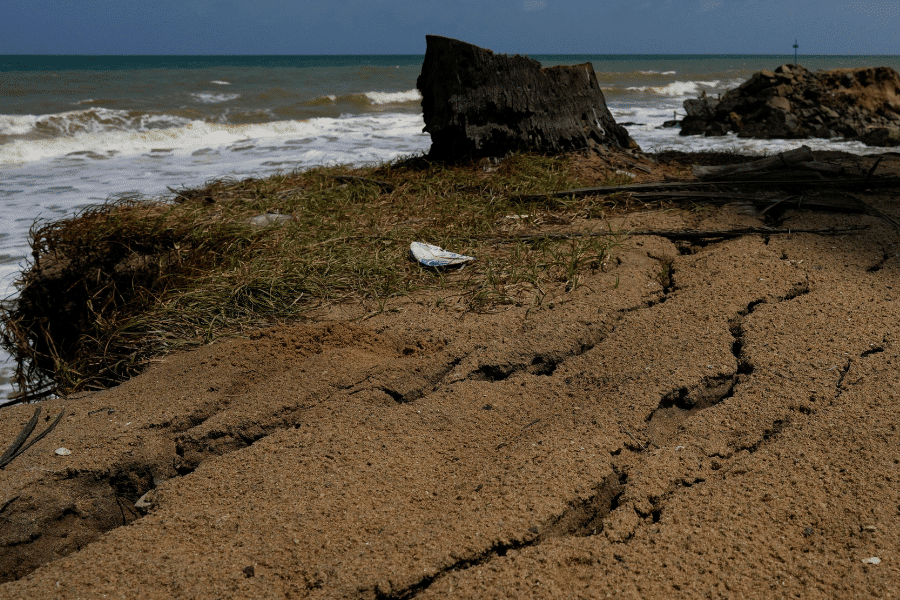
Sri Lanka is trying to do its part to combat climate change. But it will take a sea change to stop the ocean rising around the island nation. Cracks are visible from coastal erosion on sea shore in Iranawila, Sri Lanka, 19 June 2023. (AP Photo/Eranga Jayawardena )...
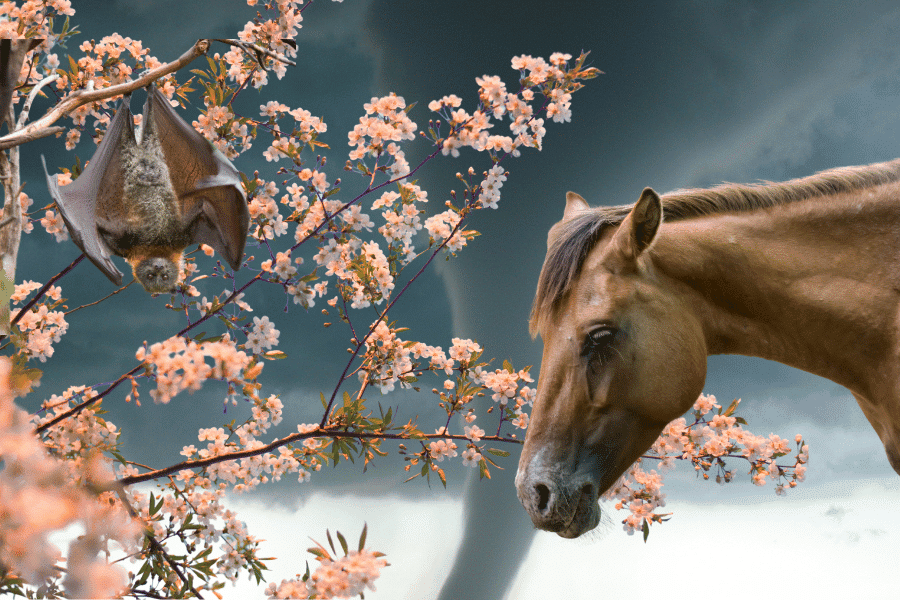
A cyclone can affect trees which impact insects and animals spreading diseases to people. Doctors are realizing that individual health is part of an ecosystem. A bat, a flowering tree and a horse against the backdrop of a tornado. (Illustration by News Decoder) This...
How is having a C-section connected to deforestation? How can a cyclone off the coast of Australia affect the population of fruit bats and horse trainers? Health and science correspondent Maggie Fox dissects the concept of One Health for students in this latest Classroom #Decoder. In the accompanying classroom activity, get students thinking about their own thinking in an exercise in metacognition.
Exercise: With this article, students will engage in The 4 C’s protocol, adapted from Project Zero of the Harvard Graduate School of Education. Students will read the article then answer the 4 C’s. (1) What connections do students draw between the text and their own lives? (2) What ideas or assumptions in the text do they want to challenge or learn more about? (3) What is the text’s key concept or takeaway? (4) How did the text change the way students thought about the topic? Did the text inspire a change in attitude or action? Have students underline or annotate the text in response to each question. Share responses in small groups, then as a larger class.
The Javan slow loris is incredibly cute and critically endangered. They are easy to hunt and sell on the illegal market. Rehabilitating them takes more effort. A Javan slow loris before its release in a cage habituation enclosure at Gunung Halimun Salak National Park...
News Decoder again partners with the Climate Academy to help students tell climate change stories and teachers to incorporate climate change into their classes. A globe in a classroom. (Photo by vitranc for Getty Images) Climate change may be the existential crisis of...
A heat pump isn’t nearly as sexy as an electric BMW or a floating wind turbine. But on an individual level, it might make a big difference. Flowers grow next to a heat pump installed at a residential house. (Photo by one pony/Getty Images) This article was...
Making sure wealthy countries can’t dump their plastic waste on poor nations is important. But how can we stop producing it in the first place? A man walks on a mountain of plastic bottles as he carries a sack of them to be sold for recycling after weighing them...
The global toy industry has a plastics predicament: How to feed children’s appetite for new toys, keep prices low and not harm the Earth in the process. A pile of plastic toys at a toy landfill. (Illustration by News Decoder) Plastic is omnipresent in our lives...
90% of the world’s new toys feature some form of plastic. As the industry continues to grow, especially in places like North America, how can we ensure toy makers are thinking of the environment — and not just profit? University of Toronto Journalism Fellow Preety Sharma covers potential solutions.
Exercise: Sharma’s article suggests that pro-environmental behavior is most commonly adopted when it is a default option. That means it is the easiest or cheapest option. In pairs, have students think about the default options in their lives. Are these the most environmentally-friendly options, or is there room for improvement? For example: students may think about the accessibility of recycling/compost bins in their local community, the types of food packaging they see in the grocery store, etc.
Massive industrial complexes for nickel mining have transformed an Indonesian island long home to fishing villages and school children. Workers walk near excavators to gather soil containing nickel ore at PT Virtue Dragon Nickel Industry, a nickel processing complex...
Understanding nuance and context is a critical skill to develop in young people. In this photo essay from guest writer Garry Lotulung, students learn about the impact of the green transition on local communities in Indonesia, where nickel is mined to produce batteries for electric cars. Globally, transitioning to renewable energy is a positive — what’s the impact for Indonesians on the ground?
Exercise: In groups of 2-3, students will engage in a See-Think-Wonder activity with the photos in the article’s gallery. Each group will focus on a different photo, logging first what they see in the image, what they think is happening and what they wonder about after examining the image. The see stage develops students’ observation skills and focuses on gathering information without making interpretations. The think stage helps students develop critical thinking by interpreting and coming to conclusions using visual evidence in the photo. The wonder stage prompts inquiry and intellectual curiosity. After the See-Think-Wonder activity, read the article as a class.
In Uganda and other places, people need to know how climate change actions will benefit their lives now. We have to change how we talk about the environment. Patrick Komakech walks through piles of trees cut for charcoal in Gulu, Uganda, 27 May 2023. The burning of...