The chaos taking place in Venezuela over its recent election feels like a rerun. Why can’t a nation rich in oil satisfy the needs and desires of its people? Nicolas Maduro dances outside the Miraflores presidential palace after electoral authorities declared him...
Obstacles to building housing have created a homeless crisis in California. Can the “Golden State” find a way to house the people living on its streets? Tents house people experiencing homelessness in the Skid Row area of Los Angeles, California on 24...
Obstacles to building housing have created a homeless crisis in California. Can the “Golden State” find a way to house the people living on its streets? Correspondent Tiziana Barghini explores housing shortages, ineffective new legislation and the realities of California’s housing crisis.
Exercise: Explore some of the issues around homelessness. What are the issues that lead to people becoming homeless. Examine these on a personal, community, national and international level. Now look for videos and articles about homelessness and the experience of being homeless. You can use resources like Invisible People or Learning To Give which have films about many facets of homelessness. Present the information that you found in your article or video to the class or write a short piece about what it’s like to be homeless.
An announcement from the Federal Reserve of the United States can send investors around the world into a frenzy. We went to our experts to find out why. The gold vault of the Federal Reserve Bank of the United States. (Photo courtesy the Federal Reserve Bank)...
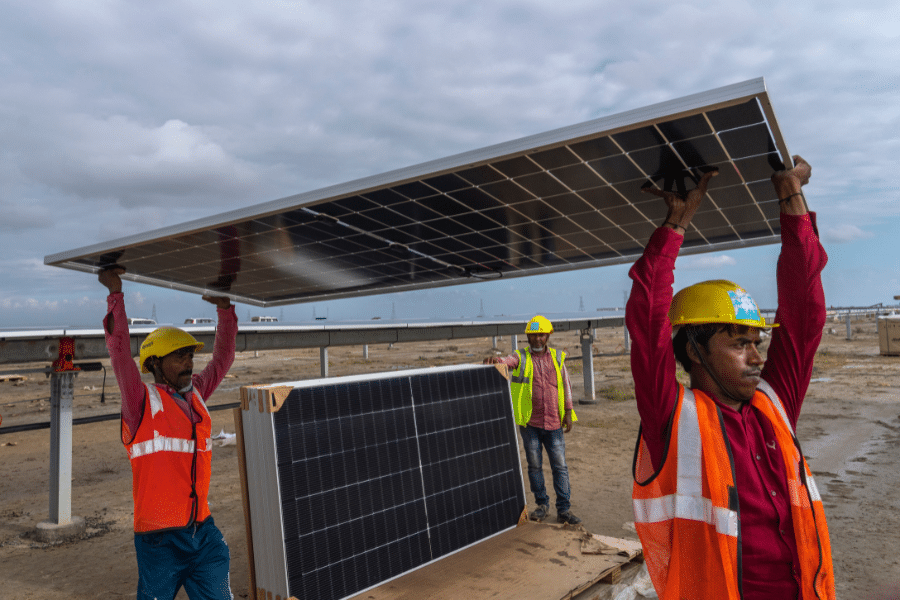
Meeting a growing energy demand can go hand-in-hand with the green transition. This is what India could show the world. Workers carry a solar panel for installation at the under-construction Adani Green Energy Limited’s Renewable Energy Park in Gujarat, India,...
India’s position as a growing global economic leader, a leading producer of renewable energy and as a large consumer of energy puts it at the center of the debate on climate-friendly energy transition. Preety Sharma looks at how if India successfully manages the move towards greener energies, it will serve as a model for low and middle-income countries as they develop economically while striving to meet climate goals.
Exercise: Individually, or in groups, students put their research skills to the test. Use the following questions as a guide to finding out more about this topic.
What is energy transition? How does it relate to the UN SDGs? What energies should we transition to and what are the issues surrounding using each of these? What would a ‘model for low and middle-income countries’ look like?
Find examples of countries that have grown and managed energy transition well.
We need to mitigate climate change. Only governments have the cash for that. Are they ready to pony up? The Earth is surrounded by dollar bills. Illustration by News Decoder. Editor’s note: On 4 April 2024, the United States Environmental Protection Agency...
People vote with their wallet. But most are clueless about economic concepts. Do they cast votes based on misconceptions about money? A man shrugs in confusion against a blackboard covered with economic terms. (Photo illustration by News Decoder) This article was...
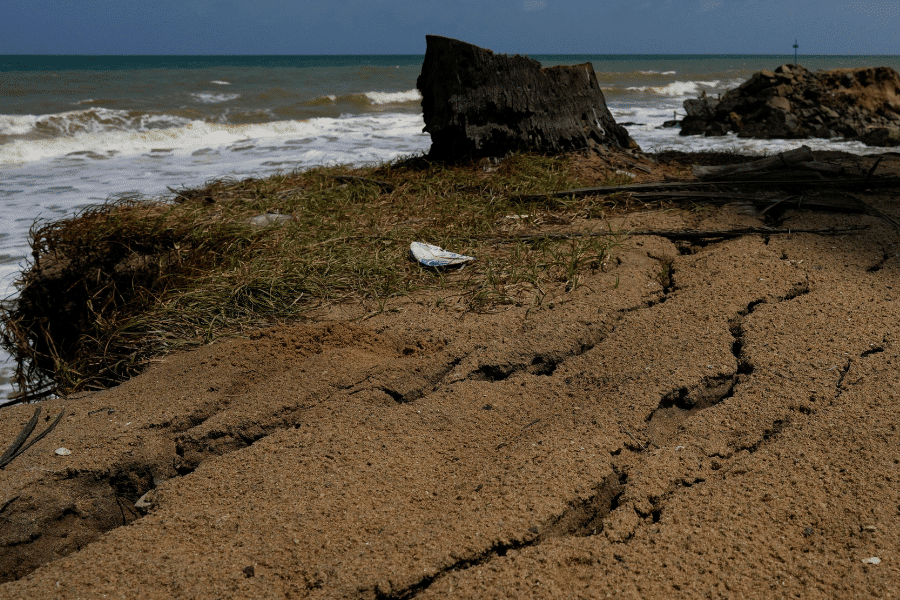
Sri Lanka is trying to do its part to combat climate change. But it will take a sea change to stop the ocean rising around the island nation. Cracks are visible from coastal erosion on sea shore in Iranawila, Sri Lanka, 19 June 2023. (AP Photo/Eranga Jayawardena )...
You don’t get a friendly face when you “buy now with 1-click” on Amazon. But the value of that friendly face keeps people shopping local all over the world. A sign in a small business says “Support Local Business”. Credit: lakshmiprasad S...
It is the top trading partner for 120 countries. So if China’s economy tanks so will the world. But fears that that will happen may be overblown. A worker checks the growth of mushroom at a modern agricultural company in Laixi city in east China’s Shandong...
The global toy industry has a plastics predicament: How to feed children’s appetite for new toys, keep prices low and not harm the Earth in the process. A pile of plastic toys at a toy landfill. (Illustration by News Decoder) Plastic is omnipresent in our lives...
90% of the world’s new toys feature some form of plastic. As the industry continues to grow, especially in places like North America, how can we ensure toy makers are thinking of the environment — and not just profit? University of Toronto Journalism Fellow Preety Sharma covers potential solutions.
Exercise: Sharma’s article suggests that pro-environmental behavior is most commonly adopted when it is a default option. That means it is the easiest or cheapest option. In pairs, have students think about the default options in their lives. Are these the most environmentally-friendly options, or is there room for improvement? For example: students may think about the accessibility of recycling/compost bins in their local community, the types of food packaging they see in the grocery store, etc.