
For 50 years, the Colgate Women’s Games have given women and girls of all ages the chance to show the world what they’ve got.
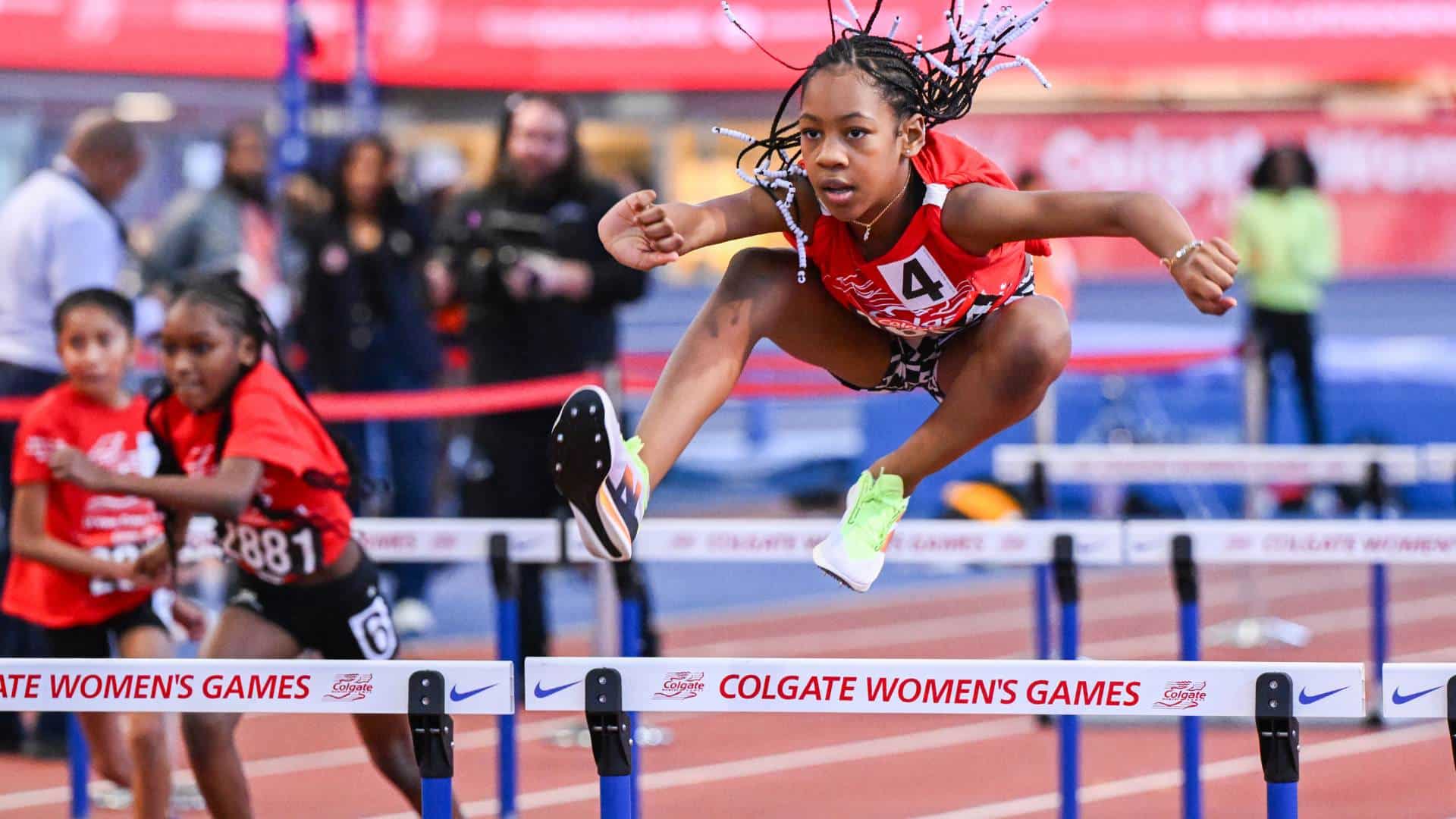
Athletes compete during the annual Colgate Women’s Games at the Nike Track & Field Center at The Armory in New York, 1 February 2025. (Diane Bondareff/AP Content Services for Colgate-Palmolive Company)
The crowd is electric. The starting gun goes off to begin a race, and you can hear and feel the passion of the crowd as they cheer. The announcer feeds the excitement, commentating every stride over the sound system, urging athletes to “pump those arms” and “keep moving.” It’s difficult not to get swept.
These are the Colgate Women’s Games, the largest amateur track and field series in the United States, which kick off its 50th iteration this year with preliminary meets 28 December.
Watching the youngest athletes compete is witnessing sports in its purest form. There’s no pretense, calculated strategies or alternative agendas. It’s just grit, unbridled joy and the thrill of pushing their bodies to the limit.
Some triumph and some falter, but they all cross the finish line giving it their all, and that authenticity is what makes the Games special.
The venue is packed wall-to-wall. Not an empty seat in sight. The athletes fill in every inch of space — so many that you can hardly see the floor beneath them. The girls wrap around what’s known at Colgate as “The Wall,” lining every side of the facility.
More than just a track meet
The line of competitors is so long, it will snake around the entire facility in a sea of athletes waiting for their moment to shine.
The fierce competitive spirit of the competitors and the crowd’s near proximity to the action combine to generate an almost tangible atmosphere. The energy doesn’t just fuel the competition, it elevates it, pushing performances to another level.
The Colgate Women’s Games are more than just track meets. They are a gateway to opportunity that transforms lives, with more than 5,000 scholarships awarded, lifelong friendships cultivated and the start of Olympic and professional dreams, athletic and non-athletic.
“It was some of the best memories I had at that time,” said Dalilah Muhammad, Olympic gold medalist and former 400-meter hurdles world record holder. “Just being a kid, nervous and excited at the same time, while being able to do it with your friends. For me, that was the most important aspect of it. It made me feel like I had a place that I belonged to with friends, that all wanted to be there and do the same thing.”
The goal is to foster a robust sense of personal accomplishment and self-worth while supporting the coaches who serve as role models and mentors for the girls.
Ideas sketched out on a napkin
Alumni include 29 Olympians, countless national champions and current and former world and national record holders at the senior, junior and youth levels. Former competitors now work as teachers, judges, lawyers, executives and ESPN anchors. One of the most recognizable is ESPN SportsCenter anchor Amina Smith.
The Colgate Women’s Games were the brainchild of Fred Thompson, a New York attorney and founder of a Brooklyn girls’ track club who was frustrated with the state of women’s athletics in the mid-1970s.
Thompson was an ABC network sportscaster, and was invited to an event hosted by the Colgate-Palmolive Company — a corporate giant known for soap and toothpaste — for the unveiling of a video presentation titled “Colgate’s Women in Sports,” to air on ABC’s telecast of the newly-launched Dinah Shore golf tournament.
The video included a segment on Thompson’s Atoms Track Club, where girl athletes trained. In the video they talked about training as well as school, why they enjoyed running and their aspirations on and off the track. It caught the eye of Colgate President David Foster. He saw that Thompson had found a way to instill in women a drive for excellence that would carry over to college and careers.
Foster wanted his company to replicate in communities around the country what Thompson had done in his community.
“[They were talking] for a long time, scribbling some stuff on a napkin and I’m sitting there wondering what is going on?” said Cheryl Toussaint, an alum of the Atoms Track Club. Toussaint had won a silver medal in the women’s 4 × 400 meters relay at the 1972 Olympics. She is now the Meet Director of the Colgate Women’s Games, having taken over the position from Thompson.
Getting girls to plan for their future
But back then, the Games were just rough ideas. Thompson and the Colgate execs wanted to bolster the sport for women, give them more opportunities and provide scholarships that could be applied to any level of education.
A pilot program at a local college gym drew a massive turnout. Colgate-Palmolive saw that with awards and scholarship opportunities, it could be something that would resonate.
Now, the Games consist of eight events — six track distances plus shot put and high jump — in six divisions for the women to compete in.
Competitors collect points for results in preliminary rounds, and those with the highest numbers move on to the semi-finals and the grand finale on 7 February 2026, which will be available livestream on ArmoryTrack.org.
The top six finishers in each event will receive a trophy and the top three finishers will be rewarded an additional educational scholarship in denominations of $2,000, $1,000 and $500. Special awards are also given for most outstanding and improved performances as well as most promising performance from a newcomer.
From local to national
All girls and women from elementary school grades 1 and up are eligible to participate in the Colgate Women’s Games. No prior experience in track and field is necessary, but all girls of school-age must be enrolled and attending school in order to participate.
As the years continued, the Games began to grow from a local meet, to a regional meet and even a national meet where girls from states such as Georgia, Arizona and Texas would travel to New York to compete.
But it’s the finals that set the Games apart. The finals aren’t just the last series of races; it’s a celebration, a ceremony marking the culmination of the preliminary and semifinal rounds.
Muhammad and many other Olympians such as Nia Ali, Ajee Wilson, Natasha Hastings, Kim Thomas Barnes (Carter), Diane Dixon and Athing Mu got their start here. The Olympians produced by the Games would represent multiple nations, demonstrating their international reach.
The Games’ impact extends beyond the track; the skills and confidence built from competing has led to careers in education, medicine, business, law, media and beyond. Some Games alumni, like basketball star Lorin Dixon, went on to excel in other sports.
Scholarships get girls thinking about college.
Colgate Women’s Games gives the competitors the chance to earn scholarships to college as early as Grade 1, around the age of 6 or 7, which gets parents and guardians planning that early for a college path for their daughters. If they continue competing, the scholarships accumulate.
If the scholarship earners opt out of college, they can apply that scholarship to career training.
For the women who would go on to run track at the high school and collegiate level, the Games introduced them to the scoring system. The girls learn at an early age how their performance affects their score and overall placement in the meet, along with race strategies to earn the maximum number of points possible.
This knowledge helps when competing at the next level where point scoring is a crucial aspect to high school and collegiate track.
Empowering women through sports
Numerous alumni have embraced the Colgate Women’s Games’ mission of empowering young girls and women.
Consider Olicia Williams, Games’ alum and three-time All-American at Baylor University, who after years of mentoring youth and serving the community through The Armory Foundation, along with coaching her high school and college alma mater, created Lili’s Lionesses Track Club, a program focused on enabling young women to thrive in academics, sports and personal development.
Impact alone doesn’t ensure survival. The Games continue to thrive after 50 years because their model is built on values that extend beyond any single season or generation.
Foremost, it’s a developmental series. Because it’s not a one-off competition, girls with no experience can come to each competition and learn as they compete. They learn they don’t need expensive equipment to participate in the sport.
Toussaint pointed out that the series not only develops competitors from a physical standpoint; it develops them mentally.
“When younger girls fall down, come in last or get bumped out of competition and feel dejected, we help them understand that it’s just one day,” Toussaint said. “We tell them and their parents, this is a place to learn what you’re made of, develop your skills and improve on what you did before.”
Eliminating barriers
The Games are free for the competitors. This makes it different from the many track meets and running events that are surprisingly expensive.
Muhammad said that everyone is there for the right reasons. “No one’s there doing it for any type of money and that’s what makes Colgate so great,” she said. “You have great people doing it for a cause that’s bigger than themselves and it’s inspiring.”
Thompson died in 2019 from complications of Alzheimer’s disease. But his legacy lives on through all the lives he’s helped, and he would be thrilled to see the Games’ 50th anniversary, says Toussaint. “He would cry tears of joy,” she said.
Women’s sports have finally surged into the mainstream. There’s WNBA stars A’ja Wilson and Sabrina Ionescu launching signature shoes that are high performing in sales, and women headlining Ultimate Fighting Championship events and selling out arenas. There’s Serena Williams transcending sport to become a global icon. But it’s important to remember that this success didn’t emerge spontaneously. It was built by pioneers who invested in women athletes long before it was profitable or popular.
The Colgate Women’s Games belong in that conversation as a cornerstone of women’s sports.
Questions to consider:
1. What is one thing about the Colgate Women’s Games that makes it different from other track and field competitions for women?
2. How can sports help girls off the field?
3. In what ways can competition be both good and bad?

Lance Roller II is a U.S.-based researcher, data analyst and freelance journalist. He is an alum of the Dalla Lana Fellowship in Journalism and Health Impact at the University of Toronto.