
While the world looks away, a war in the Democratic Republic of the Congo that has lasted for decades is getting worse. And it is being fought by children.
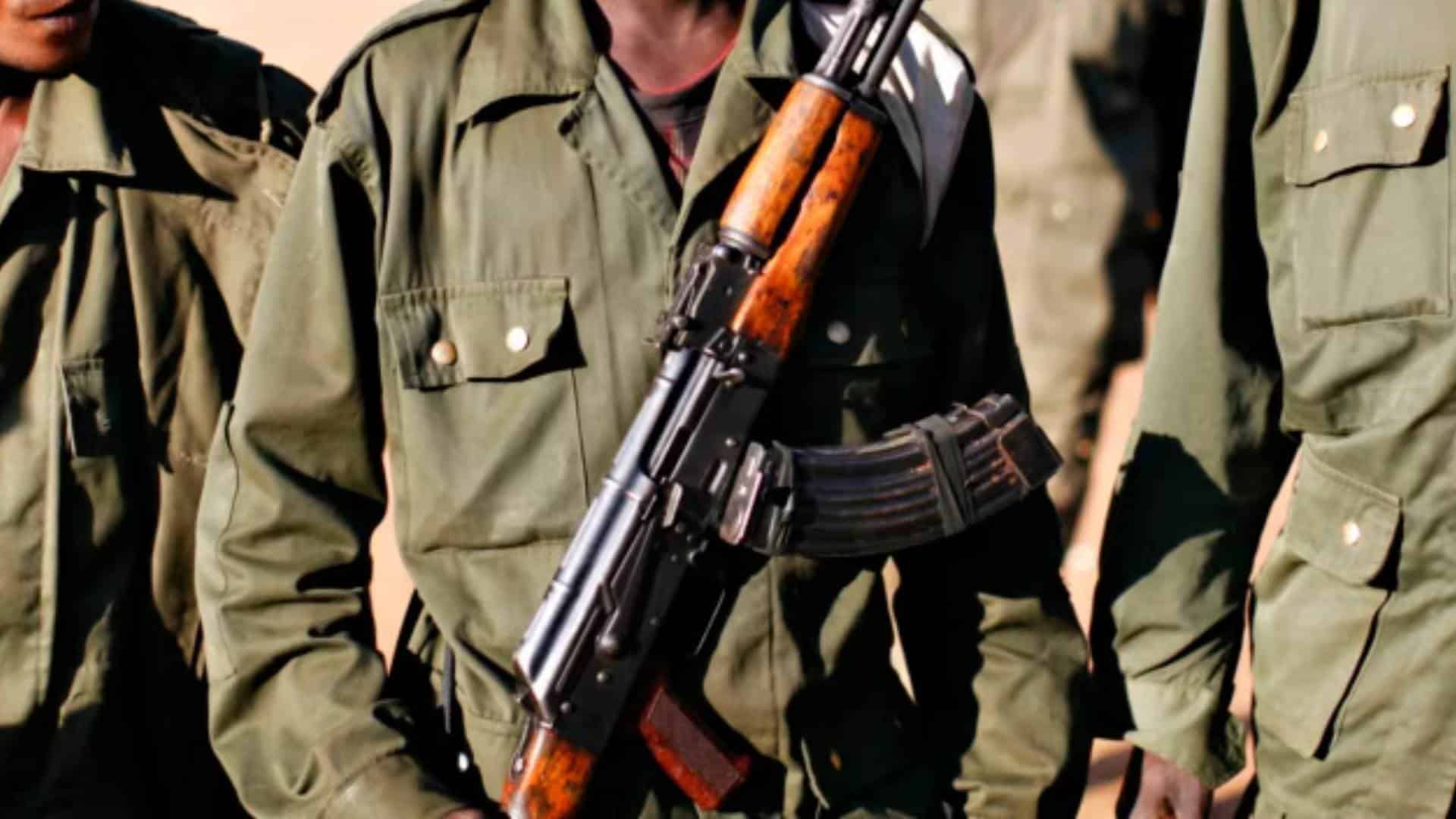
A child soldier in Eastern Congo. (Photo courtesy of Voice of America)
This article was produced out of News Decoder’s school partnership program. Junior Johnson is a student at African Leadership Academy in South Africa, a News Decoder partner institution. Learn more about how News Decoder can work with your school.
When 14-year-old Moise decided to pick up a gun, it had nothing to do with ideology. It was about lunch.
“They told us we would eat meat every day,” Moise said as he stared at his hands in a rehabilitation center on the outskirts of Goma in the DRC, the Democratic Republic of Congo. “At home, we ate once a day, sometimes not at all. In the bush, I carried a rifle, but I also carried shame. I became a man before I was even a child.”
Moise is not his real name. He is a minor and we are using a pseudonym to protect him from the armed groups that might look for him because the place he lives in is currently under rebel control.
Moise is one of thousands of children swept up in what the United Nations now calls a “predatory ecosystem” in the eastern DRC.
His story and testimony are real and he is not alone.
Arming children
Child soldiering has been normalized. Whatever international opposition to the practice there is, has been turned inside out. Using children as soldiers is now a standard operating procedure. And that’s true for all sides — those aligned with the government and those opposed.
A terrifying escalation in the 2024-2025 conflict cycle is now forging a “Lost Generation”— children systematically instrumentalized as military assets in a war that threatens to consume the region’s future.
This generation is characterized by a fundamental disconnection from traditional developmental pathways, education, healthcare and stable family structures, replaced instead by the daily reality of military labor and trauma.
The socio-economic disconnection caused by decades of war has created a new pool of military labor, where children represent a cheap, low-cost way for warlords and rebel leaders to mobilize force. While the world looks away, a war that has lasted for decades is getting worse. And it is being fought by children.
The Eastern DRC comprises three provinces, North and South Kivu, Ituri and Maniema. This is the most conflict-ridden region.
An escalation in brutality
Kivu is named after Lake Kivu, a massive body of water that separates the Congo from neighboring Rwanda. It is widely considered one of the most beautiful landscapes in Africa, high-altitude, cool, fertile and filled with rolling green hills and volcanoes, which unfortunately stand in tragic contrast to the endless violence taking place there.
In these provinces childhood ends not with family warmth, a community nor a graduation, but with a gun.
The data confirms what families in North Kivu already know: the protective environment for children has collapsed. According to recent United Nations reports 7.5 million children are out of school.
The convergence of abduction, recruitment and sexual violence has led to a 17% increase in children suffering from multiple grave violations simultaneously. In the first nine months of 2024 alone, the UN verified more child casualties than in the entire preceding year.
“We are no longer seeing children as incidental victims of crossfire,” said Dr. Amani Mumbere, a child protection specialist in Goma. “They are primary targets. Following the escalation of hostilities on 24 January 2025, reports of violations against children tripled in some sectors. Armed groups are restocking their ranks and children are the cheapest, most obedient recruits available.”
A predatory ecosystem
To understand why this is happening, you have to understand who is fighting. For up to three decades Eastern Congo has been home to more than 100 armed groups, but the whole predatory ecosystem is being driven by a few powerful ones.
The M23 (March 23 Movement) is the most organized group. They claim to fight for the rights of Congolese Tutsis, an ethnic group they say is persecuted. But they are often accused of being backed by the neighboring country of Rwanda. They operate like a professional army.
They kidnap kids and also recruit them from refugee camps with promises of jobs and money. The M23 rebel group uses forced conscription and even recruits from refugee camps.
The ADF (Allied Democratic Forces) is a totally different group in its organisation and operating system. It is originally from Uganda, they are now linked to the Islamic State (ISIS).
They are known for extreme brutality. They often attack schools, churches and villages at night, kidnapping children, raping parents and brutally murdering them. They train kids as soldiers and force them to convert to their beliefs.
CODECO (Cooperative for Development of Congo) is a religious and ethnic militia made up mostly of farmers from the Lendu community. They fight against another group called the Hema. For them, the war is about land and ancient tribal tensions. They use children to protect their villages and mines.
The Wazalendo (“Patriots”) is a new and confusing part of the war. The “Patriots” are a mix of local militias fighting alongside the government FARDC (Armed Forces of the Democratic Republic of the Congo) to stop the M23. Because they call themselves heroes defending the country, many young boys join them voluntarily. But once they join, they are used just like child soldiers in any other group.
The “patriot” trap
“My son wanted to be a hero,” said Sifa, a mother from Masisi displaced in Rusayo camp, whose 13-year old disappeared last year. “The Wazalendo told him he must defend his country. The government supports them, so he thought it was legal. But now? He is in the bush, hungry and shooting at other Congolese children. There is no patriotism there, only death.”
This state-aligned recruitment creates a culture of impunity. Despite national laws, the government’s logistical support for these groups effectively outsources the war to commanders who recruit children under 15 without fear of arrest.
Mumbere said that because the government provides material support to these groups, it effectively outsources military engagement to actors that disregard child protection laws. “It creates a ‘patriot’ narrative that exploits nationalistic fervor to pull children into the line of fire,” he said.
This has become normalized.
Survival economics
Why do children join? In early 2025, verified cases of children being forced or tricked into joining armed groups jumped by nearly 150%, according to UN reports.
“These children are no longer incidental victims of crossfire,” Mumbere said. “They are primary targets.”
While abductions have seen a sixfold increase in this same year, many join “voluntarily” as a desperate survival strategy. With 7.5 million children out of school and more than 1,500 schools closed due to conflict, the classroom has been replaced by the militia camp.
Furaha Kabuo, a local researcher, said that for a starving child, the promise of “eating meat every day” or obtaining loot through raids is a powerful incentive.
“The militia becomes the only entity capable of providing a regular meal,” Kabuo said. “It is a calculation of survival. When you have no school, no food and no police, the militia offers a grim stability. It offers a uniform, a meal and a sense of power in a powerless world.”
Invisible casualties of war
This is inextricably linked to the region’s mineral wealth. Children are frequently forced to work in artisanal mines extracting coltan and gold, minerals that power the world’s smartphones.
“The boundary between a child soldier and a child miner is non-existent,” Kabuo adds. “They carry a gun one day and a sack of coltan the next.”
Moise and other boys are visible as combatants, however girls face a darker war. Girls are abducted for labor and mostly to serve as “wives” or sexual slaves for commanders. Sexual violence incidents rose 2.5 times in early 2025. In 2024 alone, the United Nations recorded nearly 45,000 cases.
According to UNICEF, cases of sexual violence against children have tripled in recent years. The great problem is that upon escaping, they face a double stigma.
“A boy who returns is feared,” said Mumbere. “But a girl who returns, often with a baby born of rape, is rejected. She is seen as dishonored. Communities call them unmarriageable and without support many are forced into prostitution to survive. They are the invisible casualties of this war.”
A local solution
Resilience exists but the statistics remain grim. International disarmament programs have historically failed, one major program saw only 604 out of 30,000 children successfully complete reintegration.
Those that do benefit from life skill training. However, locally-led initiatives are showing the way forward. Michel, a program officer with the Centre Résolution Conflits whose full name we won’t use to protect his identity, argues that the solution must be community-based.
“We don’t just take the gun away,” Michel said. “We put former child soldiers and civilian neighbors together in cooperatives. They farm together. They repair roads together. When the community sees the child contributing, the fear vanishes.”
Evidence from Peace Direct supports this: local peacebuilding has led to significant reductions in crime and improved social cohesion in project zones.
A path forward
As the conflict grinds on, the “Lost Generation” hangs in the balance. Breaking the cycle requires multidimensional solutions ranging from international condemnation, local initiatives and government intervention.
It requires the Congolese government to end its support for proxy militias like the Wazalendo and collaborate with the international community to secure mineral supply chains. It requires the government to provide sufficient reintegration programs, and most importantly, funds for the local heroes like Michel and Dr. Mumbere who are rebuilding their society, one child at a time.
“They call us a lost generation,” Moise says, looking up from his hands. “But I am not lost. I am right here. I just need a chance to be something other than a soldier.”
Questions to consider:
1. How does the inter-generational aspect of this conflict make it harder to solve than a standard war?
2. If a community is afraid of a former child soldier, what steps can be taken to help that child be accepted home?
3. Why might a “community-based” solution be more effective than one administered by a national government or international organization?
Junior Bahozi Is in the second year at African Leadership Academy. Born and raised in South Kivu/Idjwi in the Democratic Republic of Congo, he is passionate about economics, humans rights and the environment.