
It is cold in Ukraine, where Russian bombs have cut off power for heat and electricity. To keep people warm and sane, DJs have sprung into action.
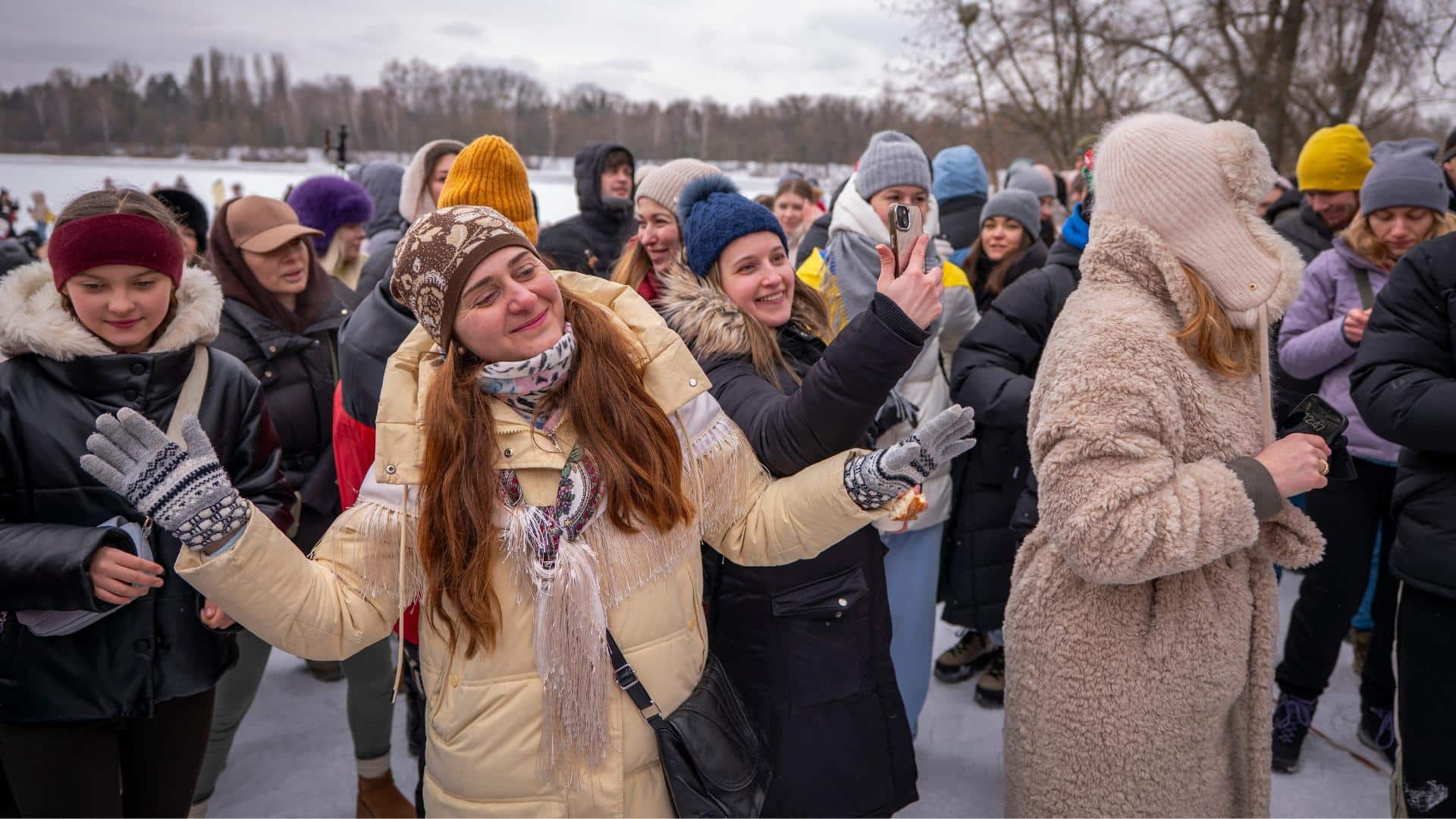
People dance in Kiev, Ukraine to warm up after Russia’s attacks on the country’s energy system left them without power, heating and water in the winter, 31 January 2026. (AP Photo/Dan Bashakov)
There’s frost covering the soccer turf and snow piled up around the edges at Urban Sport City, a sports park in the centre of Kyiv. It’s a Saturday afternoon and a video shows the sun is shining through some hazy clouds. But it’s still cold, -12°C, and part of a cold snap that has held the city since mid-January.
Dmytro “Dima” Kholod is there with his back to the soccer pitch in a shiny, dark red puffer jacket. But he’s not there to lace up cleats or go for a run. He’s there to rave.
Kholod, who goes by the name DJ Dave Kold, helped organize what he called “supportive parties.” After nearly four years of war, Kholod said he organizes these parties to help people to stay strong, stay together and, in a winter made even more frigid by Russian attacks, stay warm.
“We can’t be in a state of suffering all the time, because it leads to depression. And we know that depression is a reason why people die,” said Kholod.
Around Kyiv, neighbourhood gatherings and parties have been popping up as a way for residents to cope with the extreme cold combined with frequent power outages and lack of heating due to repeated Russian attacks on Ukraine’s energy infrastructure.
Ganna Gladkykh, who is from Ukraine but is currently living in Stockholm, said that it is something that Ukrainians tend to do, especially during difficult times, such as the war.
“There is a culture of gathering around some misery and doing something altogether,” Gladkykh said.
A different kind of cold war
In February 2022, Russia launched a full-scale invasion of Ukraine, which has become the largest and deadliest war in Europe since World War II — with an estimated total of 2 million casualties as of February 2026.
Throughout the war, Russia has consistently targeted Ukraine’s energy infrastructure, especially ahead of winter months when more energy would be for warmth. Prior to the invasion in 2022, Ukraine had 38 gigawatts of power generation capabilities — enough to power up to 35 million homes.
In January 2026, Ukraine’s power system’s capacity was at 11 gigawatts. That 7 gigawatt deficit left millions without reliable heat, water or power during a prolonged period of sub-zero temperatures.
As of December 2025, Russia occupied 19.3% of Ukraine, or 116,000 square kilometres.
In Kyiv, gatherings have been popping up all over the city, such as block parties or neighbourhood barbeques. Kholod said that these gatherings tend to happen spontaneously and close to where people live, as it can still be quite dangerous to travel around the city.
Block parties and barbeques
Kholod, who has been DJing for about a year, was asked by his friends to play a set at a party in his neighbourhood.
“We didn’t have power,” Kholod said. “It was blackout. Blackout for a few days. We had no heating.”
It was just supposed to be with 15 or so friends, but instead, he estimated that around 150 people showed up over the course of the night. It took off on social media and was shown by some news outlets.
Melissa Søvik, who is Norwegian but works in Kyiv, attended one of the supportive parties that Kholod organized. Without electricity and heat, there’s not much to do in your apartment.“
So, why not be outside?” Søvik said. “Enjoy the time with others and get some heat in your body by dancing.”
Dancing in snow pants
Dmytro Chubakov, another DJ who goes by the name DJ Mr. DiVibe, told a similar story over Instagram messages. On 24 January, Chubakov and around 20 friends wanted to hang out together and listen to music just north of the city on the frozen Kyiv Reservoir, which is on the Dnipro River.
Over the course of his three-hour DJ set where he played music that would get people dancing — mostly house, afro house and funky house — he estimated that around 500 people joined in. “It was a magical vibe,” Chubakov said.
In videos from that day, cars were parked on the ice, partygoers could be seen dressed in warm winter gear, holding hands while dancing in a circle, and moving to the music in groups.
After the success of the initial party, Kholod organized two free parties at Urban Sport City where residents could gather, eat, get hot tea and dance in the cold.
When DJing supportive parties, Kholod plays the same music he normally does — all remixes, mostly electric dance music, tech house, house, dubstep and drum and bass. Both small kids, dressed in brightly coloured snow pants and jackets, and adults, even one in a penguin costume, were all dancing on the snow-covered ground.
When baby, it’s cold outside
Kholod would like to arrange more supportive parties, but he says it’s sometimes difficult to get the permissions required and that there are still costs even though it is free for people to attend. He also doesn’t want to take too many risks during the ongoing war with Russia, he said, but is doing what he can for people.
Despite the obstacles, Kholod said that Ukrainians need to look after their mental health: “We need to stay strong, stay together and these events help us to stick together.”
Since Russia’s full-scale invasion, some Ukrainians have turned to electronic music to cope with the war.
During the first summer after the war broke out, “clean up raves” were organized where locals and volunteers gathered to restore areas that were liberated from Russian occupation all while a DJ plays techno music in the background.
Other concerts or club nights, which end before the 11 p.m. wartime curfew, not only brought people out to dance, but also helped raise money for the Ukrainian military. Some have also described a surgency of music creativity and Ukrainian, instead of Russian, language songs.
The instinct to dance and party in the midst of war is not escapism — it’s what psychologists call terror management theory. Social psychology research suggests that when humans face mortality through atrocities, such as war, negative emotions can be managed by sustaining worldviews and meaningful experiences, such as through music and dance.
Raving and resilience
Ukrainians are not alone when it comes to seeking comfort and meaning through music and gatherings. According to historian Christina L. Baade, the BBC broadcasted dance music during World War II as a way to boost morale and dancing was popular as an emotional, mental and physical escape.
Al Jazeera reporter Ibrahim al Khalili has reported how in Gaza, Ahmed Abu Amsha, a music teacher, turned daily terrifying sounds of Israeli drones and planes into something beautiful.
When DJing, Kholod always plays music that he likes. But there’s one song that stands out for him: ‘Love Tonight’ by the Australian-New Zealand duo Shouse.
The song was released in 2017, but gained worldwide popularity in 2021 after it was remixed by DJs, including internationally renowned David Guetta, and became a COVID-19 lockdown anthem, where the chorus repeats, ‘all I need is your love tonight.’
When the war started, ‘Love Tonight’ resurged as an anthem of unity for some Ukrainians. According to Top Hits website, it jumped 34 spots to number 12 on the monthly radio hits chart in February 2022. It became the favourite song for many Ukrainians because of the meaning and the lyrics, Kholod said.
The resilience Kholod speaks of has been tested by more than just the psychological toll of war. With extreme cold, rolling blackouts and infrastructure attacks a part of daily life in Kyiv, supportive parties have acted as an escape.
For now, Kholod would like to amend the lyrics to his favourite song: “All I need is love, heat and electricity.”
Questions to consider:
1. Why are so many people in Ukraine without heat or electricity?
2. Why are DJs in Ukraine organizing free outdoor parties?
3. Can you think of any ways that music has helped you through a difficult time?

Ashley Perl is a journalist covering climate, energy and science based in Stockholm. She is currently a fellow in the University of Toronto’s Dalla Lana Fellowship in Journalism and Health Impact.