
The Himalayan mountains hold the largest concentration of ice and snow outside the polar regions. What happens when all that begins to melt?
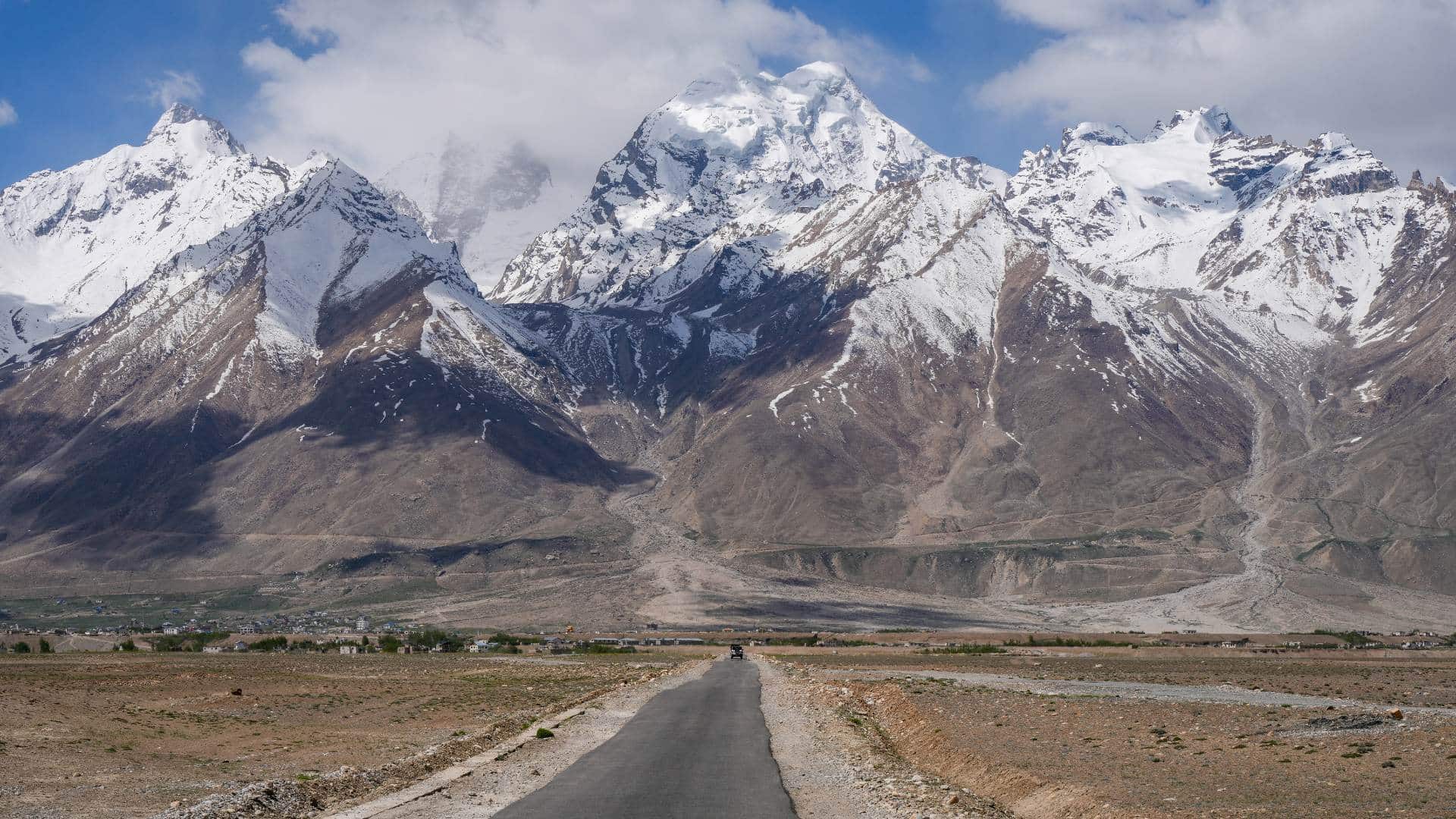
The Zanskar Mountain Range in Jammu Kashmir. (Photo by Timothy A. Gonsalves courtesy of Wikimedia Commons)
This article was produced exclusively for News Decoder’s global news service. It is through articles like this that News Decoder strives to provide context to complex global events and issues and teach global awareness through the lens of journalism. Learn how you can incorporate our resources and services into your classroom or educational program.
The night the flood came, the Himalayas were cloaked in thunder. Above Kashmir, the world’s tallest and youngest mountain range — with its glaciers, valleys and cloud-wrapped peaks — seemed to shudder under the weight of the storm.
The sky was a single, unbroken roar. Rain hammered tin roofs until they buckled; mountainsides glowed faintly under flashes of lightning. In these lower folds of the Himalayas, villages like Trenz cling to slopes that funnel rain and meltwater into sudden torrents.
In the village of Trenz in south Kashmir’s Shopian district, Ghulam Nabi, an apple farmer, woke to the sound of water clawing at his orchard.
“We had barely seconds to run,” he said. “The water came rushing down the slope like a wall of mud and stones. It took everything, trees, cattle, even the footbridge.”
For days afterward, Trenz lay cut off. The only road linking it to the highway had been buried under a landslide. Electricity poles hung like broken matchsticks. The nearest market, 15 kilometres (9 miles) away, was unreachable.
Rainfall floods the mountain valleys.
In the dark, families huddled around makeshift stoves, saving their phone batteries to catch a fleeting signal, a digital lifeline in a drowned world.
Since the catastrophic 2014 deluge, Kashmir has endured a chain of punishing floods and cloudbursts. The 2024 monsoon brought flash floods to Shopian, Kulgam and Anantnag, damaging orchards and bridges.
The following summer of 2025, heavy rainfall again swelled the Rambiara and Romshi streams, submerging farmland and washing away homes.
Across the Himalayas, such scenes are no longer exceptional. From Kashmir to Himachal Pradesh, Nepal to Bhutan, mountain life is turning precarious as climate change unleashes more violent rain, faster snowmelt and sudden cloudbursts. Rare disasters now arrive in clusters, collapsing homes, blocking rivers and triggering blackouts that reveal the deep fragility of life in one of the world’s most sensitive mountain systems.
Across the 2,400-kilometre (1,490-mile) arc of the Himalayas, the so-called “Third Pole” temperatures are rising nearly twice as fast as the global average.
The warming of a mountain range
Scientists call the Himalayas the “Third Pole” because they hold the largest store of ice outside the Arctic and Antarctic. Yet over the past half-century, the region has warmed nearly twice as fast as the global average. Average temperatures have risen by about 1.5°C, melting glaciers, destabilizing slopes and intensifying rainfall.
“Each degree of warming here has outsized effects,” said a climate scientist based in Delhi, who asked that his name not be used. “Steeper gradients mean more runoff, more erosion and more flash flooding. What happens in hours here might take days elsewhere.”
The rhythm of the mountains has shifted. Spring thaws come weeks earlier, monsoons arrive unpredictably and winters swing between drought and blizzard. In Kashmir, unseasonal rains have ruined apple harvests three years in a row, while in Himachal Pradesh, the 2023 floods swept away portions of infrastructure built along riverbanks and caused extensive and unprecedented damage.
In October 2024, when torrential rains swept across the Himalayan valley of Kashmir, the Jhelum River swelled again, flooding low-lying neighbourhoods of Srinagar.
At one point, mobile networks collapsed, cutting communications between districts.
“You suddenly see how fragile life really is,” said Rafiqa Bano, a schoolteacher in Srinagar. “When things stop working, water pumps, phones, even the classroom projector everything comes to a halt.”
From local losses to global consequences
In remote hamlets, the effects ripple deeper. Roads blocked by landslides isolate families for weeks, forcing them to walk miles for basic supplies.
For farmers like Nabi, the floods are devastating. “Our milk went sour, our vegetables rotted and the children got fevers from the damp,” says Nabi. “But what can we do? We live between the mountain and the river.”
The stakes go far beyond these valleys. The Himalayas are Asia’s great water tower, feeding 10 of the continent’s greatest rivers — the Indus, Ganges, Brahmaputra and others, which together sustain nearly two billion people downstream. As glaciers retreat, the short-term risk is flooding; the long-term threat is water scarcity.
“Imagine two billion people affected by what happens to these ice fields,” says the climate scientist. “The Himalayan crisis is not just local, it’s continental.”
Inequality deepens the disaster.
That interconnection was painfully clear when Nepal began exporting hydropower to Bangladesh through India, part of a new trilateral electricity trade highlighting how weather‑related disruptions to production and cross‑border grid ties can ripple through regional energy supplies.
By early 2025, declining Himalayan snow cover and shifts in snowmelt timing were already altering river flows in the Indus basin, threatening the water supplies that irrigate farms and support livelihoods across India and Pakistan — a fraught dynamic for two nations already tense over shared water resources.
While climate change fuels the storms, inequality magnifies their damage. Wealthier cities in the plains recover quickly, but mountain communities lack both infrastructure and political voice. Relief funds arrive slowly and rebuilding is often marred by corruption or poor planning.
Each new highway, tunnel or hydropower project carves deeper into the flanks of the Himalayas, testing the limits of what these young mountains can bear.
“We talk about resilience, but for many people here, resilience just means surviving until the next flood,” says Tariq Ahmad, an environmental activist in Srinagar. “People rebuild the same fragile houses because they have no other choice.”
At the same time, the race for development of new highways, tunnels and hydropower projects is carving deeper scars into the fragile mountains. Steep road cuttings, heavy blasting and extensive construction disturb already unstable slopes and interrupt natural drainage, amplifying landslide risks in a region where climate change is already stressing ecosystems.
Adaptation and hope on the edge
Experts warn that without stricter planning, regulation and geological study, the very projects meant to connect the Himalayas to the world could exacerbate their collapse.
Yet amid the wreckage, adaptation efforts are quietly taking root.
In parts of the Himalayas, villagers and communities are adopting climate-smart practices, from restoring water systems and diversifying crops to experimenting with traditional, hardy varieties, while renewable energy projects like solar micro‑grids are bringing reliable electricity to remote settlements that once struggled with unreliable power
Local nonprofits are training youth as “climate sentinels,” documenting changes in rainfall, snowfall and river flow with smartphone apps. Their data helps scientists build more accurate flood forecast models and gives early warnings that can save lives.
Still, these efforts face a race against time. Scientific assessments warn that even if global climate goals are met, a significant portion of glaciers in the Hindu Kush and Himalaya could melt by the end of this century, undermining freshwater supplies, ecosystems and livelihoods, with far‑reaching consequences for the people and cultures that depend on them.
A fragile future
For millennia, the Himalayas have stood as a symbol of permanence. Now, even their grandeur feels fragile, their glaciers thinning, their slopes unraveling.
For now, Nabi’s children sleep with their shoes beside the bed, ready to flee if the ground trembles or the water rises. The orchard that once fed his family for generations now bears fewer apples each year.
“We live in beauty,” Nabi said. “But it has turned against us.”
In the stillness after the flood, from 2014’s deluge to the cloudbursts and flash floods that swept through Shopian and south Kashmir in 2024 and 2025, the mountains loom serene, as if nothing happened.
But the scars on land, on homes and on hearts tell a different story. They speak of a region caught between nature’s grandeur and its growing fury, between tradition and survival, between the past and a warming future.
The Himalayas have always tested human endurance. But as the planet heats up, their challenge has changed. The question now is not how people will weather the next storm, but how long the mountains themselves can stand.
For families like Nabi’s, the fear is not abstract. “When the rain falls now, it feels different,” he said. “It doesn’t stop. It doesn’t forgive.”
Questions to consider:
1. Why are the Himalayas known as Asias “great water tower?”
2. What does it mean when we refer to the Third Pole?
3. What can be done to slow the melting of mountain ice and snow?

Sajad Hameed is an India-based journalist and filmmaker covering human rights, politics, culture, health and science and technology in India. His work has been featured in a range of international and local media outlets.

Rehan Qayoom Mir is a journalist from Kashmir who reports on the region’s landscapes.