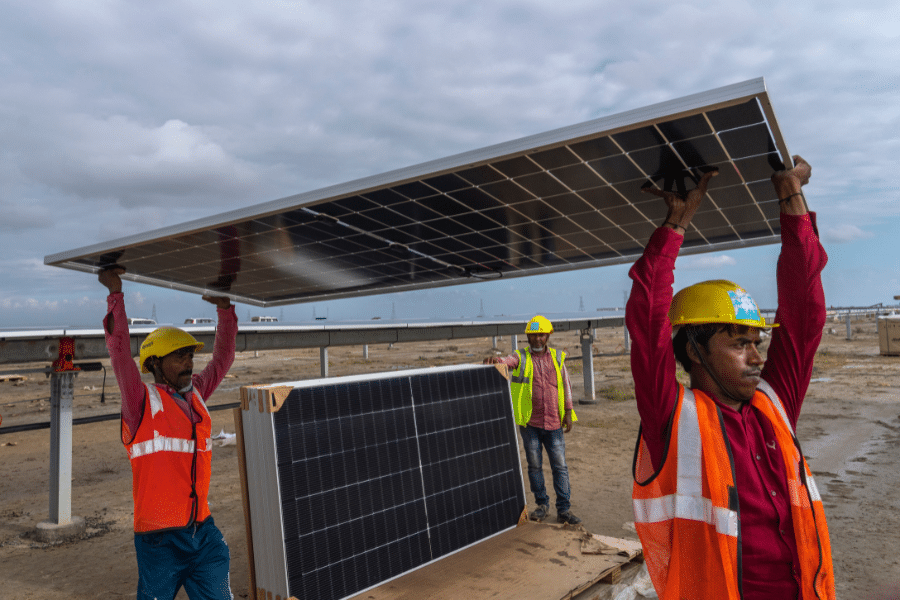
Meeting a growing energy demand can go hand-in-hand with the green transition. This is what India could show the world. Workers carry a solar panel for installation at the under-construction Adani Green Energy Limited’s Renewable Energy Park in Gujarat, India,...
India’s position as a growing global economic leader, a leading producer of renewable energy and as a large consumer of energy puts it at the center of the debate on climate-friendly energy transition. Preety Sharma looks at how if India successfully manages the move towards greener energies, it will serve as a model for low and middle-income countries as they develop economically while striving to meet climate goals.
Exercise: Individually, or in groups, students put their research skills to the test. Use the following questions as a guide to finding out more about this topic.
What is energy transition? How does it relate to the UN SDGs? What energies should we transition to and what are the issues surrounding using each of these? What would a ‘model for low and middle-income countries’ look like?
Find examples of countries that have grown and managed energy transition well.
India and Pakistan — both nuclear powers — have fought three wars over Kashmir. But neither will yield in one of the world’s intractable conflicts. Zero Bridge in Srinagar Kashmir. (Credit: P. Kijsanayothin for Getty Images Signature) Editor’s note: On 11...
This Decoder Replay by Ammar Nainar is an excellent complement to history lesson plans about decolonization and the Partition of India in 1947. How does the past continue to inform the present in ways that matter?
Exercise: Read the article with your history class after students learn about the Partition of India in 1947. Discuss how decisions made in the 1940s continue to affect people living in India and Pakistan to this day. What throughlines can students draw between past and present? Then, divide students into groups of 3-4. Each group will come up with a resolution to the dispute in Kashmir. Resolutions should consider: Who gets control of Kashmir? Which countries should be involved in negotiations? How feasible is Kashmiri independence?
More than one million people traveled to India in a one-year period for medical treatment. They came for the hospitals in Delhi not the beaches of Goa. Postcard from a hypothetical medical tourist in India. Illustration by News Decoder. Even as a majority of Indians...
Sushil Vaishnav realized that the cooking oil that clogs up sewers could be turned into green gold. And that makes him a climate change hero. Sushil Vaishnav, Founder, Ecoil This article, by author Sanjana Chauhan was a Silver Prize winner in the Climate Champion...
To keep plastics out of the waste system, Ved Krishna decided to change the way food service products were made. Yash Pakka founder Ved Krishna. Photo courtesy of Ved Krishna. This article, by author Samaya Chauhan, was a Silver Prize winner in the Climate Champion...
This article, from youth author Samaya Chauhan of India, won a Silver Prize in our Climate Champion Profiles Challenge, organized in partnership with Global Youth & News Media. Samaya profiles Ved Krishna, an entrepreneur and innovator who sees climate solutions in the ordinary and quotidian.
Exercise: Divide students into groups of two to three. In these groups, have them brainstorm items they use every day that may contribute to climate change. Examples may include: cell phone, water bottle, pieces of clothing, backpack, etc. How might these everyday, commonplace items be re-conceptualized so they support positive climate action? Look back to Ved Krishna’s profile for inspiration.