
We learn that it is good to share what we have with those less fortunate. But when those around us simply take, important social bonds begin to fray.
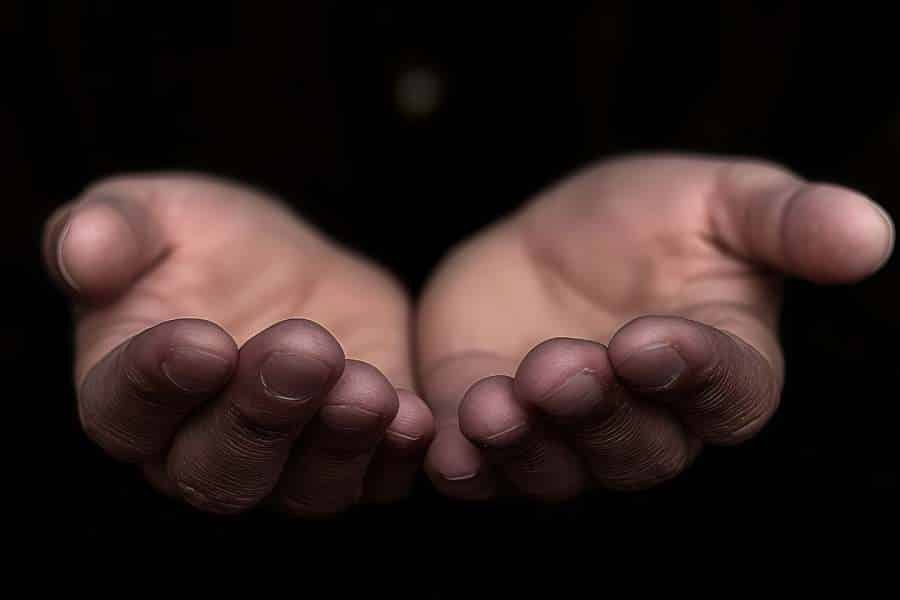
Two hands beg for help. (Photo courtesy of Adobe Stock)
This article by student Ayira Browne was produced out of News Decoder’s school partnership program. Ayira is a student at African Leadership Academy in South Africa, a News Decoder partner institution. Learn more about how News Decoder can work with your school.
My mother’s family lived between two places in Kenya: the newly emerging city of Nairobi and the rural county of Busia. During long holidays, they would take the long drive back from urban living to the farm.
Being a middle class family, they were, by the village’s quiet arithmetic, objectively “better off” than those that surrounded their household, family and friends alike. With a large compound, cows, corn and other livestock they were able to live beyond subsistence farming and expand their life’s endeavours.
Growing up in such a place, my mother described her childhood. “Whatever little we had still had to be shared, and it felt as though you lost out. It was never just a family of eight,” she said. “It was a family of twenty and more.”
School fees for cousins, meals for neighbors, jobs secured through whispered connections; these were the quiet transactions that bound them. Despite this, my mom said that this was all she knew; scarcity was communal, and so was sacrifice. Everyone understood that.
This dynamic echoes transactional relationship theory, a lens from sociology and anthropology that views social bonds as exchanges of resources for status, or security. In pre-colonial African systems like southern Africa’s Ubuntu (“I am because we are”) aid was reciprocal, fostering communal resilience amid scarcity.
The gift economy
Scholars like political scientist John Akokpari highlight how such mutualism underpins African geopolitics, where regional solidarity (e.g., intra-African migration pacts) mirrors village-level pacts. A 2019 study in the journal Africa Spectrum on Kenyan rural economies describes it as “generalized reciprocity”: Give freely today, expect aid tomorrow.
Those who give earn a sort of legitimacy — and moral standing. In return, they are folded into the collective, remembered as “good people.” Anthropologists have long described this as a “gift economy”: exchanges governed not by money alone, but by obligation and social debt. The gift is never free; it simply changes names, from help to duty.
My mother’s parents — who I will refer to as Quara (her father) and Dana (her mother) — were both shaped by their own “debts of gratitude” and poured out endlessly in return. Quara’s father and mother passed away when he was only a child. His oldest brother took him in, pushing him through an education not many got to experience. Unfortunately, he was felled by lightning in Quara’s teenage years.
Amid the turmoil, Dana’s parents took him in. He had been lifted by his wife’s family. In turn, he educated and employed his siblings’ children, carrying their burdens as his own self appointed “compensation.”
“He lived his life making sure everyone had opportunity because he knew what it meant,” my mother said.
When generosity morphs into ownership
My grandfather gave because he himself was once given to. An older brother funded his education; a father-in-law stepped in after the tragedy. Gratitude shaped an entire life philosophy: to give back relentlessly, even at personal cost. Through this context, I can see that his generosity was not naive, it was driven by an empathy that was deeply human. It would be naive to ignore this.
Yet still, in time, vulnerability exposed the fragility of the generosity he provided. As my mother’s parents aged, cousins in their thirties continued to move in, demanding care as if by birthright. Church leaders pressed for harambees (fundraisers), uniforms and hospital runs. And on top of all of this, those once aided vanished when reciprocity was due; no jobs could be found for my uncle, no visits in frailty.
The theft that follows in such contexts is rarely sudden or senseless. It is the calculated final step in a relationship where giving was assumed but never re-agreed upon. So they -– the friends, the workers, the family -– took what they deemed filled the space left by Quara’s absence: silverware, radios, porcelain and clothes.
I believe this to be an entitlement’s shadow, where generosity morphs into ownership.
Transactional theory warns of this asymmetry: a 2021 World Bank report on Kenyan social safety nets notes how informal aid networks foster “entitlement traps,” especially for women and elders in patriarchal rural setups.
Entitlement can breed fear.
When handouts wane — whether due to death, migration or depleted means — gratitude sours to resentment. Theft emerges: livestock vanish, tools disappear, homes ransacked. It’s not senseless greed, but a distorted contract. “You gave freely; now it’s ours … forever.”
Such entitlement has bred fear, a fear that reflects in my parents eyes whenever I mention visiting upcountry for the break.
My father does not speak to his siblings. Disputes over what I consider petty land has permeated the closeness they formulated in their early years. The quiet hierarchy created by the disparity in their financial situations breeds discomfort in gatherings, and the land that separates them goes beyond the green fields of Kisii County.
My father set his boundaries, and it cost him more than money. It is important to note that even then the boundaries were not strong, multiple nieces and nephews reaped the benefits of his career, and money was shared. But it was not enough.
My mother and her seven sisters rarely visit Busia. Their wounds are still sore from the heartbreak of betrayal; the loneliness my grandmother felt when the number of envelopes she and Quara used to hand out dwindled; the reality they swallowed when the radio that nested in the living room covertly disappeared at the hands of trusted staff — strangers now. I wonder, must it always be this way? Was it ever true friendship if it came at a financial cost?
The long shadow of capitalism
Societal shifts are starting to reshape these narratives. My mother speaks of a more “nuclear world now” with clearer boundaries, and direct control.
Since 2003, Kenya’s free primary education policy, combined with devolution under the 2013 Constitution, has boosted rural areas like Busia. County governments allocate funds for infrastructure such as modern homes and schools, which stimulate local businesses and reduce urban migration.
Devolution supports targeted rural development in Busia, where agriculture programs aim to halve the county’s high rural poverty rate (currently at around 70%) by 2027.
Yet resentment lingers in my family.
Hearing these stories, I have begun to ask myself questions. In capitalism’s long shadow, where individual wealth clashes with communal claims, are the lines supposed to be redrawn, adapted — or are they to be forgotten?
My mother’s hindsight urges her to focus on conditional giving, emphasising the importance of avoiding the open-ended generosity that warped people’s perceptions of kindness’ finite capacity.
Her parents’ era demanded total extension. In post colonial Africa, ridden with peoples abandoned by the systems they were forced to rely on, the only way to grow was to find strength in numbers, and to hope that the cycle would replenish itself somewhere down the line.
As my mother put it, ‘’Their scope of family extended far beyond today’s definition.” Our era allows fences, with opportunity slowly percolating settings that were once hidden. But as rural Africa modernizes, will we lose the so-called warmth that structures like Ubuntu provide, or refine it against abuse?
Questions to consider:
1. How could receiving a gift be construed as theft?
2. What does the author mean by a “gift economy”?
3. Can you think of a gift someone gave you that you felt obligated to return in kind?
Ayira Browne is a student at the African Leadership Academy in South Africa. A literary enthusiast and jazz lover, Ayira constantly looks to expand a limited understanding of the complexities of our world — both the small and large things.