
By uniting on shared values, nations like Sweden, Brazil and New Zealand can push back against superpowers. Canada is leading the way.
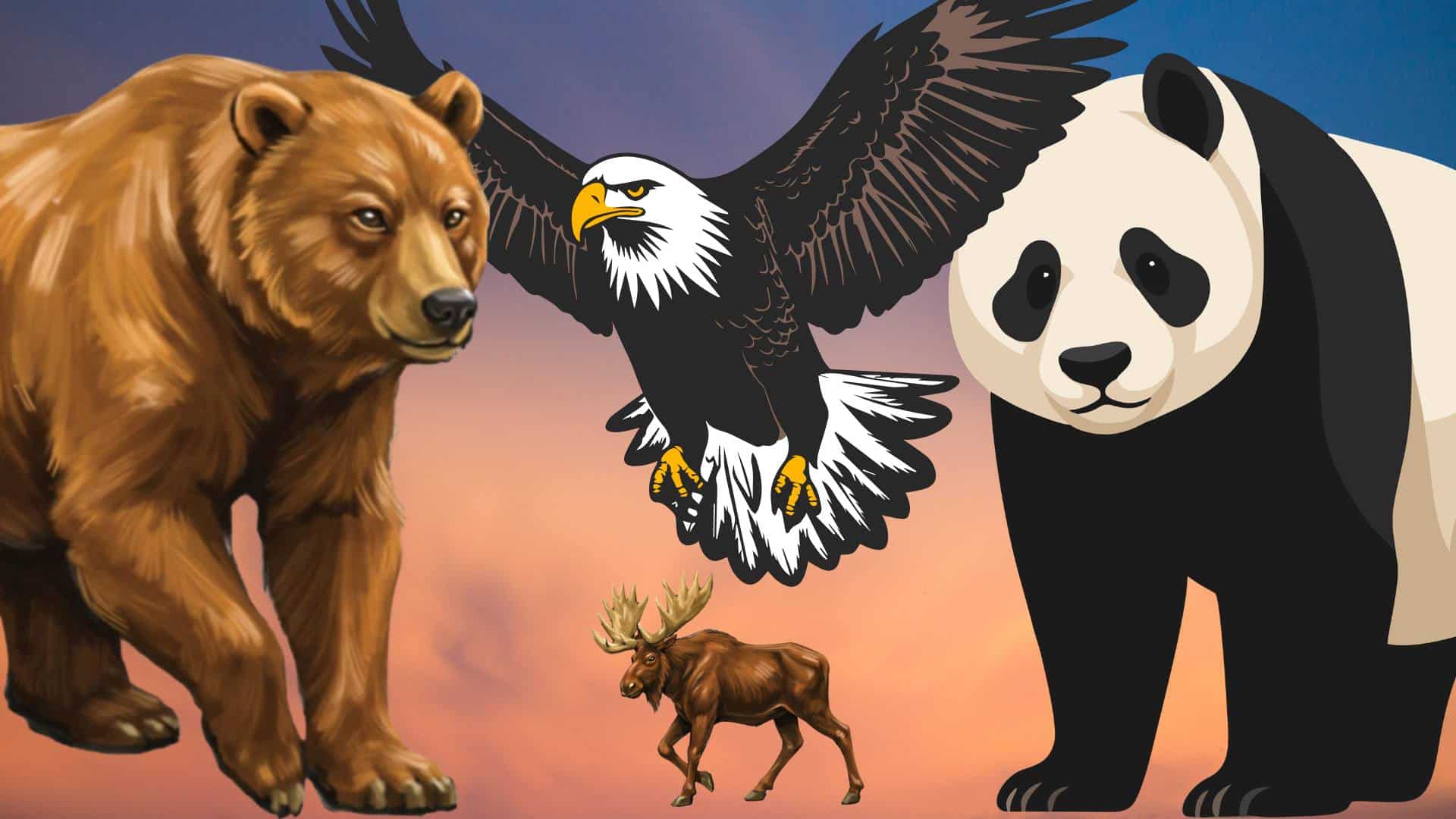
A Russian bear. American eagle and Chinese panda loom over a Canadian moose. (Illustration by News Decoder.)
This article was produced exclusively for News Decoder’s global news service. It is through articles like this that News Decoder strives to provide context to complex global events and issues and teach global awareness through the lens of journalism. Learn how you can incorporate our resources and services into your classroom or educational program.
When the Canadian prime minister spoke at the World Economic Forum in Davos in January, his speech caught the attention of the world.
Why? He chose to speak truth to power — and in the process he eloquently gave the middle-finger from a middle-power country to those great powers collectively uprooting the established rules-based order.
“Intermediate powers like Canada are not powerless,” said Prime Minister Mark Carney. “They have the capacity to build a new order that encompasses our values, like respect for human rights, sustainable development, solidarity, sovereignty and the territorial integrity of states.”
As he spoke, the world was in turmoil. Russia’s war on Ukraine was about to enter its fourth year, China was threatening Taiwan and the United States had launched a war of economic tariffs against the world and was threatening to invade Greenland.
With a values-heavy speech, Carney electrified countries and statesmen around the world, tired of the hegemony of the great powers.
Using the bully pulpit on the world
Since his arrival for a second term in Washington, the president of the United States has also been bullying Canada. As Canada’s largest trading partner by far, his threats have stalled economic growth and put an anti-American fire in the bellies of most Canadians.
Canadians have responded by saying, “Elbows up”, an old hockey term, which, in this case, means standing firm against aggression and protecting national interests.
To get into why this could be an important moment for middle power countries everywhere, let’s start by unpacking what a middle power is.
Middle powers such as Canada, Australia, Sweden, Norway, the Netherlands, New Zealand and others often punch above their weight on the world stage. What they lack in the dominant power of countries like China, the United States, Russia and others, they make up for through diplomacy, coalition-building and soft power to influence other nations.
In his Davos speech, Carney framed a rupture in the current world order, describing a shift from a comforting fiction to a harsh reality in which great powers express their disdain for a rules-based order.
Power in coalitions
Carney argued that smaller, middle powers, like Canada, are not powerless and can help construct a new order grounded in shared values — human rights, sustainable development, solidarity, sovereignty and territorial integrity.
Carney emphasized that the power of the less powerful begins with honesty. He warned that the rules-based order is weakening as the stronger nations act with impunity while the weak bear the consequences.
He underscored the need for principled, pragmatic leadership to navigate these turbulent dynamics.
As an early example, in the late 1940’s, Canadian officials, along with Western allies, grew concerned that Soviet vetoes on the UN Security Council and increasing Cold War tensions made the United Nations ineffective at maintaining peace.
As a result, Canada became a driving force in forming NATO in 1949 as an alternative, regional security collective. Canada played a key role in drafting the treaty, particularly pushing for Article 2 (known as the “Canadian Article”), which called for non-military, political and economic cooperation among members.
Middle power diplomacy
This type of power is known as ‘plurilateralism’, a form of international cooperation where three or more economic and militarily significant countries come together to negotiate agreements on specific issues.
Considered by diplomats to be more flexible and agile than multilateralism — where decisions are made through broad-based global consensus — it allows coalitions to advance policies in specialized sectors without requiring the universal agreement of all states.
This isn’t new for Canada, notes Kerry Buck, Canada’s former ambassador to NATO,
“For middle powers such as Canada, bodies like NATO, the UN or the G7 and issue-specific alliances formed inside or outside of those international institutions, can act as force multipliers, enhancing leverage,” Buck said. “We have used them effectively in the past to try to keep the U.S. engaged internationally, build cross-regional, issues-based alliances to support Canadian interests and initiatives, or to build new norms to temper extremes of state behaviour.”
As examples, she pointed to the Ottawa Landmines Treaty, the Women, Peace and Security agenda, children’s rights, maternal and child health and the creation of NATO.
“On most of these issues, Canada took a conscious policy choice to promote an initiative that ran counter to, or pushed beyond, initial U.S. positions,” she said.
When nations work together
Buck said this type of middle power diplomacy gives Canada a place to build what Carney refers to as ‘variable geometry,’ which involves various groups of states working together to build a constituency around issues such as a treaty to ban production, transfer, stockpiling and use of anti-personnel landmines, or Canada’s initiative on violence against women.
“We start with a small group of like-minded states to create treaties,” Buck said. “Then the coalition works within the UN to implement the treaties.”
In his speech, Carney described Canada’s new approach as both principled and pragmatic, committed to fundamental values like respecting sovereignty, territorial integrity and human rights while prohibiting the use of force where it is inconsistent with the UN Charter.
Alex Neve, a globally-respected lawyer and activist on human rights said that Carney suggested that middle powers could forge a different, and better, path.
“Carney has dangled for us in his Davos speech the potential for middle powers to come together to push back against and perhaps rectify the ruptures and massive detriment to the international order that is being wrought now by the U.S. and other hegemonic powers,” he said.
Neve said that despite being a human rights activist, he firmly agrees that middle powers need to respond to the world as it is.
“We are not going to make change or see progress by pretending the world is something that it isn’t,” he said. “The whole point of understanding the world we are faced with, is so we can be more focused and effective in our efforts to make it better.”
Forging a different path
Neve believes that for those who champion human rights, the conversation must begin at the community, or grassroots, level. He sees people choosing silence over action and believes it is time to not be afraid to speak out.
Change happens through power, he said, and that is why middle power countries matter.
“Most of us see that the countries that wield the greatest power are increasingly the sources of the greatest threats to the world,” he said. “So we must look elsewhere to forge a different path. There is strength in numbers. The UN has 193 member states.”
His point is that there are no outer limits to what the middle-power community is. Say there are 75 states that are not considered dominant either militarily or economically. When they combine the force of their economies, military and security power, they can counterbalance the big-power influences.
In his landmark speech at Davos, Carney galvanized states to think in terms of principled leadership and strategic alliances that collectively enable middle powers to shape global outcomes despite lacking the might of great powers.
Many people, politicians and ordinary citizens alike, drew inspiration from the engagement Carney inspired.
Neve said that some people are still at sea about where to take that conviction to engage. “It is easy to feel defeated by authoritarian governments and the climate crisis, for example,” Neve said.
Last year, he criss-crossed the country delivering a series of speeches as part of the prestigious CBC Massey Lectures. In doing so, he met many people who were ready to get involved. Despite the problem being so enormous, he said, he draws inspiration and hope from them. And so should we all.
Questions to consider:
1. What is meant by plurilateralism?
2. In what way does Mark Carney think countries like Canada and Sweden have power in world politics?
3. In what way could you have political power by uniting with other people on similar goals?

Susanne Courtney is a freelance journalist and writer based in Canada. A former Fellow in Global Journalism at the Munk School of Global Affairs and Public Policy, her writing focuses primarily on international affairs, international development and development finance. Recently she authored the 2021 State of the Sector Report on Canada's Impact Investing in Emerging and Frontier Markets.